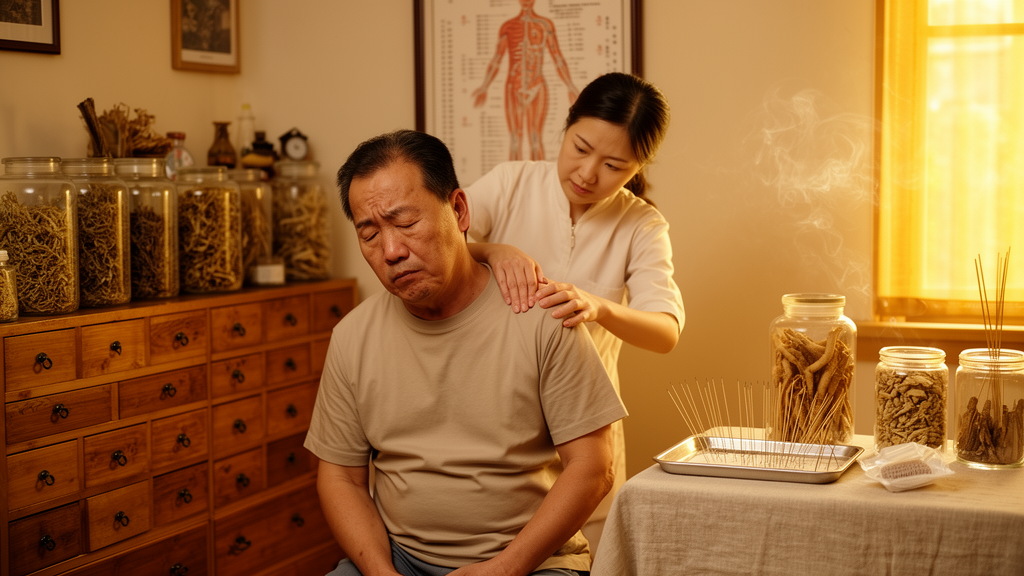
Chronic obstructive pulmonary disease, or COPD, is a progressive lung condition that narrows the airways, traps air in the lungs, and steadily erodes a person’s ability to breathe freely. Standard care—bronchodilators, inhaled corticosteroids, pulmonary rehabilitation, and smoking cessation—slows the decline and relieves symptoms, but many patients continue to live with persistent breathlessness, chronic sputum production, and fatigue. It is precisely this residual burden that pushes a substantial number of patients toward East Asian traditional medicine, a family of practices that includes individually prescribed herbal formulas, chuna (known in China as tuina) manual therapy, and acupuncture. Yet while clinical trials have tested these modalities as adjunctive treatments, remarkably little has been known about how patients themselves experience them, what they believe is happening inside their bodies, and whether those experiences translate into a willingness to continue treatment.
A new qualitative study published in BMC Complementary Medicine and Therapies by Dasol Park, Jungtae Leem, Beom-Joon Lee, Hee-Jae Jung, Kwan-Il Kim, and colleagues at Wonkwang University and Kyung Hee University in South Korea set out to close that gap. The researchers purposively recruited eleven patients with COPD who had prior experience with East Asian traditional medicine and conducted semi-structured, in-depth interviews with them, continuing until no new codes emerged from the transcripts—a saturation point that signals the thematic landscape has been fully mapped. Every interview was audio-recorded and transcribed verbatim, then analyzed using qualitative content analysis, a systematic method in which two researchers independently performed open coding, compared and refined their codes against the raw transcripts, and negotiated categories through consensus. The result is a granular, patient-centered account of what it actually feels like to undergo herbal decoctions, spinal and thoracic manipulation, and needling when your lungs are failing.
The analytical architecture of the study is chronological, mirroring the patient’s own journey through four categories: prior experiences with East Asian traditional medicine for conditions other than COPD; the reasons for attempting it for COPD or for joining East Asian traditional medicine clinical research; the experiences of treatment itself; and the shifts in attitude that followed. This design matters because it reveals that patients rarely arrive at traditional medicine as a first resort. Their decisions were described in relation to symptoms that persisted despite standard treatment, memories of earlier encounters with Korean or Chinese medicine for other complaints, and the views of family members, acquaintances, and—perhaps most tellingly—their own physicians. The social scaffolding around a treatment decision, in other words, is as influential as any pharmacological rationale.
What emerged most strikingly from the interviews is that patients did not experience East Asian traditional medicine as a single, homogeneous category. Each modality produced a distinct phenomenological signature. Herbal medicine users described gradual respiratory and functional changes—slow shifts in breathing ease, sputum, and day-to-day stamina that unfolded over weeks of consuming individually tailored decoctions. In contrast, users of chuna manual therapy emphasized immediate bodily sensations: a sensation of the chest opening, muscular relaxation, or easier clearance of sputum right after a session. This temporal contrast is scientifically interesting because it suggests that the two modalities engage different perceptual and possibly different physiological pathways—one building through sustained systemic exposure to herbal compounds, the other through acute mechanical and neuromuscular effects of manipulation of the thorax and spine.
The study is equally candid about negative and null experiences. Some participants described no meaningful improvement in their major respiratory symptoms at all, and acupuncture accounts were limited and varied, defying any simple summary. Favorable, unfavorable, and uncertain experiences coexisted within the same small cohort, and the researchers resist the temptation to average them into a single verdict. This honesty is a methodological strength: qualitative work is not designed to estimate effect sizes but to surface the full range of patient-reported phenomena, including those that clinical trial questionnaires never capture. A patient’s report that their chest felt looser after manipulation is a real datum about their lived experience, even if it does not correspond to a measurable change in forced expiratory volume.
To probe that correspondence, the team did something unusual for a qualitative study. After the interviews and category development were complete, they exploratorily compared participant-level quantitative data from previous clinical studies of chuna manual therapy and herbal medicine with the symptom and functional changes that the same patients described in their interviews. The comparison revealed both same-direction patterns, where a patient’s narrative of improvement aligned with improvements on standardized instruments, and different-direction patterns, where the story and the numbers diverged. Some experiences described in the interviews had no comparable quantitative measure at all. That mismatch is the study’s quiet methodological punchline: the outcome domains used in traditional medicine trials—forced expiratory volume in one second, six-minute walking distance, St. George’s Respiratory Questionnaire scores, dyspnea scales—may simply not be tuned to the changes patients actually notice and care about.
Attitudes toward future use, the study’s final chronological category, were shaped less by whether a treatment had worked than by a cluster of practical and epistemic concerns. Participants weighed cost, the burden of repeated clinic visits, their limited understanding of how the treatments were supposed to work, safety concerns, and the quality of their communication with physicians. A favorable sensation that faded quickly, or an unexplained mechanism, could undermine willingness to continue even a treatment that had felt helpful. This finding has direct implications for integrative respiratory care: if clinicians want patients to make informed, sustained decisions about adjunctive traditional medicine, they need to address expectations, explain what is known and unknown about mechanisms, and keep the conversation open rather than dismissing the question outright.
The technical details of the study reinforce its credibility. It complied with the Declaration of Helsinki, was approved by the Institutional Review Board of Kyung Hee University Korean Medicine Hospital, and was registered as a clinical trial (KCT0007227) in the Clinical Research Information Service Registry, with written informed consent obtained from all participants. The work was funded by the Korea Health Technology R&D Project through the Korea Health Industry Development Institute under the Ministry of Health and Welfare of the Republic of Korea. The abbreviations that populate the underlying clinical literature—FEV1, FVC, 6MWD, CAT, mMRC, mBorg, VAS, SGRQ—mark the quantitative instruments against which these patient narratives were exploratorily compared, and the inclusion of a specific herbal formula, Cheongsangboha-tang, among the studied interventions illustrates how Korean medicine trials typically evaluate standardized decoctions rather than ad hoc prescriptions.
Why should a global readership care about eleven Korean patients and their decoctions and manipulations? Because COPD is the third leading cause of chronic morbidity worldwide and a top cause of death, and because the gap between what trials measure and what patients feel is a universal problem in respiratory medicine. Breathlessness is notoriously poorly correlated with spirometric values; two patients with identical lung function can report radically different quality of life. Qualitative studies like this one act as a bridge, translating lived experience into hypotheses that future quantitative research can test—ideally with more diverse samples and outcome domains that better reflect what patients actually describe, as the authors themselves recommend. The finding that manual therapy produces immediate perceived changes while herbal medicine produces gradual ones, for example, could directly shape the design and timing of outcome assessments in future trials.
There is also a cautionary lesson here for how traditional medicine is communicated in the media and in clinics. The coexistence of favorable, unfavorable, and uncertain experiences within a single cohort is a reminder that anecdotes—however vivid—are not evidence of efficacy, and that patients themselves know this at some level, which is why their attitudes hinged on cost, burden, safety, and dialogue with their doctors rather than on a single dramatic improvement. The study does not claim that herbal medicine, chuna, or acupuncture treats COPD; it claims something more modest and more useful: that patients experience these modalities in modality-specific, meaning-laden ways, and that any research program or clinical service hoping to integrate them responsibly must start from that reality. In an era when integrative medicine is expanding across health systems, understanding the patient’s side of the encounter may prove as important as understanding the intervention itself.
Subject of Research: Patient experiences with East Asian traditional medicine modalities as adjunctive treatment for chronic obstructive pulmonary disease
Article Title: Patients’ experiences with East Asian traditional medicine for chronic obstructive pulmonary disease: a qualitative study focusing on herbal medicine, chuna (or tuina) manual therapy, and acupuncture
Article References: Patients’ experiences with East Asian traditional medicine for chronic obstructive pulmonary disease: a qualitative study focusing on herbal medicine, chuna (or tuina) manual therapy, and acupuncture. (n.d.). https://doi.org/10.1186/s12906-026-05618-6
Image Credits: AI Generated
DOI: 10.1186/s12906-026-05618-6
Keywords: COPD, East Asian traditional medicine, herbal medicine, chuna manual therapy, tuina, acupuncture, qualitative research, patient experience, integrative medicine, respiratory disease, Korean medicine, qualitative content analysis
News Source: Barbara Leach. (October 15, 2026). What COPD Patients Really Feel When They Try Herbal Medicine, Tuina, and Acupuncture. Scienmag.