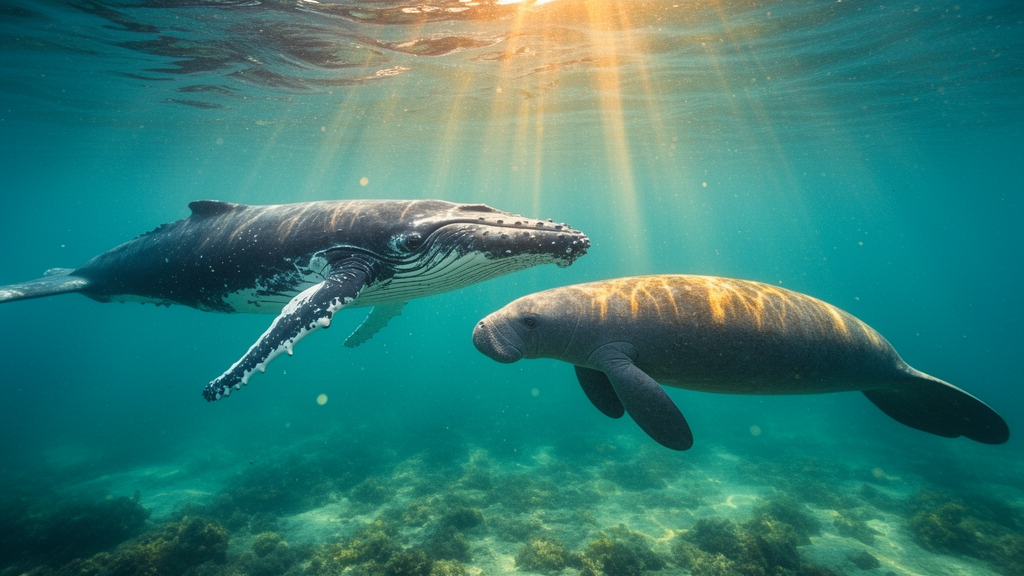
Whales and manatees independently lost the melanocortin 5 receptor gene and their functional sebaceous glands through two entirely distinct molecular mechanisms during their evolutionary transitions to marine environments. Although both lineages are fully aquatic mammals, they belong to separate orders without an immediate common ancestor, making their shared physiological shifts a prominent example of convergent evolution. A molecular investigation published in Development Genes and Evolution reveals that while manatees experienced an incomplete deletion driven by homologous recombination between short repeated sequences, whales completely lost the receptor sequence following the genomic insertion of a retrotransposon-derived reverse transcriptase element.
Melanocortin 5 receptor, commonly designated MC5R, is a G protein-coupled receptor featuring seven transmembrane domains that functions within the regulation of energy homeostasis. Experimental evidence in knockout mice has previously demonstrated that the absence of functional MC5R substantially reduces water rejection efficiency after swimming. Whales and manatees both exhibit hairlessness or sparse pelage alongside the degeneration or total absence of sebaceous glands, a morphological shift that relaxed the functional requirement to retain an intact receptor gene.
Convergent evolution encompasses similar morphological or physiological traits arising independently across disparate evolutionary lineages under comparable selective pressures. Whales belong to the order Cetartiodactyla, whereas Florida manatees represent Sirenia, indicating that marine mammals do not form a single taxonomic group but instead evolved aquatic adaptations along separate phylogenetic trajectories. Alongside the loss of sebaceous glands and hair reduction, cetaceans underwent extensive modifications for underwater life, including specialized underwater hearing and acoustic communication, dense skeletal structures to regulate buoyancy, internal testes, and underwater birth.
To establish the baseline genomic organization of the receptor, researchers queried annotated mammalian sequences using the 978-nucleotide human protein-coding sequence and wild yak sequences across representative placental taxa. In terrestrial mammals, including humans, marmosets, mice, Norway rats, cattle, dogs, and African savanna elephants, the genomic architecture surrounding MC5R remains highly conserved.
Genomic comparisons of the Florida manatee, Trichechus manatus latirostris, confirmed that the species retains only a degraded relic of the original receptor rather than a functional coding sequence. Relative to the intact genome of the African savanna elephant, Loxodonta africana, manatees harbor a 2,823-base-pair genomic deletion. This structural loss eliminates 1,991 base pairs of the 5-prime untranslated region along with 832 base pairs of the protein-coding sequence, leaving behind only a nonfunctional fragment at the terminal end of the locus.
The molecular mechanism driving this loss in manatees was traced directly to homologous recombination between conserved pentanucleotide motifs. In the closely related elephant genome, two homologous sequences reading TTATC flank the region, with the first sequence positioned upstream of the coding sequence and the second situated 131 base pairs before the stop codon. In the manatee genome, recombination between the chromosomal segments bounded by these two motifs excised the intervening sequence, collapsing the boundary into a single remaining TTATC motif adjacent to the degraded receptor relic.
In contrast to the partial sequence survival observed in manatees, genomic analyses of six diverse cetacean species revealed the total eradication of the receptor sequence. Comparative screens spanning the bottlenose dolphin, killer whale, beluga whale, sperm whale, minke whale, and Yangtze River dolphin failed to identify any remaining MC5R coding open reading frame. Despite the complete absence of the receptor itself, the broader chromosomal neighbourhood remained intact, retaining conserved flanking segments that border the RNMT and MC2R loci.
Detailed alignment with terrestrial relatives, specifically cattle and wild yak, demonstrated that the cetacean deletion coincided with the targeted insertion of a transposable genetic element. In place of the intact MC5R sequence, all six examined whale species possessed an inserted reverse transcriptase sequence known as RTASE. Long interspersed nuclear elements, or LINE-1 retrotransposons, represent autonomous transposable elements capable of self-directed insertion across genomes, and sequence analysis confirmed that only the reverse transcriptase portion of the LINE-1 machinery remained integrated at the precise genomic position where the receptor previously resided.
The retrotransposition event stably disrupted and replaced the functional locus early in cetacean history, permanently establishing gene loss in the ancestral marine population.
Together, these findings illustrate how gene loss can serve as a potent genomic driver of convergent ecological adaptation through entirely different mutational pathways. While homologous recombination and retrotransposon insertion produced identical functional outcomes in fully aquatic lineages, the investigation noted that semiaquatic marine mammals, including walruses and Weddell seals, continue to preserve intact MC5R sequences. Determining why semiaquatic species have maintained functional receptor genes despite amphibious lifestyles represents a critical unresolved question for future comparative evolutionary research.
Beyond documenting the loss of specific genes, the study situates these genomic events within the broader theoretical framework of convergent adaptation. Convergent evolution operates across biological scales, spanning molecular structures to complex behavioral phenotypes, and arises when distinct ancestral lineages develop similar characteristics under parallel environmental selective pressures. Evolutionary biologists observe that this dynamic allows organisms to manage novel ecological stimuli while curbing unnecessary metabolic expenditure during exposure to recurring, innocuous conditions. Whereas identical genetic modifications drove convergence in sensory traits such as echolocation between bats and dolphins, gene loss provides an alternate genomic route to convergence. In the case of marine adaptation, the gradual deterioration of sebaceous gland activity following the land-to-sea transition relaxed the selective requirement to preserve the melanocortin receptor, permitting separate structural gene deletions to persist.
To resolve these genetic events, the researchers established a systematic bioinformatic workflow using sequence data mined from public repositories. The investigative team retrieved annotated genomic records for seventeen placental mammal taxa, spanning human, white-tufted-ear marmoset, mouse, Norway rat, wild yak, domestic cattle, dog, walrus, Weddell seal, African savanna elephant, Florida manatee, and six distinct cetaceans: the bottlenose dolphin, killer whale, beluga whale, sperm whale, minke whale, and Yangtze River dolphin. Investigators used the 978-nucleotide human protein-coding sequence alongside wild yak sequences as query probes to perform basic local alignment search tool comparisons across placental lineages. Following sequence extraction, the researchers aligned the downloaded coding sequences using Clustal W version 1.83 under default operational parameters. They subsequently reconstructed molecular phylogenetic relationships using the neighbor-joining algorithmic method within MEGA version 4, assessing tree topology confidence through 2,000 bootstrap replicates.
Detailed sequence mapping around the ancestral locus highlighted intricate patterns of chromosomal conservation across cetacean lineages and their terrestrial artiodactyl relatives. In domestic cattle and wild yak, the intact melanocortin locus resides between conserved flanking segments that maintain stable synteny across mammals. Alignment of the corresponding cetacean loci demonstrated that although the receptor coding frame was replaced by reverse transcriptase, surrounding noncoding sequence blocks were conserved in a mosaic pattern across divergent whale species. One conserved segment is shared among cattle, yak, bottlenose dolphins, killer whales, and beluga whales, whereas a second distinct segment appears only in cattle, yak, and minke whales. A third conserved block links cattle and yak to the sperm whale and Yangtze River dolphin, while a fourth flanking sequence is present across all examined species except the minke whale. This shared architectural framework confirms that the insertion targeted an identical ancestral chromosomal neighborhood.
The investigation also characterized the precise genomic context enabling homologous recombination in sirenians by evaluating closely related Afrotherian and outgroup taxa. In the African savanna elephant genome, the two conserved TTATC pentanucleotide motifs are accompanied by a conserved upstream CTGGGT hexanucleotide motif that is likewise retained in the Florida manatee. To assess sequence divergence across mammals, researchers examined genomic regions in the bat Desmodus rotundus and the Cape golden mole Chrysochloris asiatica. In the bat, the upstream sequence displays a mutation to TGAGG, while the golden mole features ATTTT. Despite these upstream variations, the second motif within the coding sequence exhibits high conservation across these comparative taxa, registering as TCATC in the bat and TAATC in the golden mole.
The contrasting cetacean deletion reflects the mutagenic capacity of autonomous retrotransposons in mammalian genome evolution. Autonomous elements encode their own enzymatic machinery, enabling them to replicate and transpose independently across the host chromosome. Long interspersed nuclear elements, particularly the LINE-1 family, represent the sole autonomous retrotransposon group in the human genome, where they comprise approximately seventeen percent of total sequence content. Although healthy somatic cells enforce strict epigenetic surveillance to suppress LINE-1 mobilization and maintain chromosomal stability, transposable elements frequently become active during cellular senescence as heterochromatic gene-poor regions relax. Uncontrolled transposition can cause pathological mutations, as demonstrated by LINE-1 exon disruptions documented in Meckel-Gruber syndrome.
Subject of Research: Convergent evolutionary loss of the MC5R gene in marine mammals
Article Title: Differential MC5R loss in whales and manatees reveals convergent evolution to the marine environment
Article References: Liu, J., Shu, M., Liu, S., Xue, J., Chen, H., Li, W., Zhou, J., Amanullah, A., Guan, M., Bao, J., Pu, D., & Deng, C. (2022). Differential MC5R loss in whales and manatees reveals convergent evolution to the marine environment. Development Genes and Evolution, 232(2-4), 81-87. https://doi.org/10.1007/s00427-022-00688-1
Image Credits: AI Generated
DOI: 10.1007/s00427-022-00688-1
Keywords: Melanocortin 5 receptor, MC5R, convergent evolution, whales, manatees, sebaceous glands, G protein-coupled receptors, homologous recombination, reverse transcriptase, retrotransposons, LINE-1, marine mammals, RNMT, MC2R, Cetartiodactyla, Sirenia
News Source: Gavin Prescott. (November 12, 2026). Whales and Manatees Lost MC5R Through Two Distinct Evolutionary Mechanisms. Scienmag.