• HOME
  • NEWS
  • EXPLORE
    • CAREER
      • Companies
      • Jobs
    • EVENTS
    • iGEM
      • News
      • Team
    • PHOTOS
    • VIDEO
    • WIKI
  • BLOG
  • COMMUNITY
    • FACEBOOK
    • INSTAGRAM
    • TWITTER
Monday, August 31, 2026
BIOENGINEER.ORG
No Result
View All Result
  • Login
  • HOME
  • NEWS
  • EXPLORE
    • CAREER
      • Companies
      • Jobs
        • Lecturer
        • PhD Studentship
        • Postdoc
        • Research Assistant
    • EVENTS
    • iGEM
      • News
      • Team
    • PHOTOS
    • VIDEO
    • WIKI
  • BLOG
  • COMMUNITY
    • FACEBOOK
    • INSTAGRAM
    • TWITTER
  • HOME
  • NEWS
  • EXPLORE
    • CAREER
      • Companies
      • Jobs
        • Lecturer
        • PhD Studentship
        • Postdoc
        • Research Assistant
    • EVENTS
    • iGEM
      • News
      • Team
    • PHOTOS
    • VIDEO
    • WIKI
  • BLOG
  • COMMUNITY
    • FACEBOOK
    • INSTAGRAM
    • TWITTER
No Result
View All Result
Bioengineer.org
No Result
View All Result
Home NEWS Science News Biology

Whale of a debate put to rest

Bioengineer by Bioengineer
July 10, 2023
in Biology
Reading Time: 3 mins read
0
Caperea and blue whale
Share on FacebookShare on TwitterShare on LinkedinShare on RedditShare on Telegram

Researchers have finally settled a decades-long dispute about the evolutionary origins of the pygmy right whale.
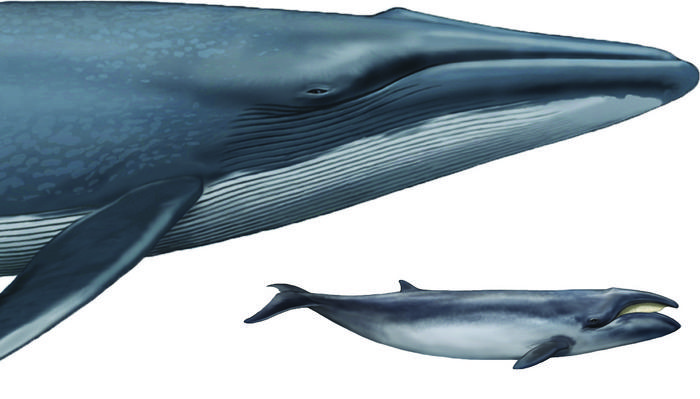
Caperea and blue whale

Credit: Carl Buell

Researchers have finally settled a decades-long dispute about the evolutionary origins of the pygmy right whale.


The smallest of the living baleen whales, it’s tank-like skeleton is unique, and its ecology and behaviour remain virtually unknown.


Because it is so unusual, the evolutionary relationships of the pygmy right whale (Caperea marginata) have long been a bone of contention.


In a study that solves the debate, just published in Marine Mammal Science, an international group of researchers sequenced the complete genome of Caperea, combining their findings with morphology and palaeontology.


Co-author Dr Felix Marx, curator of marine mammals at the Museum of New Zealand Te Papa Tongarewa explains the skull shape of the pygmy right whale seems to be adapted for skim-feeding, where a whale will swim at the water’s surface with its mouth open to food.


“This is very similar to the larger true right whale, leading some scientists to believe the two whales are closely related, hence their similar names. However, others believe the pygmy right whale is more closely related to species like the blue whale, which take big gulps of water to collect food instead of skimming,” he says.


He was pleased to be able to exploit the power of genomics to elucidate the history of life.


“After 150 years of anatomical orthodoxy and decades of dispute, genomics now shows beyond reasonable doubt that Caperea is a distinct lineage and not related to right whales.


“Like river dolphins and sperm whales, Caperea is the sole guardian of a unique piece of evolutionary heritage. It’s not just another weird right whale – it truly is the last survivor of an otherwise lost family that once played a much bigger role in Earth’s history,” he says.


Co-lead author Dr Kieren Mitchell, of Manaaki Whenua – Landcare Research, says new genetic information often prompts scientists to reconsider why different animals appear more similar or different to each other.


“When DNA and anatomy seem to be at odds about the relationship between species, usually that means there’s an even deeper and more interesting story to be discovered about their evolution,” he says.


Co-author Dr Nic Rawlence, Otago Palaeogenetics Laboratory Director, describes Caperea as a “wonderful case of convergent evolution”, which occurs when two unrelated species end up appearing more and more alike as they adapt to similar selective pressures.


“Caperea has historically been aligned with right whales because they look the same due to similar feeding strategies, when, in fact, it’s probable that Caperea is the last surviving member of an ancient group of whales called cetotheres,” he says.


Co-lead author Dr Ludo Dutoit, of Otago’s Department of Zoology, says now its position in the family tree of whales has been confirmed, researchers can start to explore what the Caperea lineage looks like, and what kind of past events were significant in driving its evolution.


Dr Marx agrees, adding that Caperea may be another example of how being ‘unusual’ helped save a lineage from extinction.


“River dolphins likely survived the demise of their marine relatives because they invaded freshwater habitats; sperm whales persisted when their toothed relatives disappeared because they were deep-diving suction specialists; and Caperea survived because it adapted to be a skim filter feeder, when most of its relatives presumably didn’t.”


Journal

Marine Mammal Science

DOI

10.1111/mms.13047

Article Title

Convergent evolution of skim feeding in baleenwhales

Share12Tweet8Share2ShareShareShare2

Related Posts

Methylation puts parasites in motion

Methylation puts parasites in motion

August 31, 2026
Desiccation promotes DNA damage and rifampin resistance in Mycobacterium tuberculosis

Desiccation promotes DNA damage and rifampin resistance in Mycobacterium tuberculosis

August 31, 2026

Gastrointestinal Parasitism in Cattle and Water Buffaloes in Pakistan: Prevalence and Associated Risk Factors

August 31, 2026

Development of HPLC–PDA method for steviol glycosides analysis in food matrices

August 31, 2026

POPULAR NEWS

  • β-Sitosterol from Ipomoea carnea Jacq. As a promising anti-inflammatory agent: Evidence from in silico modeling and in vitro validation

    29 shares
    Share 12 Tweet 7
  • Design, fabrication and characterization of a wearable Fiber Bragg grating sensor for cardiorespiratory monitoring using finger plethysmography

    29 shares
    Share 12 Tweet 7
  • KAIST opens the era of industrial-scale microbial foods, proposing growth strategies for the next-generation protein market

    29 shares
    Share 12 Tweet 7
  • Virologist awarded $2 million NIH grant to investigate how virus-infected cells live and die

    29 shares
    Share 12 Tweet 7

About

We bring you the latest biotechnology news from best research centers and universities around the world. Check our website.

Follow us

Recent News

β-Sitosterol from Ipomoea carnea Jacq. As a promising anti-inflammatory agent: Evidence from in silico modeling and in vitro validation

Design, fabrication and characterization of a wearable Fiber Bragg grating sensor for cardiorespiratory monitoring using finger plethysmography

KAIST opens the era of industrial-scale microbial foods, proposing growth strategies for the next-generation protein market

Subscribe to Blog via Email

Enter your email address to subscribe to this blog and receive notifications of new posts by email.

Join 85 other subscribers
  • Contact Us

Bioengineer.org © Copyright 2023 All Rights Reserved.

Welcome Back!

Login to your account below

Forgotten Password?

Retrieve your password

Please enter your username or email address to reset your password.

Log In
No Result
View All Result
  • Homepages
    • Home Page 1
    • Home Page 2
  • News
  • National
  • Business
  • Health
  • Lifestyle
  • Science

Bioengineer.org © Copyright 2023 All Rights Reserved.