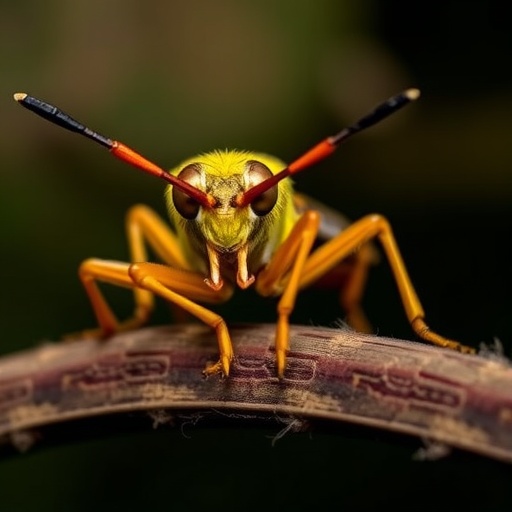
Western University researchers have unveiled a groundbreaking computational model that reconstructs the singing behavior of crickets with unprecedented accuracy, a feat that resolves a mystery scientists have long pondered. This innovative method leverages detailed physical measurements of cricket forewings, combining them with sophisticated computational modeling techniques. By analyzing preserved specimens alongside live samples, the team has developed a reliable approach to predict the intricate vibrational patterns that generate cricket songs, shedding light on the mechanics and evolution of one of nature’s earliest sound-producing systems.
Historically, past modeling approaches, including a seminal 2012 study, made simplifying assumptions about cricket wing mechanics. They treated regions of the wing with a high density of veins as immobile or “clamped” in place. While such assumptions reduced computational complexity, they limited the biological realism of the simulation. Crucially, natural cricket wings do not have such rigid fixation points except at the wing base, where they hinge. These simplifications resulted in models that could approximate vibrational behavior but failed to capture the full dynamism of wing movement, especially when applied across species with varying wing venation patterns.
.adsslot_bfhOlQg4qz{ width:728px !important; height:90px !important; }
@media (max-width:1199px) { .adsslot_bfhOlQg4qz{ width:468px !important; height:60px !important; } }
@media (max-width:767px) { .adsslot_bfhOlQg4qz{ width:320px !important; height:50px !important; } }
ADVERTISEMENT
The new method devised by Western biology professor Natasha Mhatre and her team addresses these shortcomings by embracing a more nuanced physical representation of cricket wings. Their computational model now treats wing veination flexibly, only constraining the wing at its natural hinge. This adjustment aligns with the physical realities observed in living crickets, leading to simulations that closely mirror real-world vibration modes. Notably, the model was validated against empirical wing vibration patterns obtained from live crickets of the species Teleogryllus oceanicus, or the Australian field cricket, showing remarkable predictive power.
Preserved specimens, such as those housed in natural history museums, have long been a treasure trove for evolutionary and genetic research but were previously underutilized in bioacoustic reconstructions due to changes in material properties over time. As the cricket forewings dry, they become stiffer, altering their resonant frequencies and making it challenging to infer their original sound profiles. The Western team’s breakthrough includes demonstrating that these frequency shifts can be corrected by hydrating the wings or adjusting stiffness parameters computationally, effectively “reviving” the wing’s acoustic behavior. This approach opens new avenues for reconstructing the calls of extinct cricket species and understanding the evolutionary pressures shaping insect communication.
The model’s capacity to generalize beyond its initial training data implies it could be used to predict the vocalizations of crickets and related species whose wings have not been measured directly. This scalability is vital for mapping the evolutionary trajectories of acoustic signaling, offering biologists a powerful tool to investigate how cricket songs evolved and diversified over millions of years. Since cricket songs often serve in mate attraction and territorial displays, decoding their physical underpinnings can illuminate broader ecological and evolutionary dynamics.
What makes this research particularly compelling is its interdisciplinary methodology, straddling neurobiology, biophysics, and computational simulation. Developing a physics-based framework that bridges morphology and behavior not only advances our understanding of crickets but serves as a model for studying other biomechanical sound producers in nature. The collaboration between Western University and the University of St. Andrews further exemplifies the global and collaborative nature of modern science, enhancing the robustness and reach of these findings.
The study was a concerted effort involving multiple researchers, including three undergraduate thesis students, which highlights the pedagogical and mentorship dimensions integral to contemporary research. Notably, the computational techniques employed use finite element modeling, a numerical approach traditionally utilized in engineering disciplines to solve complex differential equations. Applying this methodology to biological structures like insect wings demonstrates the increasing convergence of biology with computational and physical sciences.
Another aspect of the study is its implication for museum practices and the handling of preserved biological samples. Knowing that hydrating wings can restore their acoustic fidelity suggests that curatorial protocols may incorporate measures to facilitate sound-related studies in archived specimens. This insight could revolutionize how museums contribute to dynamic biological research, transforming static collections into portals for understanding past ecological interactions.
Furthermore, the research underscores the unique evolutionary niche crickets occupy concerning sound production. Unlike mammals and birds, whose vocalizations depend on soft tissues that rarely fossilize, crickets’ songs hinge on durable chitinous structures exquisitely captured in fossils and museum specimens. This durability ensures a rare continuity of morphological and behavioral data across evolutionary time, enabling scientists to peer into the past with enhanced resolution.
Overall, this breakthrough represents a paradigm shift in bioacoustic research, demonstrating that with accurate physical models and computational power, we can reliably reconstruct not only what an organism looked like but also how it sounded. By solving a technically complex problem with elegant modeling that respects biological authenticity, the Western research team has opened new doors for evolutionary biology, neuroethology, and even paleobiology.
The implications extend beyond crickets and insects, presaging a future in which the sounds of extinct animals might be revived through sophisticated modeling of preserved remains. This not only enriches scientific understanding but has the potential to captivate public imagination, telling stories about the ancient natural world in an unprecedented sensory way. By transforming silent specimens into acoustic archives, this research bridges centuries to bring the living world of crickets roaring back to life.
Subject of Research: Animals
Article Title: Reliable reconstruction of cricket song from biophysical models and preserved specimens
News Publication Date: 30-Jul-2025
Web References:
http://dx.doi.org/10.1098/rsos.251005
References:
[DOI: 10.1098/rsos.251005]
Image Credits: Natasha Mhatre
Keywords: Biophysics, Evolutionary biology, Organismal biology
Tags: acoustic signatures of cricket speciesbiomechanics of cricket forewingscomputational modeling of cricket songscricket song mechanismevolution of sound production in insectshistorical studies on cricket songinsights into insect signaling behaviorsmorphological analysis of cricket wingsresearch on cricket communicationsignificance of wing venation in soundvibrational patterns in cricketsWestern University cricket research