Size of muscle fibres predicted flight performance in the wild
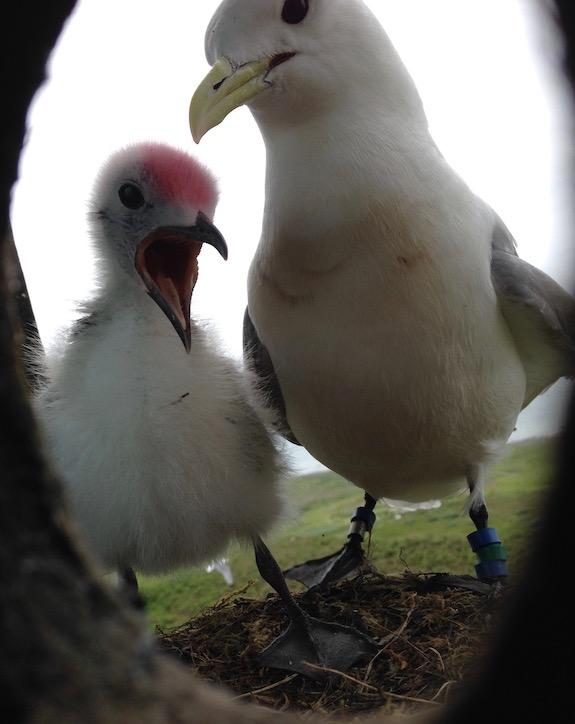
Credit: IMAGE CREDIT: Kristen Lalla
Muscle structure and body size predict the athletic performance of Olympic athletes, such as sprinters. The same, it appears, is true of wild seabirds that can commute hundreds of kilometres a day to find food, according to a recent paper by scientists from McGill and Colgate universities published in the Journal of Experimental Biology.
The researchers studied a colony of small gulls, known as black-legged kittiwakes, that breed and nest in an abandoned radar tower on Middleton Island, Alaska. They attached GPS-accelerometers–Fitbit for birds — onto kittiwakes to track their flight performance, discovering that they sometimes travel as far as 250 km a day to find food for their offspring.
By combining data from the GPS tracker with minute muscle samples from some of the birds, the researchers found that, despite beating their wings less frequently, birds with larger muscle fibres were able to fly as fast as those with smaller fibres. The team also found that birds that flew faster had a higher number of nuclei – which produce the proteins to power flight – in their muscle cells, allowing the birds to activate more muscle fibres to power their flight.
Exercising to build muscle
Athletes exercise to maintain muscle tone. The same may be happening with kittiwakes, with those individuals that exercise the most–that is, fly the most–having better developed muscles than those that move less.
“These birds are no couch potatoes. Clearly, like elite athletes, they need to have the appropriate body and muscles in excellent shape to be able to travel over these long distances to feed their offspring. But there’s been a long-standing biological question about why some individual birds perform so much better than others,” says Kyle Elliott, an assistant professor in McGill University’s Dept. of Natural Resource Sciences in the Bieler School of Environment, and co-author of the study. “Past studies have focused on hormone levels, body mass or levels of red blood cells as a predictor of flight performance. We found that muscle structure and body mass together predict performance.”
Using miniature smart phones to track wild birds
“With the data from the GPS-accelerometers, we can understand a lot about these birds, like where they’re going to find food, how fast they’re flying, and how frequently they’re beating their wings in flight,” says Kristen Lalla, the first author on the paper, which she co-authored as an undergraduate student under the supervision of Elliott. “In the past, one of the challenges of measuring muscle structure in small birds was that it usually requires biopsying the muscle.”
The Gulf of Alaska experienced the largest marine heat wave on record during the study in 2017, and kittiwakes were forced to forage four to five times farther away than pre-heatwave. The researchers are excited to continue the study and determine how muscle structure and flight performance vary when conditions are a little less challenging.
###
To read: “Accelerometry predicts muscle ultrastructure and flight capabilities in a wild bird” by Kristen M. Lalla et al in the Journal of Experimental Biology
doi: 10.1242/jeb.234104
The research was funded by the Natural Sciences and Engineering Research Council.
About McGill University
Founded in Montreal, Quebec, in 1821, McGill University is Canada’s top ranked medical doctoral university. McGill is consistently ranked as one of the top universities, both nationally and internationally. It is a world-renowned institution of higher learning with research activities spanning two campuses, 11 faculties, 13 professional schools, 300 programs of study and over 40,000 students, including more than 10,200 graduate students. McGill attracts students from over 150 countries around the world, its 12,800 international students making up 31% of the student body. Over half of McGill students claim a first language other than English, including approximately 19% of our students who say French is their mother tongue.
Contacts:
Katherine Gombay,
Media Relations Office,
McGill University
[email protected]
1-514-717-2289
http://www.
http://www.
Media Contact
Katherine Gombay
[email protected]
Original Source
https:/
Related Journal Article
http://dx.