On thousands of New Zealand dairy farms, the moment a young heifer first shows signs of estrus — the behavioral hallmark of puberty — has long been a matter of guesswork, visual observation, and luck. Now, a large-scale proof-of-concept study suggests that a simple leg-mounted accelerometer can capture that moment automatically, even in animals that spend most of their lives far from any fixed receiver, and turn it into a fertility phenotype that could accelerate genetic improvement across entire breeding programs.
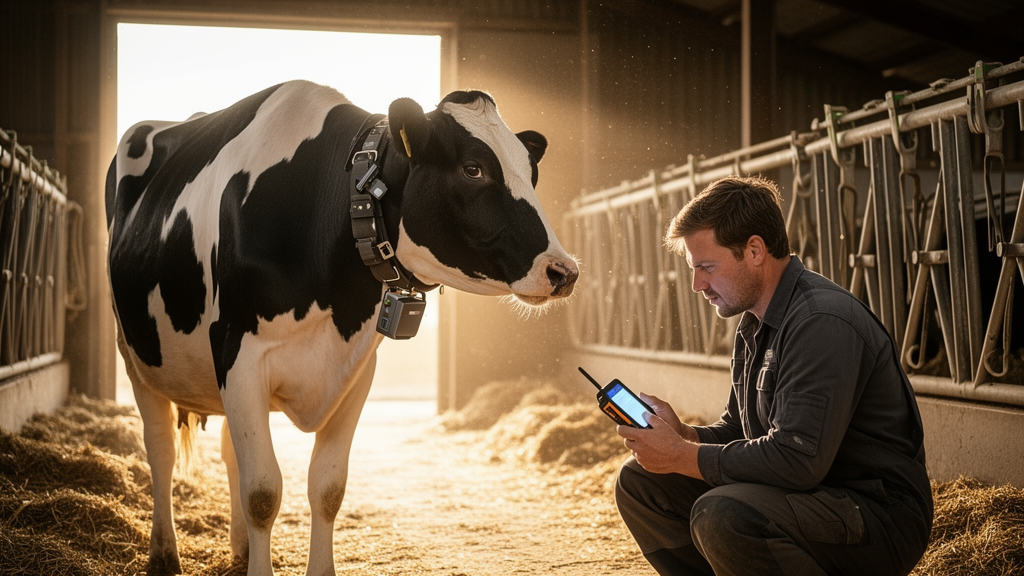
The research, led by Simon Woodward of DairyNZ Ltd and published in Frontiers in Animal Science, fitted IceQube triaxial accelerometers to 1,880 nulliparous Holstein-Friesian and Holstein-Friesian × Jersey crossbred heifers across 18 herds in 2019, and to 1,786 primiparous cows across 17 herds in 2020. The animals were managed in pasture-based, seasonal calving systems — an environment where replacement heifers are often grazed remotely, yarded infrequently, and can be out of range of fixed receivers for extended periods. Rather than relying on real-time data transmission, the team leaned on extended onboard storage within the devices themselves, retrieving the data only when the animals were finally brought in.
The core challenge was signal processing. Raw step counts and lying time recorded at 15-minute intervals are noisy, shaped by diurnal rhythms, herd management routines, and individual behavior. To isolate the estrus signal, the researchers first calculated a right-aligned 24-hour moving average for each animal, smoothing out daily patterns. They then subtracted the herd mean at each time step, correcting for whole-herd activity spikes caused by events like paddock shifts or milking routines. The resulting deviation was standardized for each animal to a mean of zero and a standard deviation of one. A high-activity event was flagged when the standardized deviation remained above a threshold of 2.2 for at least 12 hours within a two-day window.
Calibration relied on two reference datasets. In one herd of heifers, trained observers used tail paint and visual mounting checks three times weekly to record estrus events, labeling them as Strong or Weak depending on the degree of paint removal. For 14 herds of first-lactation cows, recorded insemination dates — separated into Gold events with confirmed pregnancies and Silver events without — served as benchmarks. The algorithm’s predictions were then scored against these observations using recall, precision, and the F1 statistic, the harmonic mean of the two.
Performance was respectable. For cows, using step data, the algorithm achieved recall of 80.9 percent, precision of 71.5 percent, and an F1 of 75.9 percent. For heifers, recall was 62.7 percent, precision 72.8 percent, and F1 67.3 percent. The authors note that these figures compare favorably with commercial activity monitoring devices reported in the literature, where recall has ranged from 37 to 90 percent and precision from 55 to 83 percent depending on the device and scenario. The slightly lower heifer performance likely reflects weaker estrus expression in first cycles and the limited observational data available for calibration in that group.
Beyond simply detecting estrus, the team derived novel fertility phenotypes: age at first detected estrus in heifers, and days to first estrus after calving in cows. For the 67 percent of heifers with non-censored results, the median age at first estrus was 330 days, with a survival-adjusted mean of 334 days and a standard deviation of 36 days. For cows, 88 percent had non-censored results, with a median of 45 days postpartum and a survival-adjusted mean of 58 days. The researchers also characterized estrus duration, maximum activity above herd mean, and total steps above threshold — metrics that could themselves become selectable traits.
Handling missing data, spurious spikes, and censored outcomes was central to the approach. The team identified days with abnormally high numbers of predicted events — likely caused by one-off management procedures like weighing or regrouping — and removed them systematically. They accepted inter-estrus intervals of 13 to 27 days as valid, aligning with known cattle cycle lengths, and applied left- and right-censoring to account for animals whose first estrus fell outside the monitoring window. Survival analysis was then used to estimate herd-level distributions despite these gaps.
The implications for genetic selection are significant. Timing of first estrus is an informative predictor of reproductive performance, and the authors argue that wearable-derived phenotypes could provide the high-frequency, high-volume data needed for genetic evaluation across large populations. Unlike blood progesterone sampling, which is costly and lacks temporal resolution, or visual observation, which is labor-intensive, accelerometers offer a scalable path to fertility phenotyping — provided the data can actually be retrieved from animals grazing far from infrastructure.
The authors are candid about limitations. The short monitoring period for heifers, constrained by onboard storage capacity, resulted in substantial censoring: 11.8 percent of heifers received left-censored predictions and 24.1 percent had no estrus detection before device removal. Further validation across commercial heifer herds would strengthen application in replacement animals. Longer monitoring periods, improved data retrieval infrastructure — such as direct-to-satellite links or longer-range receivers — and exploration of correlations with established fertility traits are all flagged as necessary next steps before these novel phenotypes can be deployed in breeding programs at scale.
Still, the proof of concept stands. Simple signal processing applied to step and lying time data from leg-mounted accelerometers can quantify the timing, strength, duration, and total activity of first estrus in peripubertal heifers and first-lactation cows, even under the constraints of extensive grazing. As wearable technology adoption grows and connectivity improves, these sensor-derived fertility phenotypes could help overcome longstanding barriers to ranking sires and accelerating genetic gain in dairy cattle reproduction — particularly in pasture-based systems where traditional phenotyping methods struggle to scale.
Subject of Research: Activity-based first estrus detection in grazing dairy heifers and cows using wearable accelerometers to derive scalable fertility phenotypes
Article Title: Activity-based first estrus detection in grazing heifers and first-lactation dairy cows for use as novel fertility phenotypes at scale
Article References: Woodward, S. J. R., Garrick, D. P., Steele, N. M., Stephen, M. A., Phyn, C. V. C., Meier, S., & Burke, C. R. (2026). Activity-based first estrus detection in grazing heifers and first-lactation dairy cows for use as novel fertility phenotypes at scale. Frontiers in Animal Science, 7, Article 1916553. https://doi.org/10.3389/fanim.2026.1916553
Image Credits: AI Generated
DOI: 10.3389/fanim.2026.1916553
Keywords: estrus detection, wearable sensors, accelerometers, dairy cattle, fertility phenotypes, genetic selection, precision livestock farming, grazing systems, heifers, puberty, signal processing, reproductive performance
News Source: William Thompson. (October 17, 2026). Wearable Sensors Turn Cattle Estrus Into Scalable Fertility Data. Scienmag.