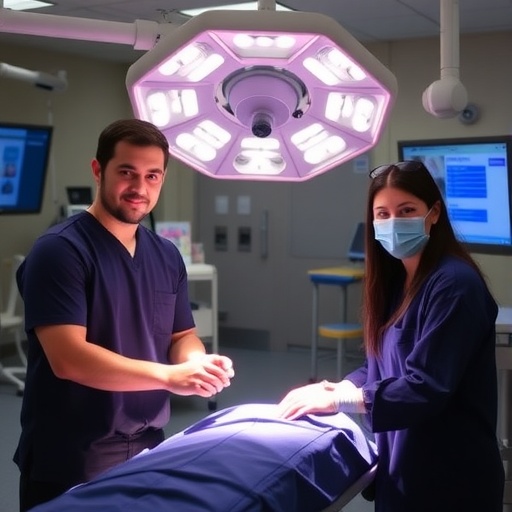
In a landmark advancement set to revolutionize surgical procedures, Wayne State University, in partnership with RediMinds Inc., has secured a patent for an innovative technology designed to detect and visualize arterial bleeding during minimally invasive surgeries. The newly granted United States Patent No. 12,635,098 B2, issued on May 26, 2026, represents a pivotal leap in surgical safety, addressing one of the most challenging complications faced by surgeons—unexpected intraoperative bleeding. This development holds the promise of dramatically improving patient outcomes in robotic and laparoscopic surgeries, where precise control over bleeding is critical.
Minimally invasive surgical procedures, including robotic and laparoscopic surgeries, have transformed the medical landscape by reducing recovery times and minimizing trauma. However, they are not without significant risks. Among these, arterial bleeding is a particularly severe complication. When bleeding occurs unexpectedly inside the surgical field, it can obscure the surgeon’s view, creating a dangerous scenario termed a “red out.” This occlusion of the visual field complicates the surgeon’s ability to manage the procedure effectively, potentially leading to adverse patient outcomes including increased mortality.
Led by Dr. Abhilash K. Pandya, a professor of electrical and computer engineering at Wayne State’s James and Patricia Anderson College of Engineering, the research incorporates cutting-edge computer vision and machine learning technologies. These sophisticated techniques analyze real-time data from the surgical camera, enabling the system to detect the onset of arterial bleeding instantly. The patented system goes beyond simple detection by providing precise localization and assessment of the bleeding source, which is then visually communicated to the surgeon through augmented reality overlays.
The core innovation lies in the seamless integration of artificial intelligence (AI) with existing surgical visualization tools. Surgical cameras already provide live video feeds during operations, but this technology enhances those feeds with AI-driven analysis that identifies bleeding with remarkable accuracy. By superimposing detailed visual cues onto the real-time surgical view, it guides the surgeon to the exact location of arterial injury, thus enabling swift and targeted intervention to control the bleeding.
This bleeding management system is designed as an add-on module compatible with the more than 2,000 robotic and 7,000 laparoscopic surgical systems currently deployed across hospitals in the United States. Its compatibility ensures that existing surgical infrastructure can be upgraded without requiring entirely new equipment, facilitating rapid adoption and widespread impact across healthcare institutions. The potential integration signals a significant stride toward the era of AI-assisted surgery, where technology acts as a vigilant partner alongside the surgeon.
Dr. Pandya emphasized the strategic importance of this development, describing the patented technology as a precursor to more sophisticated AI support systems in the operating room. Such systems are envisioned to monitor a variety of critical parameters beyond bleeding, including patient vitals and surgeon fatigue, providing timely warnings and augmenting human decision-making during complex surgical interventions. This holistic approach could transform surgical safety by proactively preventing complications and enhancing the surgeon’s situational awareness.
The implications of this advancement are profound. The ability to monitor and manage intraoperative bleeding with high precision is expected to minimize the need for blood transfusions, reduce infection rates, and decrease the length of hospital stays, all contributing to improved patient welfare and lower healthcare costs. Moreover, the technology holds promise in advancing intelligent safety tools that will serve as safeguards in the challenging environment of modern surgery, where every second and detail matter.
Dean Ali Abolmaali of the James and Patricia Anderson College of Engineering highlighted the interdisciplinary nature of the project, which synthesizes expertise in artificial intelligence, computer vision, and medical science. This synergy exemplifies how engineering innovations are poised to tackle complex healthcare challenges by translating laboratory discoveries into practical technologies with tangible benefits. The research portfolio showcased by Dr. Pandya and his collaborators illustrates the kind of transformative work that positions Wayne State University at the forefront of health-related engineering advancements.
From a commercialization perspective, Wayne State University’s commitment to transitioning early-stage innovations into market-ready solutions was underscored by Taunya Phillips, assistant vice president for technology commercialization at Wayne State. Securing this patent is a critical milestone in protecting intellectual property and ensuring that the invention not only advances science but also delivers societal and economic benefits. The collaboration between academic research and industry partners stands as a model for accelerating the impact of scientific breakthroughs on real-world medical practice.
As surgical procedures continue to evolve with the integration of robotics and AI, technologies like Dr. Pandya’s bleeding detection system portend a future where surgical errors and complications due to visual impairment from bleeding could become significantly less common. By automating the detection and localization process, this system frees surgeons to focus on critical decision-making and precision control, ultimately enhancing the safety and effectiveness of surgical interventions.
In closing, this patented technology heralds a new chapter in surgical innovation, leveraging AI to provide augmented reality-enhanced visualization that directly addresses the critical challenge of intraoperative bleeding. With the potential to save lives and improve surgical outcomes nationwide, this invention exemplifies how academic ingenuity can lead to global healthcare improvements. As adoption grows, the promise of AI as a vigilant and trustworthy assistant in the operating room moves closer to reality.
Subject of Research: Artificial Intelligence and Computer Vision Applications in Surgical Safety
Article Title: Wayne State University Secures Patent for AI-Driven Arterial Bleeding Detection System in Surgery
News Publication Date: May 26, 2026
Web References: research.wayne.edu
Image Credits: Wayne State University
Keywords
Applied sciences and engineering, Engineering, Human health, Biomedical engineering, Surgery
Tags: advanced surgical tools for bleeding controlarterial bleeding detection in surgerycomputer engineering in medical devicesimproving patient outcomes in robotic surgeryintraoperative bleeding managementlaparoscopic surgery safety technologyminimally invasive surgery innovationsRediMinds Inc surgical partnershipreducing complications in minimally invasive surgeryrobotic surgery bleeding visualizationsurgical field visualization technologyWayne State University surgical technology patent