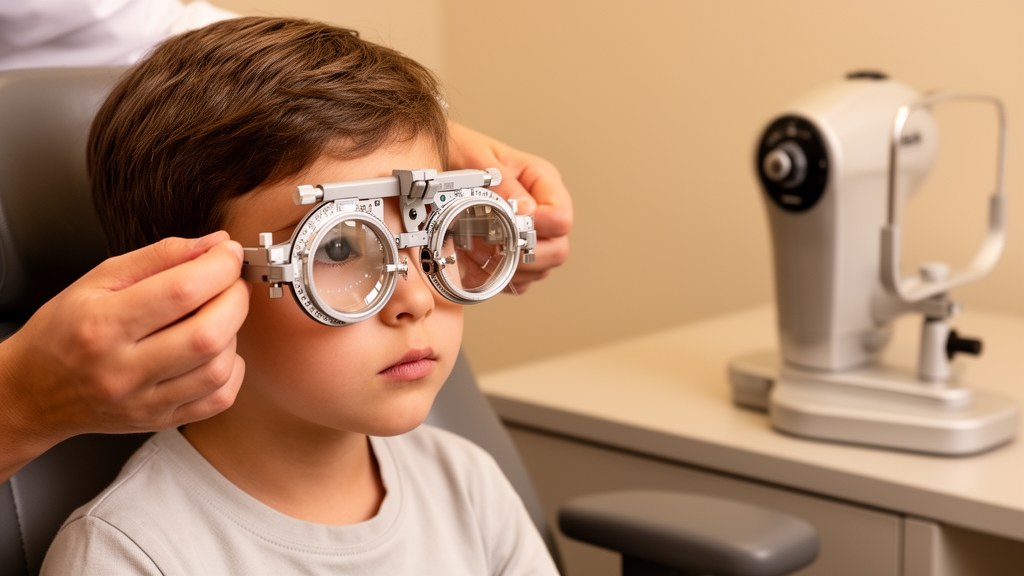
In a prospective agreement trial evaluating computational refraction for children with astigmatism, an artificial intelligence framework combining individualized wavefront reconstruction, virtual lens simulation, and machine-learning residual calibration produced an average spherical equivalent bias closer to zero than conventional autorefraction when compared against masked subjective refraction. Prescribing spectacles for pediatric astigmatism requires the simultaneous determination of sphere, cylinder power, and cylinder axis to achieve acceptable visual performance, but young patients often encounter difficulty sustaining the subtle subjective comparisons demanded by traditional phoropter examinations. To address these clinical challenges, investigators evaluated whether objective numerical wavefront aberrometry combined with learned calibration could calculate complete spherocylindrical prescriptions directly, eliminating the need for iterative subjective refinement during follow-up visits while maintaining functional visual clarity.
The prospective study, conducted at Beijing Tongren Hospital, enrolled children aged 6 to 18 years presenting with at least 0.50 diopters of astigmatism. Following initial screening with cycloplegic refraction, seventy-seven participants returned the next day for post-cycloplegia follow-up examinations once their accommodative amplitude had returned to baseline pre-administration levels. To prevent statistical distortion from correlated fellow eyes, investigators prespecified that only the right eye of each participant would be analyzed. The cohort exhibited a mean age of 10.1 years and included thirty-eight girls and thirty-nine boys, presenting with a mean baseline subjective refraction spherical equivalent of -2.92 diopters. The cohort was stratified into three astigmatic tiers based on absolute cylinder power determined by subjective refraction, comprising thirty-one eyes with low astigmatism below 1.00 diopter, twenty-eight eyes with moderate astigmatism between 1.00 and 1.50 diopters, and eighteen eyes with high astigmatism exceeding 1.50 diopters.
The computational pipeline was engineered to bypass subjective testing by synthesizing physical optical principles with clinical prescribing patterns rather than relying solely on raw spot images or direct end-to-end regression. Wavefront data were captured using a commercial Shack-Hartmann aberrometer that internally averaged five discrete wavefront maps per acquisition. The instrument exported numerical arrays containing five sets of refractive records and thirty-three normalized real-valued Zernike polynomial expansion coefficients spanning radial orders two through seven across defined pupil apertures. From these exported measurements, the algorithm generated an individualized optical grid over the maximum valid pupil diameter. Under monochromatic scalar-diffraction assumptions at a 550-nanometer wavelength, the optical module executed virtual lens simulations across candidate spherocylindrical corrections, calculating energy-normalized point spread functions and deriving conventional Strehl ratios to identify an initial optical prescription vector that maximized image quality across supported viewing conditions.
To reconcile purely optical image quality with practical clinical tolerance, this initial optical vector was refined by a multilayer perceptron trained to predict residual corrections. The calibration model was developed using a separate, independent historical dataset of 5,630 right eyes measured on the same wavefront platform. Supervised labels were established from final prescriptions determined by experienced optometrists through subjective refraction and formally accepted by patients following spectacle dispensing. The neural network received a fifty-eight-dimensional standardized input vector comprising thirty-three adapted Zernike coefficients, pupil diameter, fifteen power-vector elements from five aberrometer refraction passes, participant age, indicator variables for sex and laterality, and the three standardized components of the simulated optical vector. Operating with two hidden layers of sixty-four and thirty-two units with rectified linear unit activations, the 5,955-parameter model predicted standardized residuals for mean spherical equivalent, vertical Jackson cross-cylinder power, and oblique Jackson cross-cylinder power.
The prospective evaluation implemented rigorous methodological controls to isolate measurement differences and mitigate observer bias during clinical comparisons. The order of examinations was randomized using a computer-generated sequence, determining whether aberrometry acquisition and computational execution occurred prior to or following conventional autorefraction and subjective refraction. Autorefraction was executed using a commercial instrument, providing a baseline starting point that remained visible throughout subjective refinement. An experienced optometrist masked to computational outputs performed subjective refraction using a phoropter, incorporating fogging, Jackson cross-cylinder refinement, duochrome red-green verification, and binocular balancing to identify the maximum plus power providing optimal visual acuity. For computational evaluation, the artificial intelligence model was locked prior to prospective cohort analysis, ensuring that algorithm weights were not updated using prospective data and that calculated prescriptions entered comparisons without optometrist intervention.
Refractive agreement analyses revealed that the artificial intelligence framework attained a mean spherical equivalent bias of 0.01 diopters relative to subjective refraction, accompanied by a standard deviation of paired differences of 0.48 diopters and conventional Bland-Altman limits of agreement spanning -0.94 to 0.96 diopters. In comparison, conventional autorefraction demonstrated a mean signed spherical equivalent bias of 0.22 diopters with a standard deviation of 0.57 diopters and limits of agreement ranging from -0.89 to 1.33 diopters. A direct paired comparison between the objective modalities demonstrated a statistically significant difference in signed spherical equivalent bias of -0.21 diopters favoring the artificial intelligence framework. Both objective modalities demonstrated strong linear correlations with subjective refraction, yielding Pearson correlation coefficients of 0.964 for artificial intelligence and 0.958 for autorefraction, although distributions of paired differences departed significantly from normality across all evaluated refractive parameters.
Despite the closer mean spherical equivalent alignment observed with the computational model, paired analyses of individual error magnitudes and astigmatic vector components failed to demonstrate comprehensive superiority for the artificial intelligence system over conventional autorefraction. The mean absolute error for spherical equivalent was 0.296 diopters for artificial intelligence and 0.388 diopters for autorefraction, yielding an average paired difference of -0.092 diopters whose 95% bootstrap confidence interval ranged from -0.232 to 0.042 diopters, thereby crossing zero. Root mean squared errors for spherical equivalent similarly overlapped, measuring 0.480 diopters for artificial intelligence and 0.606 diopters for autorefraction. For astigmatic vector components, mean composite vector errors were nearly identical at 0.193 diopters for the computational model and 0.186 diopters for autorefraction, while exploratory evaluations of oblique astigmatism root mean squared error showed a slight numerical advantage for conventional autorefraction.
Threshold agreement analyses reinforced the comparable individual dispersion between the two objective modalities when evaluated against clinical subjective refraction. The proportion of children achieving an absolute spherical equivalent error within 0.25 diopters was 58.4 percent under the computational framework compared with 50.6 percent under conventional autorefraction, while the proportion meeting a 0.50-diopter threshold reached 84.4 percent versus 80.5 percent, respectively. For composite astigmatic vector errors, 76.6 percent of artificial intelligence estimates and 80.5 percent of autorefraction measurements fell within 0.25 diopters, whereas 97.4 percent and 93.5 percent remained within 0.50 diopters. Exact McNemar tests demonstrated that none of these threshold differences reached statistical significance, indicating that while average population bias was minimized by the computational framework, the dispersion of individual paired refractive deviations remained broad across both objective methods.
Secondary functional assessments evaluated immediate trial-frame visual performance and subjective preference between complete prescriptions generated by the computational model and subjective refraction. Two identical trial frames, labeled anonymously and assigned through a randomized schedule, were tested sequentially following ten-minute adaptation intervals separated by a ten-minute washout period. Both the participating children and the outcome assessor were masked to prescription sources. Corrected visual acuity was significantly better with the computational prescription, averaging -0.069 logMAR compared to -0.001 logMAR under subjective refraction, representing an average paired difference of -0.068 logMAR. When asked to report their immediate subjective wearing experience, fifty-one of the seventy-seven participants, representing 66.2 percent, expressed a preference for the computational prescription, while eleven preferred subjective refraction and fifteen reported being unable to distinguish between the two trial lenses.
Exploratory subgroup evaluations indicated that immediate visual performance varied across baseline astigmatism severities, offering clues regarding potential target populations for computational prescribing. Visual acuity gain, defined as subjective refraction visual acuity minus computational visual acuity, averaged 0.025 logMAR in the low-astigmatism group, 0.093 logMAR in the moderate-astigmatism group, and 0.104 logMAR in the high-astigmatism group. Robust statistical testing confirmed significant between-group differences that persisted following demographic adjustment for participant age, with greater gains observed in moderate and high astigmatism cohorts compared to low astigmatism. In contrast, subjective preference distributions did not differ significantly across astigmatic subgroups. Procedural timing records showed that computational aberrometry acquisition and calculation required 26.82 seconds on average, compared to 483.90 seconds for complete subjective refraction, although investigators emphasized that these timings encompassed disparate procedural tasks and cannot represent net time savings across full clinic workflows.
The study authors highlighted critical methodological boundaries, cautioning that a smaller population mean bias and favorable short-term trial-lens metrics do not establish clinical interchangeability or individual prescription safety. Visual acuity with autorefraction prescriptions was not tested, precluding direct functional comparisons between the two objective techniques. Furthermore, five children exhibited computational spherical equivalent values more than 0.50 diopters more minus than subjective refraction, including two exceeding 1.00 diopter, raising considerations regarding undetected overminus correction that cannot be diagnosed from single-visit acuity tests alone. The trial evaluated only immediate twenty-minute trial-frame wear without dispensing physical spectacles for daily use, leaving long-term visual comfort, binocular adaptation, asthenopia, and safety unverified. The researchers concluded that randomized multicenter trials adhering to standardized reporting protocols remain necessary to determine whether these computational prescriptions maintain stable performance and clinical efficacy across diverse pediatric populations.
Subject of Research: Evaluation of optical simulation and machine learning for pediatric astigmatic spectacle prescription
Article Title: Wavefront-based optical simulation and machine learning for pediatric astigmatic refraction: a prospective agreement study using power vector analysis
Article References: Zhen, Y., Chang, H., Huang, Y., & Gao, J. (2026). Wavefront-based optical simulation and machine learning for pediatric astigmatic refraction: a prospective agreement study using power vector analysis. Frontiers in Digital Health, 8, Article 1920169. https://doi.org/10.3389/fdgth.2026.1920169
Image Credits: AI Generated
DOI: 10.3389/fdgth.2026.1920169
Keywords: pediatric astigmatism, wavefront aberrometry, optical simulation, machine learning, subjective refraction, autorefraction, spherical equivalent, power vector analysis, Zernike polynomials, point spread function, Strehl ratio, visual acuity, trial-lens testing, residual calibration, refractive error, ophthalmic engineering
News Source: Harold Sullivan. (November 17, 2026). Wavefront Simulation Model Aligns Pediatric Astigmatism Prescriptions with Subjective Refraction. Scienmag.