A brief, tablet-based training protocol providing closed-loop sensory feedback selectively improved tactile detection thresholds at a single trained digit in adult stroke survivors, according to a pilot randomized controlled trial in the Journal of NeuroEngineering and Rehabilitation. The intervention, called the Active Touch Paradigm, paired manual scanning of virtual textures with movement-contingent electrotactile stimulation delivered to the affected hand. While participants receiving the experimental training exhibited significant gains in tactile sensitivity at the trained index finger, the protocol produced no accompanying transfer to untrained digits or broader upper-limb motor performance relative to standard care.
Despite their high prevalence and negative impact on daily functioning, sensory deficits frequently remain underdiagnosed and undertreated within routine clinical rehabilitation pathways. By delivering immediate sensory pulses during active exploration, researchers sought to determine whether this strategy could enhance somatosensory recovery and improve quality of life after stroke.
To examine the intervention, researchers conducted a pilot randomized controlled trial enrolling 20 adults in the recovery stage following ischemic or hemorrhagic stroke. All participants were at least one month post-stroke onset and presented with impaired upper-limb somatosensation. The participants were randomly allocated in equal numbers to an experimental intervention group or a control group. Throughout the trial, all participants across both groups continued their standard physician-prescribed rehabilitation programs, allowing researchers to evaluate the experimental training as an adjunctive therapeutic intervention.
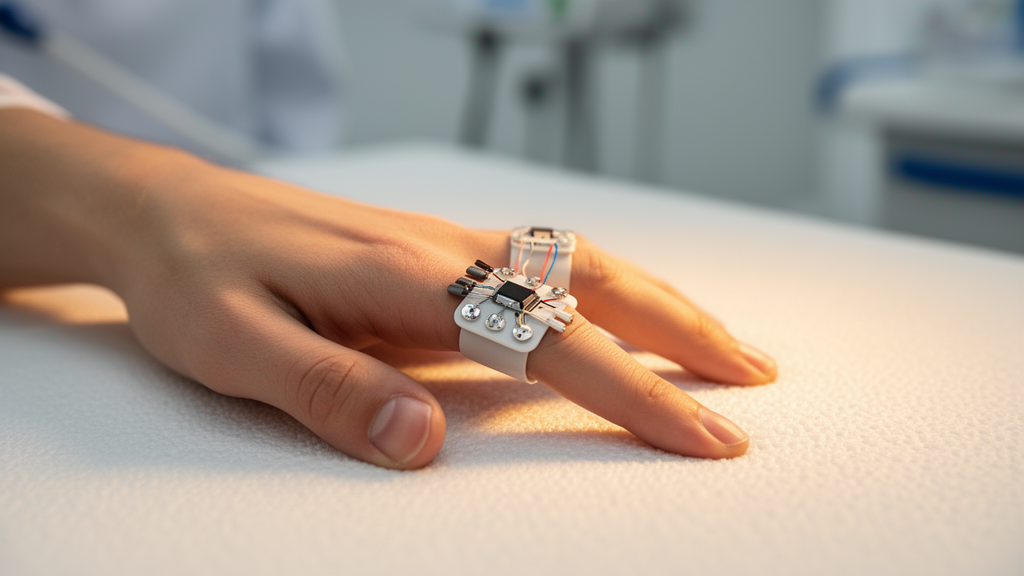
Participants in the experimental group were scheduled for 10 sessions of the Active Touch Paradigm over two weeks, with each session consisting of 60 trials lasting 15 to 30 minutes. During training, participants used the affected index finger to scan pairs of invisible virtual textures displayed on a tablet screen. Each crossing of an invisible virtual line triggered a single electrotactile pulse delivered to the dorsum of that same finger, creating movement-contingent electrotactile feedback. Nine of the 10 experimental participants completed all 10 planned sessions, while one completed eight sessions due to an early, self-requested discharge from inpatient care. The control group received standard rehabilitation alone and did not receive a time-matched additional therapy dose.
The primary outcome measure was the tactile detection threshold at the trained index fingertip, assessed using Semmes-Weinstein monofilaments and recorded in evaluator size. Secondary outcome measures included tactile thresholds at the thumb and middle finger of the affected hand, sensory thresholds across a subset of ipsilateral digits, and upper-limb motor and functional performance. Motor and functional outcomes were assessed using the Fugl-Meyer Assessment and the Action Research Arm Test. All outcomes were evaluated pre- and post-intervention, though the study authors noted that outcome assessors were not blinded to group assignments.
Statistical analysis revealed a significant Time-by-Group interaction for the affected index-finger threshold (F(1,18) = 6.90, p = 0.017, partial eta-squared = 0.28). The experimental group improved from a baseline mean of 5.34 (standard deviation 1.10) to 4.79 (standard deviation 1.30) evaluator size, whereas the control group changed from 4.82 (standard deviation 1.16) to 4.69 (standard deviation 1.15). Using North Coast sensory grades, seven of the 10 experimental participants improved by at least one grade at the trained digit, compared with two of the 10 controls. No significant interactions were observed for thumb or middle-finger thresholds, although a trend emerged for the thumb. Both groups improved over time on Fugl-Meyer and Action Research Arm Test scores.
The authors concluded that the brief, tablet-based training protocol selectively improved tactile sensitivity at a single trained digit after stroke without providing additional benefit on broader motor outcomes. The Active Touch Paradigm appeared feasible, clinically practical, and specifically effective for post-stroke tactile rehabilitation. However, several methodological limitations were identified, including the small pilot sample size of 20 participants, the lack of blinded outcome assessors, the absence of a time-matched control intervention, and retrospective registration on ClinicalTrials.gov under identifier NCT06962397 on April 30, 2025. The investigators noted that larger mechanistic trials and studies exploring integration with task-oriented upper-limb training are warranted.
Subject of Research: Movement-contingent electrotactile feedback for post-stroke tactile rehabilitation
Article Title: Movement-contingent electrotactile feedback improves tactile sensitivity and sensory recovery after stroke: a randomized preregistered and controlled trial
Article References: Volodina, M., Tumyalis, A., Ivanova, E., Ivanov, T., Kirichenko, A., Ivanova, G., & Ossadtchi, A. (2026). Movement-contingent electrotactile feedback improves tactile sensitivity and sensory recovery after stroke: a randomized preregistered and controlled trial. Journal of NeuroEngineering and Rehabilitation. https://doi.org/10.1186/s12984-026-02211-3
Image Credits: AI Generated
DOI: 10.1186/s12984-026-02211-3
Keywords: stroke recovery, somatosensory deficits, electrotactile feedback, active touch paradigm, tactile sensitivity, randomized controlled trial, upper-limb rehabilitation, semmes-weinstein monofilaments, tactile detection threshold, fugl-meyer assessment, action research arm test, north coast sensory grades, closed-loop feedback, ischemic stroke, hemorrhagic stroke, post-stroke rehabilitation
News Source: Cassandra Pierce. (November 17, 2026). Electrotactile Feedback Selectively Improves Finger Tactile Sensitivity in Stroke Recovery Trial. Scienmag.