Occupational exposure to respirable crystalline silica dust is linked to an accelerated decline in human lung function, with advanced statistical modeling indicating an annual exposure threshold of approximately 0.09 to 0.10 milligrams per cubic meter below which cumulative pulmonary damage appears not to accumulate. In a comprehensive investigation published in the Journal of Occupational Medicine and Toxicology, researchers Christin Schröder and Dennis Nowak evaluated four distinct mathematical and pathophysiological models to assess how crystalline silica particles affect spirometric decline across working lifetimes. Utilizing long-term occupational surveillance data from the historical Wismut German Uranium Mining Cohort Study, the investigators sought to clarify whether the exposure-response relationship governing quartz dust and lung impairment exhibits a measurable threshold. Their primary findings demonstrate that an exposure model featuring a constant annual threshold without overload provided the most biologically plausible and statistically robust characterization of spirometric deterioration among exposed miners, establishing quantitative benchmarks for occupational protection.
The health consequences of crystalline silica inhalation represent a longstanding concern across numerous global industries, including quarrying, underground mining, manufacturing, and construction. Crystalline silica, most commonly encountered as quartz within sand and natural rock formations, is an established causative factor in severe non-malignant and malignant respiratory conditions such as silicosis, lung cancer, silicotuberculosis, and chronic obstructive pulmonary disease. Chronic obstructive pulmonary disease is defined by persistent airway narrowing and progressive pulmonary function deterioration, contributing to roughly 3.5 million deaths worldwide every year according to data compiled by the World Health Organization. While personal cigarette smoking and domestic biomass burning remain leading causes of obstructive airway disorders, hazardous workplace dust exposures represent a substantial contributor. Industrial safety records show that roughly 2.3 million workers in the United States and approximately 5.3 million laborers across the European Union face silica exposure during regular duties, including more than 628,000 individuals in Germany alone.
Prior epidemiological and clinical investigations have confirmed that occupational exposure to quartz dust can cause measurable decreases in lung capacity independently of radiographic signs of parenchymal silicosis. This clinical divergence indicates that silica particles impair airway function through specific physiological pathways separate from classic fibrotic tissue remodeling. Under normal environmental conditions, the respiratory system relies on three complementary clearance mechanisms to remove foreign materials: mucociliary transport in the conducting airways, cellular phagocytosis by alveolar macrophages residing in peripheral lung tissue, and cellular translocation across the thin alveolar-capillary barrier into lymphatic channels or general circulation. When respirable crystalline silica reaches the deep alveolar spaces, it exerts cytotoxic effects that induce cell death among alveolar macrophages after particle engulfment. Because alveolar macrophage populations maintain their local numbers through in situ cellular self-renewal rather than systemic recruitment from circulating bone marrow precursors, extensive silica-induced cell lysis can overwhelm local replacement rates, establishing a mechanical basis for clear exposure thresholds.
To evaluate these theoretical clearance dynamics under actual industrial conditions, the research team analyzed longitudinal health records from a dedicated sub-cohort of the German Wismut uranium workforce. The analytical dataset was specifically restricted to male personnel who initiated underground employment after 1970, a critical methodological cut-off chosen because mining methods, workplace dust suppression practices, and quartz concentrations changed substantially compared to earlier operational eras. Routine measurements continued through 1991, capturing the modern period of industrial oversight before facility closures. The final study sample encompassed 1,418 male underground miners who collectively underwent 7,116 routine spirometric examinations during their active employment. The median age of participants was 22 years at the initial lung function evaluation and 33 years at their final scheduled examination, representing a young to middle-aged occupational workforce monitored across active working periods spanning up to two decades.
Accurate historical exposure reconstruction was achieved using a validated, detailed job-exposure matrix established specifically for the Wismut enterprise. This matrix incorporated approximately 1.3 million individual personal air monitoring and stationary dust concentration measurements gathered systematically by the German Social Accident Insurance throughout the active operational lifespan of the mines. The matrix systematically assigned respirable crystalline silica concentrations based on specific job classifications, facility locations, and distinct calendar intervals, thereby integrating ongoing reductions in airborne dust resulting from modernized mechanical ventilation and dust suppression systems. By calculating individual mean annual exposure concentrations in milligrams per cubic meter, the authors generated cumulative lifetime exposure metrics expressed in milligram per cubic meter-years, matching job tenure timelines to spirometry appointments. Previous validation studies confirmed consistent agreement between matrix-derived estimates and directly measured individual worker exposures.
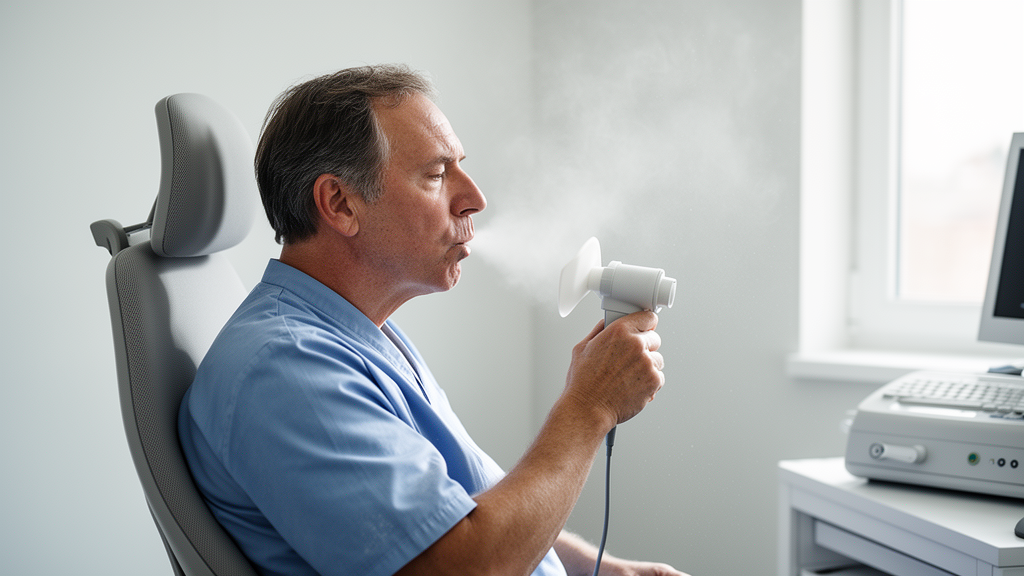
Spirometric examinations were conducted systematically at the commencement of employment and subsequently every two years using standardized Stollberg spirometers administered during morning hours before active underground shifts. Testing protocols deliberately excluded bronchodilator medication to measure native physiological status. From observed forced expiratory volume in one second and forced vital capacity measurements, the authors derived z-scores for the ratio of forced expiratory volume to forced vital capacity based on the Global Lung Function Initiative 2012 reference equations. These reference equations incorporate age, biological sex, standing height, and race to establish standard deviations from healthy population means, with the lower limit of normal demarcated at a z-score of minus 1.645. Over the course of the surveillance period, the median overall cohort z-score decreased from minus 0.19 at baseline to minus 0.34 at final observation, marking a relative decline from the 42nd down to the 36th population percentile, with reductions clearly observable in non-smoking subsets.
The study formulated and systematically compared four mathematical models reflecting competing biological hypotheses regarding dust tolerance and lung deterioration. Model 1 conceptualized a constant annual exposure threshold without overload, postulating that pulmonary macrophages successfully clear exposures below a critical level without cumulative harm, while only the incremental concentration exceeding that threshold generates permanent spirometric injury. Model 2 adapted this structure by introducing an abrupt clearance failure overload mechanism, postulating that whenever annual exposure exceeds the threshold, the entire annual exposure contributes to functional damage because biological defenses fail completely. Model 3 postulated a delayed onset dynamic where injury is solely governed by cumulative lifetime dust dose rather than annual rates, meaning functional decline begins only after exceeding an absolute cumulative threshold. Model 4 evaluated a dynamic threshold that declined linearly over successive calendar years, reflecting progressive, permanent wear on clearance structures caused by aging and ongoing cytotoxic dust exposure.
Model parameters were estimated through a structured two-stage statistical pipeline implemented in R utilizing Bayesian regression modeling in Stan via the brms package. In the primary stage, Bayesian algorithms evaluated the threshold values across thousands of Markov chain Monte Carlo iterations using an inverse-logit transformation bounded within realistic empirical ranges. Convergence was formally confirmed through potential scale reduction factors and effective sample sizes. In the secondary analytical stage, the cumulative exposure values derived from each threshold formula were introduced into linear mixed-effects models containing individual random intercepts to account for repeated spirometric measures, adjusting for participant smoking status. These linear mixed-effects models quantified the cumulative exposure required to drive an average worker down to the clinically recognized impairment threshold of minus 1.645 z-score, while leave-one-out cross-validation was used to determine out-of-sample predictive accuracy.
The comparative evaluation revealed decisive differences in mathematical performance and biological coherence among the candidate approaches. Model 1, Model 3, and Model 4 successfully converged to distinct threshold estimates, whereas Model 2 encountered severe numerical convergence failures caused by mathematical discontinuity at the threshold boundary, remaining unstable even after introducing steeply declining functions. Models 1 and 4 identified remarkably comparable annual exposure thresholds between 0.09 and 0.10 milligrams per cubic meter. In Model 4, the estimated rate of threshold decline was so minuscule that the threshold trajectory functioned as a horizontal line without practical slope. Meanwhile, Model 3 yielded an exceptionally low cumulative threshold, implying that nearly all occupational exposure would accumulate damage almost from day one, which contradicted observed clinical latency patterns. Leave-one-out cross-validation decisively favored Model 1 as possessing the lowest information criterion value, establishing it as the most statistically and biologically consistent model.
Under the preferred framework of Model 1, the critical annual exposure concentration was estimated at approximately 0.09 milligrams per cubic meter, coupled with an estimated cumulative threshold of 2.0 milligrams per cubic meter-years required to induce clinically significant impairment. This formulation predicts that individuals subjected to high average dust levels face meaningful pulmonary function decline within realistic occupational career timeframes. For example, under sustained high exposures of 0.30 milligrams per cubic meter, the model projects that roughly ten years of active underground work would accumulate sufficient excess exposure to reach the cumulative damage threshold. Conversely, workers remaining at or below the 0.09 milligram threshold would avoid cumulative functional deterioration, highlighting the utility of maintaining ambient air concentrations below this critical concentration.
The authors emphasized important limitations inherent to the empirical dataset and analytical structures. Because the Wismut sub-cohort was restricted to workers entering underground positions after 1970 and tracked only through 1991, the maximum observed subject age was approximately 35 years. Consequently, no individual participant within the recorded timeframe actually accumulated enough total exposure to reach the modeled cumulative threshold of 2.0 milligrams per cubic meter-years during observation. As a result, while the annual threshold of 0.09 milligrams per cubic meter is firmly anchored in empirical observations containing measurements on both sides of the value, the cumulative lifetime threshold relies on mathematical extrapolation beyond the observed data range. Furthermore, 84 percent of the mining cohort were documented smokers, an active lifestyle factor that directly influences baseline spirometry and longitudinal lung function changes, although no explicit interaction term between tobacco smoke and silica exposure was included in the primary modeling.
Despite these demographic and observational constraints, the findings provide vital quantitative evidence demonstrating that high occupational crystalline silica dust exposure accelerates the decline of spirometric performance in exposed workers. By demonstrating that Model 1 provides a biologically realistic and statistically superior fit to empirical mining records, the study supports the existence of a definitive annual threshold at roughly 0.09 milligrams per cubic meter. While the projected cumulative lifetime threshold warrants prospective validation in older cohorts possessing extended post-exposure follow-up, the robust identification of an annual protective threshold offers actionable technical evidence for regulatory authorities and industrial hygienists striving to establish protective occupational exposure limits and prevent chronic occupational respiratory disease.
Subject of Research: Occupational crystalline silica dust exposure thresholds and spirometric lung function decline
Article Title: Assessment of spirometric decline from silica dust: threshold values and calculation methods for cumulative exposure
Article References: Schröder, C., & Nowak, D. (2026). Assessment of spirometric decline from silica dust: threshold values and calculation methods for cumulative exposure. Journal of Occupational Medicine and Toxicology, 21(1), Article 10. https://doi.org/10.1186/s12995-026-00507-7
Image Credits: AI Generated
DOI: 10.1186/s12995-026-00507-7
Keywords: crystalline silica, occupational health, spirometry, lung function decline, threshold models, Wismut cohort, uranium miners, job-exposure matrix, FEV1, forced vital capacity, respirable dust, alveolar macrophages, pulmonary clearance, chronic obstructive pulmonary disease, Bayesian regression, linear mixed-effects models, occupational exposure limits
News Source: Ophelia Keating. (November 19, 2026). Study Identifies Silica Dust Exposure Threshold Linked to Accelerated Spirometric Decline. Scienmag.