When a hurricane bears down on a coastal town, the difference between a building that survives and one that is torn apart often comes down to how the wind interacts with its outer skin. Now a team at the FAMU-FSU College of Engineering has shown that a surprisingly simple geometric change—replacing flat walls and roofs with gently undulating, wave-shaped surfaces—can slash the peak wind pressures that low-rise buildings must endure by as much as 60 percent. The findings, published in the journal Engineering Structures, suggest that the shape of a building itself could become one of the most powerful tools available for defending against severe storms.
The research, led by Pedro Fernández-Cabán, assistant professor of civil engineering at the FAMU-FSU College of Engineering, together with associate professor Qian Zhang, doctoral student Arezoo Bakhshizadeh and alumnus Peter Tsouroukdissian, set out to answer a question that has long intrigued wind engineers: can macro-scale corrugation of a building envelope meaningfully disrupt the aerodynamic mechanisms that tear roofs off houses and peel cladding from walls? The answer, according to their wind tunnel experiments, is a resounding yes. Models with the deepest wave patterns tested reduced peak wind pressures by 40 to 60 percent near roof and wall corners—the very zones where destructive forces concentrate—across multiple wind directions.
“Changing a building’s shape can significantly reduce the intensity of wind forces it has to withstand,” said Fernández-Cabán. “These nonconventional building shapes reduce the damage from worst-case severe weather scenarios. It’s another tool for engineers and designers to protect against wind damage.” That statement captures a shift in thinking that has been gathering momentum in structural engineering for years. Rather than simply building thicker walls or specifying stronger materials to resist wind loads, engineers can instead reshape the building so that the loads never fully develop in the first place.
To test the concept, the team fabricated 3D-printed scale models of low-rise buildings equipped with wave-shaped exterior roof and wall systems in place of traditional flat surfaces. Three-dimensional printing allowed the researchers to produce precise, repeatable geometries that would have been difficult or impossible to construct by hand. They then systematically varied the depth of the waves, evaluating amplitudes between 5 and 10 percent of the building height, and compared each configuration against a conventional flat-walled control model. Pressure taps embedded in the model surfaces recorded the fluctuating wind pressures at high resolution as the models were subjected to controlled airflow in the college’s wind tunnel.
The physics behind the improvement lies in the behavior of vortices—rotating masses of air that form when wind flows over sharp edges and corners. When wind sweeps smoothly across a flat wall or a pitched roof, the flow separates abruptly at the leading edge, curling back on itself and creating powerful conical vortices that cling to roof corners and wall edges. These vortices generate regions of intense suction, where the local air pressure drops far below the ambient atmospheric pressure. The higher pressure inside the building then pushes outward on the roof or wall surface toward that low-pressure zone, and it is this differential—often acting suddenly and in gusts—that lifts roofing membranes, rips off shingles and tears siding loose. The strongest forces reliably develop at the corners and edges of the roof, where the vortices congregate and pose the greatest threat to structural integrity.
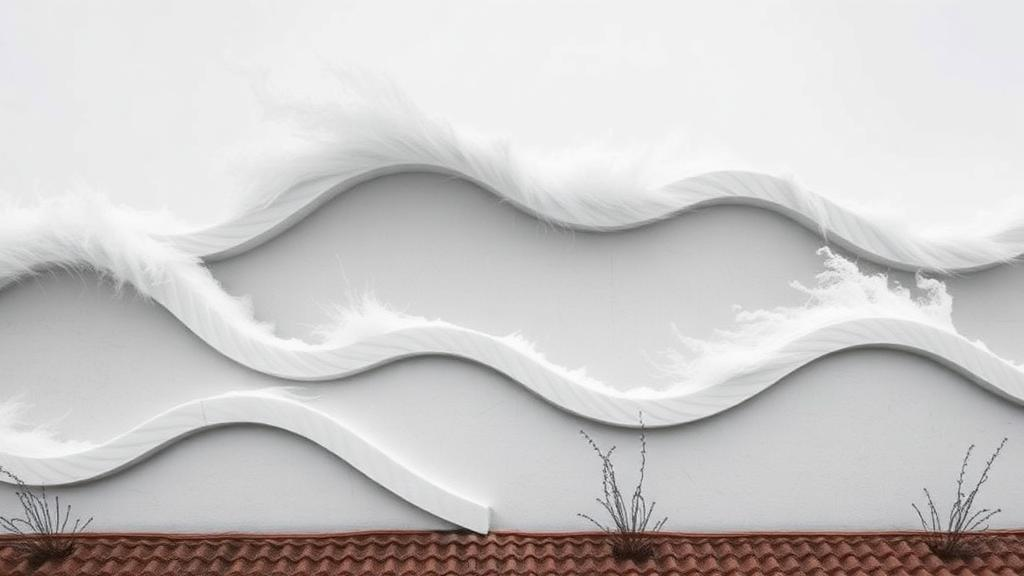
Wave-shaped surfaces attack this mechanism at its root. Instead of presenting a sharp, straight edge where flow can separate cleanly and organize into a coherent vortex, the undulating envelope presents a series of rounded hills and valleys that continuously disrupt the airflow. The wind skips across these contours like a stone bouncing across the surface of a lake, unable to settle into the steady separation patterns that produce concentrated suction loads. Each successive crest and trough breaks up the pressure zones and redirects the flow away from the building envelope, preventing the pockets of high suction from forming in the first place. In effect, the geometry converts one large, coherent, destructive aerodynamic structure into many small, weak, rapidly mixing ones.
The wind tunnel data confirmed this picture quantitatively. Among the configurations tested, the model with the greatest wave depth proved the most effective at alleviating wind load effects, delivering peak pressure reductions of 40 to 60 percent near roof and wall corners across multiple wind directions. That range matters enormously in practice, because hurricanes do not arrive from a single predictable heading, and a mitigation strategy that only works when the wind blows from one quarter would be of limited value. The consistency of the benefit across directions suggests that corrugated envelopes could provide robust, all-around protection rather than a narrow, orientation-dependent advantage.
The economic logic of the approach is equally compelling. Battling wind pressure has long been an ongoing challenge in structural design, and the conventional toolkit reflects that struggle. Exterior architectural features such as rounded corners, sloped walls and stepped setbacks are known to alleviate wind loads, and another common strategy is to make walls thicker or sturdier by adding more or tougher material. These techniques can be effective, but they are expensive. Design and site constraints rule out some features entirely, and retrofitting them onto existing structures can be impractical or prohibitively costly. A corrugated facade, by contrast, modifies the geometry of the envelope itself, potentially adding aerodynamic resilience without demanding dramatic increases in material quantity or fundamentally altering the building’s footprint. The research demonstrates the possibility of adopting building facades with nontraditional shapes as a practical route to wind protection.
The implications of the work extend well beyond the structural engineering community. The underlying fluid dynamics—the behavior of turbulent boundary layers, flow separation and vortex shedding over curved and corrugated surfaces—carry broad relevance for any field that investigates how fluids move around obstacles. “We’re dealing with air, and other engineers and scientists might be dealing with waves and water, but the understanding of fluid dynamics can inform design and engineering across fields,” Fernández-Cabán said. “Aerodynamic optimization requires a multidisciplinary approach that balances structural safety, resilience, material efficiency and performance.” Researchers in aeronautics, environmental science and fundamental physics all grapple with versions of the same problem: how geometry shapes the turbulent flows that determine forces, heat transfer and mixing. Insights from building aerodynamics could inform everything from the design of more efficient aircraft components to models of how wind transports particles and pollutants over rough terrain.
Much work remains before wave-shaped envelopes appear on real construction sites. The current study measured the wind pressures acting on the surfaces of the models, which is the critical first step, but the research team is already conducting additional experiments to better understand the detailed wind flows around these envelope systems—how the air actually moves, separates and reattaches as it travels over the corrugations. The researchers also plan to deploy computational fluid dynamics modeling to further optimize the wave patterns and to explore other surface geometries that were not physically tested in the wind tunnel. Together, these efforts could yield design guidelines that architects and engineers can apply directly, turning an elegant laboratory result into a standard strategy for hurricane resilience. For communities on the front lines of increasingly severe storms, the message from Tallahassee is striking: sometimes the best defense against the wind is not more material, but a better shape.
Subject of Research: Aerodynamic mitigation of hurricane wind loads on low-rise buildings using wave-shaped corrugated wall and roof surfaces
Article Title: FAMU-FSU College of Engineering researchers develop wave-shaped wall and roof designs that protect against hurricane-force winds
Article References: FAMU-FSU College of Engineering researchers develop wave-shaped wall and roof designs that protect against hurricane-force winds. (n.d.). Original publication
Image Credits: AI Generated
DOI: Not provided
Keywords: wind engineering, hurricane resilience, building aerodynamics, wind tunnel testing, vortex dynamics, low-rise buildings, corrugated envelopes, structural engineering, fluid dynamics, wind loads, 3D-printed models, Engineering Structures
News Source: Denise Maddox. (October 7, 2026). Wave-Shaped Walls and Roofs Cut Hurricane Wind Loads by Up to 60 Percent. Scienmag.