


When scuba divers need to say “I’m okay” or “Shark!” to their dive partners, they use hand signals to communicate visually. But sometimes these movements are difficult to see. Now, researchers reporting in ACS Nano have constructed a waterproof “e-glove” that wirelessly transmits hand gestures made underwater to a computer that translates them into messages. The new technology could someday help divers communicate better with each other and with boat crews on the surface.
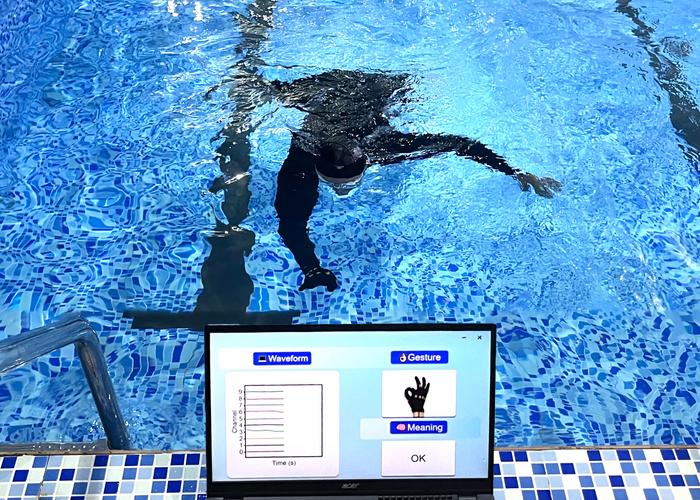
Credit: Adapted from ACS Nano 2024, DOI: 10.1021/acsnano.3c13221
When scuba divers need to say “I’m okay” or “Shark!” to their dive partners, they use hand signals to communicate visually. But sometimes these movements are difficult to see. Now, researchers reporting in ACS Nano have constructed a waterproof “e-glove” that wirelessly transmits hand gestures made underwater to a computer that translates them into messages. The new technology could someday help divers communicate better with each other and with boat crews on the surface.
E-gloves — gloves fitted with electronic sensors that translate hand motions into information — are already in development, including designs that allow the wearer to interact with virtual reality environments or help people recovering from a stroke regain fine motor skills. However, rendering the electronic sensors waterproof for use in a swimming pool or the ocean, while also keeping the glove flexible and comfortable to wear, is a challenge. So Fuxing Chen, Lijun Qu, Mingwei Tian and colleagues wanted to create an e-glove capable of sensing hand motions when submerged underwater.
The researchers began by fabricating waterproof sensors that rely on flexible microscopic pillars inspired by the tube-like feet of a starfish. Using laser writing tools, they created an array of these micropillars on a thin film of polydimethylsiloxane (PDMS), a waterproof plastic commonly used in contact lenses. After coating the PDMS array with conductive layer of silver, the researchers sandwiched two of the films together with the pillars facing inward to create a waterproof sensor. The sensor — roughly the size of a USB-C port — is responsive when flexed and can detect a range of pressures comparable to the light touch of a dollar bill up to the impact of water streaming from a garden hose. The researchers packaged 10 of these waterproof sensors within self-adhesive bandages and sewed them over the knuckles and first finger joints of their e-glove prototype.
To create a hand-gesture vocabulary for the researchers’ demonstration, a participant wearing the e-glove made 16 gestures, including “OK” and “Exit.” The researchers recorded the specific electronic signals generated by the e-glove sensors for each corresponding gesture. They applied a machine learning technique for translating sign language into words to create a computer program that could translate the e-glove gestures into messages. When tested, the program translated hand gestures made on land and underwater with 99.8% accuracy. In the future, the team says a version of this e-glove could help scuba divers communicate with visual hand signals even when they cannot clearly see their dive partners.
The authors acknowledge funding from the Shiyanjia Lab, National Key Research and Development Program, Taishan Scholar Program of Shandong Province in China, Shandong Province Key Research and Development Plan, Shandong Provincial Universities Youth Innovation Technology Plan Team, National Natural Science Foundation of China, Natural Science Foundation of Shandong Province of China, Shandong Province Science and Technology Small and Medium sized Enterprise Innovation Ability Enhancement Project, Natural Science Foundation of Qingdao, Qingdao Key Technology Research and Industrialization Demonstration Projects, Qingdao Shinan District Science and Technology Plan Project, and Suqian Key Research and Development Plan.
The paper’s abstract will be available on April 10 at 8 a.m. Eastern time here: http://pubs.acs.org/doi/abs/10.1021/acsnano.3c13221
###
The American Chemical Society (ACS) is a nonprofit organization chartered by the U.S. Congress. ACS’ mission is to advance the broader chemistry enterprise and its practitioners for the benefit of Earth and all its people. The Society is a global leader in promoting excellence in science education and providing access to chemistry-related information and research through its multiple research solutions, peer-reviewed journals, scientific conferences, eBooks and weekly news periodical Chemical & Engineering News. ACS journals are among the most cited, most trusted and most read within the scientific literature; however, ACS itself does not conduct chemical research. As a leader in scientific information solutions, its CAS division partners with global innovators to accelerate breakthroughs by curating, connecting and analyzing the world’s scientific knowledge. ACS’ main offices are in Washington, D.C., and Columbus, Ohio.
To automatically receive news releases from the American Chemical Society, contact [email protected].
Note: ACS does not conduct research, but publishes and publicizes peer-reviewed scientific studies.
Follow us: X, formerly Twitter | Facebook | LinkedIn | Instagram
Journal
ACS Nano
DOI
10.1021/acsnano.3c13221
Article Title
Underwater Gesture Recognition Meta-Gloves for Marine Immersive Communication
Article Publication Date
10-Apr-2024
![Tuning Endergonic Triplet Photosensitization Enables Bicyclo[1.1.0]butane–Alkene Cycloadditions](https://bioengineer.org/wp-content/uploads/2026/08/Tuning-Endergonic-Triplet-Photosensitization-Enables-Bicyclo110butane–Alkene-Cycloadditions-120x86.jpg)
