• HOME
  • NEWS
  • EXPLORE
    • CAREER
      • Companies
      • Jobs
    • EVENTS
    • iGEM
      • News
      • Team
    • PHOTOS
    • VIDEO
    • WIKI
  • BLOG
  • COMMUNITY
    • FACEBOOK
    • INSTAGRAM
    • TWITTER
Friday, June 26, 2026
BIOENGINEER.ORG
No Result
View All Result
  • Login
  • HOME
  • NEWS
  • EXPLORE
    • CAREER
      • Companies
      • Jobs
        • Lecturer
        • PhD Studentship
        • Postdoc
        • Research Assistant
    • EVENTS
    • iGEM
      • News
      • Team
    • PHOTOS
    • VIDEO
    • WIKI
  • BLOG
  • COMMUNITY
    • FACEBOOK
    • INSTAGRAM
    • TWITTER
  • HOME
  • NEWS
  • EXPLORE
    • CAREER
      • Companies
      • Jobs
        • Lecturer
        • PhD Studentship
        • Postdoc
        • Research Assistant
    • EVENTS
    • iGEM
      • News
      • Team
    • PHOTOS
    • VIDEO
    • WIKI
  • BLOG
  • COMMUNITY
    • FACEBOOK
    • INSTAGRAM
    • TWITTER
No Result
View All Result
Bioengineer.org
No Result
View All Result
Home NEWS Science News Chemistry

Waterborne polyurea/urethanes significantly reduce hydrate growth rate in pipelines

Bioengineer by Bioengineer
March 20, 2020
in Chemistry
Reading Time: 2 mins read
0
IMAGE
Share on FacebookShare on TwitterShare on LinkedinShare on RedditShare on Telegram

A paper appeared in Journal of Natural Gas Science and Engineering.
IMAGE

Credit: Kazan Federal University


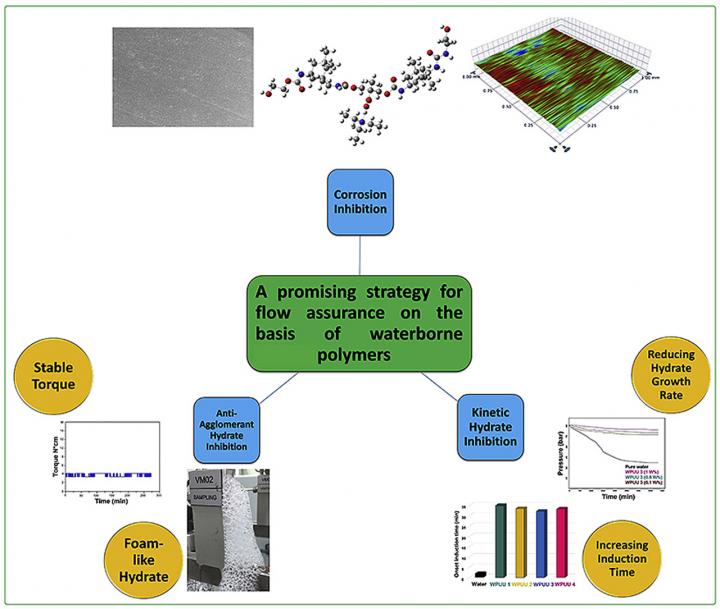
Previously, KFU scientists were able to develop the first inhibitors based on castor oil and chitosan. Researchers came up with the idea to create them to solve at least two tasks: ensure efficient production and transportation of hydrocarbons, as well as reduce environmental risks. Now a series of inhibitors has appeared with new reagents based on water-soluble polyurethanes.

“We are looking for new ways to obtain complex reagents – so that one molecule can solve two problems simultaneously. New reagents, as well as those developed by us earlier, effectively inhibit corrosion and hydrate formation. We developed them using urethane technology. This synthesis was carried out in an aqueous medium, which allowed us to obtain water-soluble polyurethanes that can be utilized quite easily,” explains Mikhail Varfolomeev, Head of EcoOil Research Unit at the University.

“This reagent has shown high efficiency in the inhibition of hydrates, both in dynamic conditions of pipeline transport and in static conditions. In addition, detailed studies of the new reagent for corrosion inhibition were carried out, and methods of microscopy and electrochemical analysis were used. All of them showed that this reagent forms a protective layer on the metal surface, which prevents corrosion,” elaborates co-author Abdolreza Farhadian, Research Associate of the Rheological and Thermochemical Research Lab.

Corrosion and the formation of gas hydrate plugs in offshore oil and gas pipelines pose vital risks to operation and safety. As oil and gas exploration and production moves to deeper deposits and longer pipelines, the costs associated with hydrate blocking will increase significantly.

“The idea is that with the help of our inhibitor you can change the situation with the use of reagents. So far, it is customary to use different inhibitors to eliminate problems with corrosion and gas hydrate plugs, and inhibitors can significantly impair each other’s effectiveness. Unlike existing inhibitors, our reagent, in the form of only one molecule, is able to perform these functions. This can qualitatively change the general strategies for applying and solving these problems,” adds another co-author Arman Kudbanov.

###

The project is supported by the Russian Foundation for Basic Research, grant number 18-05-70121.

The paper was made available online in March 2020 and will appear in print in May 2020.

Media Contact
Yury Nurmeev
[email protected]

Original Source

https://kpfu.ru/eng/news-eng/waterborne-polyureaurethanes-significantly-reduce.html

Related Journal Article

http://dx.doi.org/10.1016/j.jngse.2020.103235

Tags: Chemistry/Physics/Materials SciencesEnergy SourcesPolymer Chemistry
Share13Tweet8Share2ShareShareShare2

Related Posts

AI and Physics Collaborate to Design Advanced Hydrogen Storage Materials

June 25, 2026

International Team Including Dresden Scientists Develops Novel Designer Proteins for Advanced Study of Living Tissue

June 25, 2026

New Study Uncovers Key Factors Driving Water Chemistry in Nanoscale Environments

June 25, 2026

Plasma Technology Extends Catalyst Lifespan in Hydrogen Production

June 24, 2026
Please login to join discussion

POPULAR NEWS

  • Saying Goodbye to PGY-6: Pediatric Fellowship Realities

    103 shares
    Share 41 Tweet 26
  • Multi-Hospital Study Reveals Long Covid Burden Is Twice as High as Current Estimates

    92 shares
    Share 36 Tweet 23
  • Detection of EDCs in Breast Milk and Infant Urine Up to Six Months Highlights Early Exposure Risks

    77 shares
    Share 31 Tweet 19
  • New Drug Candidate Developed at McMaster Shows Potential for Treating Brain Cancer

    58 shares
    Share 23 Tweet 15

About

We bring you the latest biotechnology news from best research centers and universities around the world. Check our website.

Follow us

Recent News

Tracking Lanthanide-Labeled Microplastics in Plants

POSTECH Researchers Slash Cost of Reconstituted Cell-Free Systems by 95%

AI and Physics Collaborate to Design Advanced Hydrogen Storage Materials

Subscribe to Blog via Email

Success! An email was just sent to confirm your subscription. Please find the email now and click 'Confirm' to start subscribing.

Join 82 other subscribers
  • Contact Us

Bioengineer.org © Copyright 2023 All Rights Reserved.

Welcome Back!

Login to your account below

Forgotten Password?

Retrieve your password

Please enter your username or email address to reset your password.

Log In
No Result
View All Result
  • Homepages
    • Home Page 1
    • Home Page 2
  • News
  • National
  • Business
  • Health
  • Lifestyle
  • Science

Bioengineer.org © Copyright 2023 All Rights Reserved.