• HOME
  • NEWS
  • EXPLORE
    • CAREER
      • Companies
      • Jobs
    • EVENTS
    • iGEM
      • News
      • Team
    • PHOTOS
    • VIDEO
    • WIKI
  • BLOG
  • COMMUNITY
    • FACEBOOK
    • INSTAGRAM
    • TWITTER
Thursday, September 24, 2026
BIOENGINEER.ORG
No Result
View All Result
  • Login
  • HOME
  • NEWS
  • EXPLORE
    • CAREER
      • Companies
      • Jobs
        • Lecturer
        • PhD Studentship
        • Postdoc
        • Research Assistant
    • EVENTS
    • iGEM
      • News
      • Team
    • PHOTOS
    • VIDEO
    • WIKI
  • BLOG
  • COMMUNITY
    • FACEBOOK
    • INSTAGRAM
    • TWITTER
  • HOME
  • NEWS
  • EXPLORE
    • CAREER
      • Companies
      • Jobs
        • Lecturer
        • PhD Studentship
        • Postdoc
        • Research Assistant
    • EVENTS
    • iGEM
      • News
      • Team
    • PHOTOS
    • VIDEO
    • WIKI
  • BLOG
  • COMMUNITY
    • FACEBOOK
    • INSTAGRAM
    • TWITTER
No Result
View All Result
Bioengineer.org
No Result
View All Result
Home NEWS Science News Chemistry

Water-induced MAPbBr3@PbBr(OH) with enhanced luminescence and stability

Bioengineer by Bioengineer
March 24, 2020
in Chemistry
Reading Time: 2 mins read
0
IMAGE
Share on FacebookShare on TwitterShare on LinkedinShare on RedditShare on Telegram

IMAGE

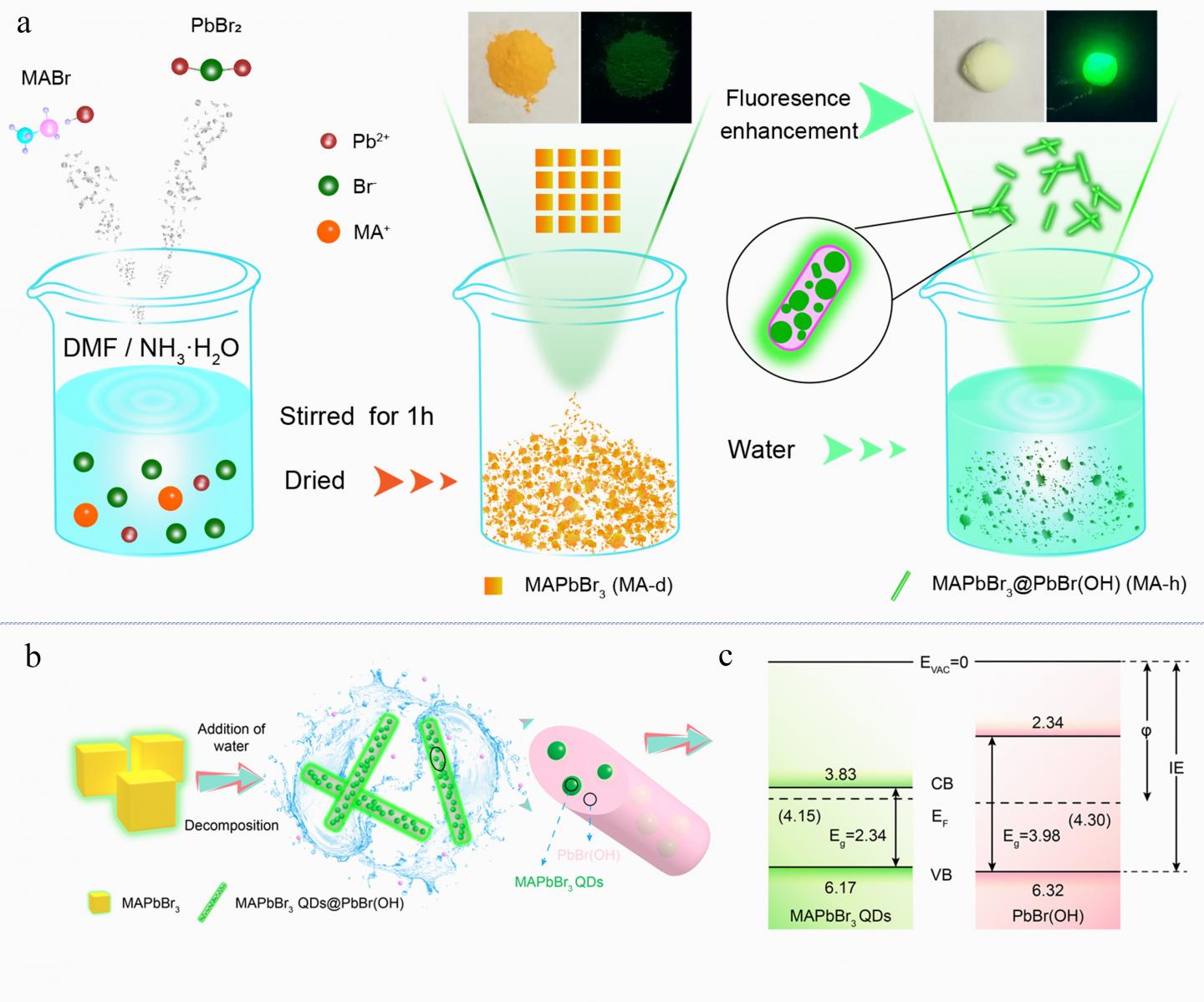
Credit: by Kai-Kai Liu, Qian Liu, Dong-Wen Yang, Ya-Chuan Liang, Lai-Zhi Sui, Jian-Yong Wei, Guo-Wei Xue, Wen-Bo Zhao, Xue-Ying Wu, Lin Dong, Chong-Xin Shan…


In recent years, lead halide perovskites have emerged as promising materials for photovoltaics and light-emitting diodes (LEDs) due to their attractive optical and electrical properties, such as high photoluminescence (PL) quantum yield (QY), narrow emission spectrum, tuneable emission wavelength, high absorption coefficient, and long carrier diffusion length. Profound developments have been witnessed in the fields of solar cells, solid-state light-emitting diodes, photodetectors, and lasers. However, the poor stability of LHPs, especially in water and polar solvents, remains a crucial issue that hampers their applications.

In a new paper published in Light Science & Application, scientists from Zhengzhou University, China, and co-workers developed a new synthetic method that the PL QY of perovskites can be increased from 2.5% to 71.54% by addition a dose of water and decreases minimally in aqueous solution in one year. In addition, the as-synthesized MAPbBr3@PbBr(OH) can maintain their luminescence in many kinds of solvents and also exhibit excellent ambient, thermal and photostabilities. The enhanced stability and PL QY can be attributed to the water-induced MAPbBr3@PbBr(OH). PbBr(OH) passivated the defects of the MAPbBr3 QDs and confined carriers within the QDs so that MAPbBr3@PbBr(OH) could reach high emission efficiency; additionally, PbBr(OH) can prevent the exposure of the QDs to air and moisture, thus increasing the stability.

“The found that PL QY of perovskites can be increased by addition of water is amazing, and the reason for enhanced PL QY and stability can be attributed to the formation of stable and larger bandgap PbBr(OH) on the surface of the lead halide perovskites quantum dots after addition of water. PbBr(OH) passivated the defects of the MAPbBr3 QDs and preventd the exposure of the QDs to air and moisture, thus increasing efficiency and stability” .

“We note that this strategy is universal to methylamino lead halide perovskites (MAPbBr3), formamidine lead halide perovskites (FAPbBr3), inorganic lead halide perovskites (CsPbBr3), etc” they added.

“Since the as-prepared MAPbBr3@PbBr(OH) has high fluorescence efficiency and stability, this will stimulate research interest in the field of laser, LED and so on. This efficient approach for the synthesis of ultrastable and highly efficient luminescent perovskites will push forward their practical applications. ” the scientists forecast.

###

Media Contact
Lin Dong
[email protected]

Related Journal Article

http://dx.doi.org/10.1038/s41377-020-0283-2

Tags: Chemistry/Physics/Materials SciencesOptics
Share12Tweet8Share2ShareShareShare2

Related Posts

Chemists Turn CO2, Nitrite and Aldehydes Into Valuable Amino Acids Using Only Electricity

Chemists Turn CO2, Nitrite and Aldehydes Into Valuable Amino Acids Using Only Electricity

September 24, 2026
Chemists Program Crystal Frameworks Atom by Atom with a Single Versatile Molecule

Chemists Program Crystal Frameworks Atom by Atom with a Single Versatile Molecule

September 24, 2026

Nanoparticle-Coated Fabrics Promise Antibacterial, Self-Cleaning and Conductive Clothing

September 24, 2026

Bismuth Tungstate Wrapped in Conductive Polymer Yields Supercapacitor Electrode That Barely Fades Over 1,000 Cycles

September 24, 2026
Please login to join discussion

POPULAR NEWS

  • Jumping Genes Divide the Animal Kingdom into Sea and Land Clades

    29 shares
    Share 12 Tweet 7
  • Wrist-Worn CO2 Sensor Uses Silicone Layer and Smart Statistics to Deliver Reliable Early Readings

    29 shares
    Share 12 Tweet 7
  • How Organoids Became Biology’s Most Powerful Miniature Laboratories

    29 shares
    Share 12 Tweet 7
  • Glowing Hands and AI: How UV Feedback Helped Schoolchildren Wash Better for Months

    29 shares
    Share 12 Tweet 7

About

We bring you the latest biotechnology news from best research centers and universities around the world. Check our website.

Follow us

Recent News

Jumping Genes Divide the Animal Kingdom into Sea and Land Clades

Wrist-Worn CO2 Sensor Uses Silicone Layer and Smart Statistics to Deliver Reliable Early Readings

How Organoids Became Biology’s Most Powerful Miniature Laboratories

Subscribe to Blog via Email

Enter your email address to subscribe to this blog and receive notifications of new posts by email.

Join 85 other subscribers
  • Contact Us

Bioengineer.org © Copyright 2023 All Rights Reserved.

Welcome Back!

Login to your account below

Forgotten Password?

Retrieve your password

Please enter your username or email address to reset your password.

Log In
No Result
View All Result
  • Homepages
    • Home Page 1
    • Home Page 2
  • News
  • National
  • Business
  • Health
  • Lifestyle
  • Science

Bioengineer.org © Copyright 2023 All Rights Reserved.