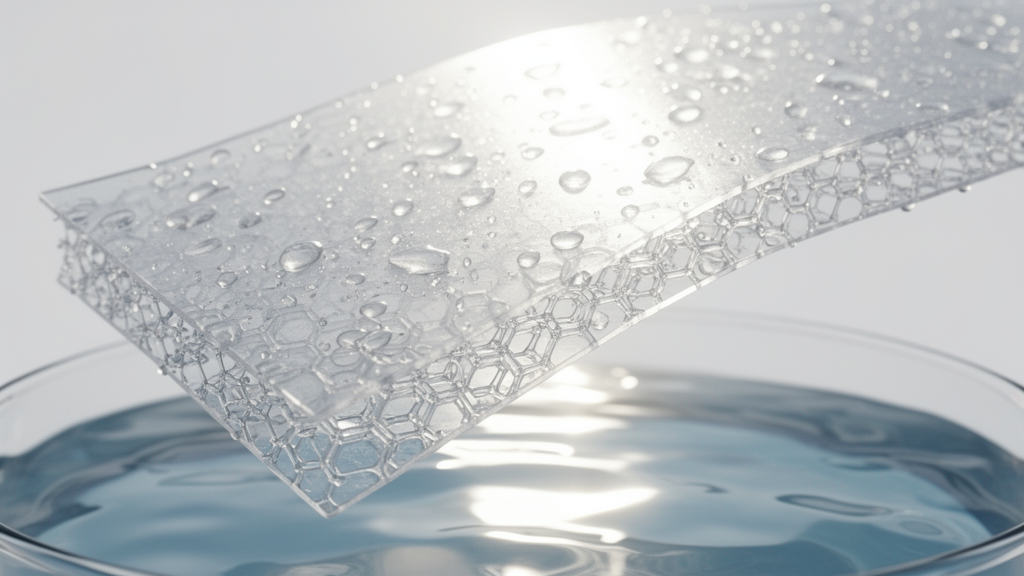
Researchers have developed flexible absorbent composite sheets based on poly(potassium acrylate) for solar-driven desalination. The study, published in Polymer Bulletin, introduces a water-free synthesis technique for poly(potassium acrylate) (PPAK) composites, aiming to address the global demand for sustainable desalination technologies. By eliminating the need for water in the polymerization process, the team sought to reduce energy consumption and material costs while maintaining the mechanical integrity of the resulting hydrogels.
The researchers synthesized the composite sheets using two distinct approaches: conventional water-based solution polymerization and a novel solvent-based water-free solution polymerization technique. Carbon black was incorporated into the sheets to serve as a photothermal light absorber, converting solar energy into heat for evaporation. Additionally, cetyl trimethyl ammonium bromide (CTAB) was added to the composites to function as an antibacterial agent, addressing potential microbial growth in the desalination device.
A key finding of the study is that the solvent-based PPAK sheets exhibit permanent flexibility and stretchability. Unlike conventional hydrogels, which often become brittle or lose mechanical integrity after drying, the water-free synthesized sheets maintained their structural robustness. Comprehensive characterization tests, including swelling, rheological, tensile, and antibacterial assessments, confirmed that these composites retain their functional properties even in a dry state, making them suitable for repeated use in solar evaporation systems.
To evaluate the practical application of these materials, the researchers designed and fabricated a custom 3D-printed desalination device using ABS filament. This device was used to measure the solar evaporation efficiency of the optimized composites under one sun irradiation conditions. The water-based system achieved an evaporation rate of 6.93 kg·m⁻²·h⁻¹, while the solvent-based system achieved a rate of 6.5 kg·m⁻²·h⁻¹.
The solvent-based synthesis method offered significant advantages over the conventional water-based approach. By eliminating the drying stage, the new technique reduced both energy consumption and material costs. Furthermore, the water-free process allowed for a decrease in acrylic acid content by nearly 40%, which contributes to a more environmentally favorable and scalable manufacturing strategy. This reduction in raw material usage aligns with the goal of developing low-cost, sustainable water purification technologies.
Solar-driven interfacial evaporation systems offer a sustainable solution by utilizing renewable solar energy to purify water.
Subject of Research: Flexible poly(potassium acrylate)–carbon black composite sheets synthesized via water-free polymerization for high-efficiency solar-driven desalination using a 3D-printed device
Article Title: Flexible poly(potassium acrylate)–carbon black composite sheets synthesized via water-free polymerization for high-efficiency solar-driven desalination using a 3D-printed device
Article References: Nemati, E., Kabiri, K., Sabzevari, A., & Mehr, M. J. Z. (2027). Flexible poly(potassium acrylate)–carbon black composite sheets synthesized via water-free polymerization for high-efficiency solar-driven desalination using a 3D-printed device. Polymer Bulletin, 84(1), Article 17. https://doi.org/10.1007/s00289-026-06766-y
Image Credits: AI Generated
DOI: 10.1007/s00289-026-06766-y
Keywords: Flexible, poly, potassium, acrylate, carbon, black, composite, sheets, synthesized, water-free, polymerization, high-efficiency
News Source: Neil Sanderson. (November 8, 2026). Water-Free Polymer Sheets Boost Solar Desalination Efficiency. Scienmag.