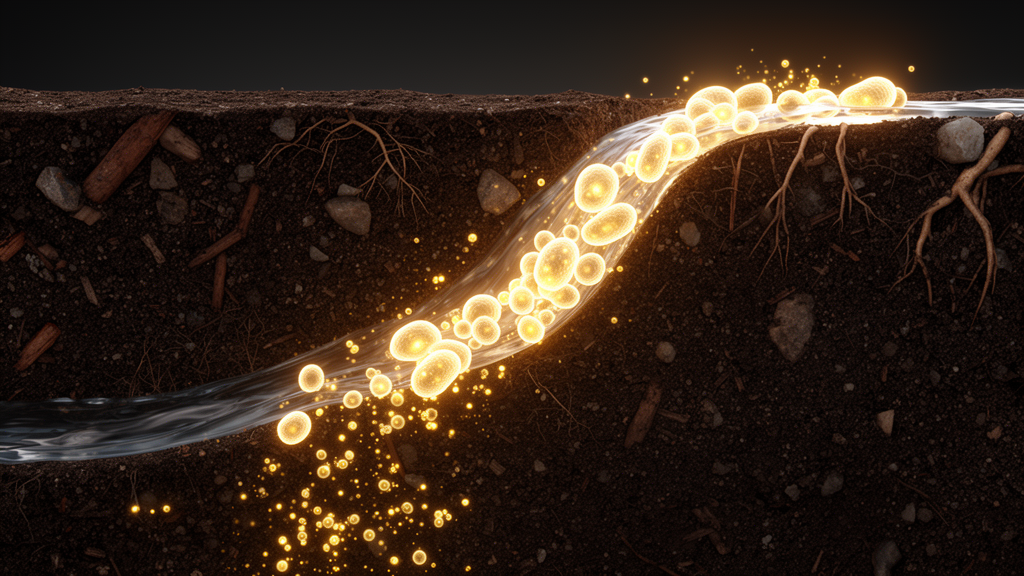
Water erosion does more than wash fertile topsoil off sloping farmland. According to a new study of China's black soils, it also reprograms the microbial communities left behind, pushing them to decompose the organic carbon that remains far more aggressively than microbes at depositional lower slope sites. The research, published in Carbon Research, found that soil organic carbon degradation rates were 41% to 48% higher at erosion-prone upper slope positions than at depositional lower slopes, and that this acceleration was concentrated in the top 40 centimeters of the soil profile.
The study was led by Yulong Shi and colleagues, working at Hongxing Farm in Bei’an City, Heilongjiang Province, in northeastern China. The region has a temperate monsoon climate with mean annual precipitation of about 555 millimeters, most of it falling between July and September.
In September 2022, the team sampled a 5-degree sloping cropland under a maize-soybean rotation. They used cesium-137 measurements to identify a relative erosion site on the upper slope, with a cesium-137 inventory of 654 becquerels per square meter, and a relative deposition site on the lower slope, with 1143 becquerels per square meter. Six randomly located sampling points were established at each position, spaced roughly 20 to 30 meters apart, with about 100 meters between the two slope transects. Using impact-vibration drilling rigs, the researchers collected soil at four depth intervals: 0 to 20, 20 to 40, 40 to 60, and 60 to 100 centimeters, yielding 48 samples in total.
The physical picture that emerged was one of selective removal. Water erosion preferentially strips fine, colloidal particles that are especially rich in organic matter. Compared with the lower slope, the upper slope had lost 30% to 59% of its 2 to 10 micrometer colloidal organic carbon, 30% to 57% of its 1 to 2 micrometer fraction, and 27% to 49% of its 0.45 to 1 micrometer fraction across the profile; within the 0 to 40 centimeter layer the corresponding losses were 30% to 39%, 30% to 48%, and 27% to 41%. Total soil organic carbon, dissolved organic carbon, and microbial biomass carbon were all consistently higher at the depositional lower slope, by 16% to 59%, 7% to 23%, and 23% to 40%, respectively.
Those losses appear to have starved the upslope microbes. Enzyme vector analysis, in which a longer vector length signals stronger relative microbial carbon limitation, showed vector lengths exceeding one in the 0 to 60 centimeter layers, with the largest values at the upper slope, particularly in the top 40 centimeters. No significant differences in vector angle appeared between slope positions, suggesting the limitation was specifically for carbon rather than nitrogen or phosphorus. When the researchers normalized enzyme activities per unit of soil organic carbon, the picture sharpened: specific beta-1,4-glucosidase activity was 21% to 32% higher at the upper slope, NAG and LAP activities were 8.2% to 26% higher, and acid phosphatase activity was 13% to 25% higher.
The microbial community itself had shifted. In the 0 to 20 centimeter layer, only the genus Streptomyces was enriched at the upper slope, while eight genera, including Azospirillum, Pseudomonas, Staphylococcus, and Vibrio, were more abundant at the carbon-richer lower slope. Streptomyces correlated positively with the soil organic carbon decomposition rate, whereas several lower-slope genera correlated negatively. In the 20 to 40 centimeter layer, Streptomyces and several other genera were again enriched upslope. The authors suggest that severe carbon stress allowed a few taxa with efficient nutrient-acquisition strategies to dominate, and that Streptomyces in particular can exploit relatively complex organic substrates under carbon-limited conditions.
Functional gene analysis reinforced this interpretation. Using Quantitative Microbial Element Cycling, the team quantified 36 carbon-cycling genes. In the 0 to 20 centimeter layer, genes involved in organic carbon decomposition, including cdh, abfA, manB, glx, mnp, and pgu, were significantly more abundant at the upper slope, matching its higher cumulative carbon dioxide production. In the 20 to 40 centimeter layer, naglu, chiA, abfA, and glx were positively correlated with cumulative carbon dioxide production and more abundant upslope. Below 60 centimeters, no significant differences in carbon decomposition genes were observed. The gene glx, associated with lignin decomposition, was directly linked to decomposition in the analysis, and the 2 to 10 micrometer colloidal fraction was enriched in plant-derived compounds such as lignin and cellulose.
The decomposition measurements came from a laboratory microcosm incubation, in which 15 grams of air-dried soil were incubated in the dark at 25 degrees Celsius for 27 days after a three-day pre-incubation, with headspace carbon dioxide measured by gas chromatograph. In the topsoil layers, the decomposition rate ranged from 141 to 681 milligrams of carbon dioxide per kilogram of soil over the incubation, and declined exponentially with depth. The authors caution that this is a laboratory measurement under controlled conditions, though soil water content was adjusted to levels recorded at the time of field sampling.
A partial least squares path model tied the pieces together. Water erosion, represented by slope position and soil erodibility, mainly triggered microbial carbon limitation by altering the spatial distribution of soil organic carbon across the slope. That limitation reshaped the microbial community and changed the abundance of carbon-related functional genes, which in turn regulated decomposition. Slope position, microbial carbon limitation, extracellular enzyme activity, and carbon-functional genes all had positive standardized effects on decomposition in the topsoil, while the colloidal carbon fractions and microbial community structure had negative effects. Lasso regression identified slope position and soil erodibility as key factors, with the 2 to 10 micrometer colloidal organic carbon fraction and beta-glucosidase activity strongly influencing variation in decomposition rates.
The deeper layers told a different story. Below 40 centimeters, the influence of erosion weakened progressively, microbial biomass did not differ between slope positions, and community shifts lost their correlation with decomposition. The authors attribute this to limited physical disturbance at depth, where organic carbon remains protected within mineral-organic complexes and aggregates, and to the adaptability of deep-soil microbes to long-term nutrient-poor conditions. The broader significance is considerable: the study notes that in northeastern China, carbon dioxide emissions from erosion-induced decomposition of soil organic carbon exceed 0.2 megatonnes of carbon per year, accounting for over 10% of the national total from this source. The findings challenge the view that erosion-induced carbon loss occurs mainly through physical displacement, and the authors argue that erosion control, particularly protecting upper-slope positions and the 0 to 40 centimeter layer, is essential for sustaining soil carbon storage and agricultural productivity.
Subject of Research: Microbial adaptation to water erosion stress and its effects on soil organic carbon decomposition in sloping cropland
Article Title: Microbial adaptation to water erosion stress accelerated organic carbon decomposition
Article References: Shi, Y., Li, T., Hao, W., Gao, Y., Li, M., Liu, Y., Wang, D., Wei, X., Zhang, Q., & Ros, G. H. (2026). Microbial adaptation to water erosion stress accelerated organic carbon decomposition. Carbon Research, 5(1), Article 53. https://doi.org/10.1007/s44246-026-00293-1
Image Credits: AI Generated
DOI: 10.1007/s44246-026-00293-1
Keywords: soil organic carbon, water erosion, soil microbiome, Streptomyces, carbon decomposition, black soils, extracellular enzymes, carbon-functional genes, colloidal organic carbon, northeastern China, slope positions, carbon dioxide emissions
News Source: Morgan Morrow. (October 29, 2026). Water erosion primes soil microbes to break down carbon faster. Scienmag.