• HOME
  • NEWS
  • EXPLORE
    • CAREER
      • Companies
      • Jobs
    • EVENTS
    • iGEM
      • News
      • Team
    • PHOTOS
    • VIDEO
    • WIKI
  • BLOG
  • COMMUNITY
    • FACEBOOK
    • INSTAGRAM
    • TWITTER
Sunday, June 28, 2026
BIOENGINEER.ORG
No Result
View All Result
  • Login
  • HOME
  • NEWS
  • EXPLORE
    • CAREER
      • Companies
      • Jobs
        • Lecturer
        • PhD Studentship
        • Postdoc
        • Research Assistant
    • EVENTS
    • iGEM
      • News
      • Team
    • PHOTOS
    • VIDEO
    • WIKI
  • BLOG
  • COMMUNITY
    • FACEBOOK
    • INSTAGRAM
    • TWITTER
  • HOME
  • NEWS
  • EXPLORE
    • CAREER
      • Companies
      • Jobs
        • Lecturer
        • PhD Studentship
        • Postdoc
        • Research Assistant
    • EVENTS
    • iGEM
      • News
      • Team
    • PHOTOS
    • VIDEO
    • WIKI
  • BLOG
  • COMMUNITY
    • FACEBOOK
    • INSTAGRAM
    • TWITTER
No Result
View All Result
Bioengineer.org
No Result
View All Result
Home NEWS Science News Chemistry

Water as a nonlinear medium for ultrabroadband white laser

Bioengineer by Bioengineer
January 16, 2024
in Chemistry
Reading Time: 2 mins read
0
An intense white-light laser casts a brilliant rainbow, as demonstrated by a photo from the experiments conducted by L. Hong’s team at South China University of Technology.
Share on FacebookShare on TwitterShare on LinkedinShare on RedditShare on Telegram

Scientists are making significant strides in the development of ultrabroadband white laser sources, covering a wide spectrum from ultraviolet to far infrared. These lasers find applications in diverse fields such as large-scale imaging, femto-chemistry, telecommunications, laser spectroscopy, sensing, and ultrafast sciences.
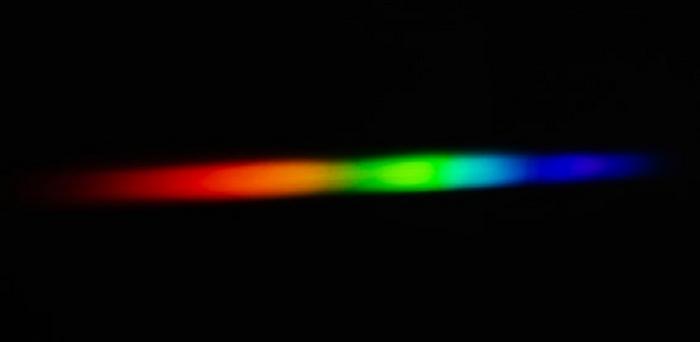
An intense white-light laser casts a brilliant rainbow, as demonstrated by a photo from the experiments conducted by L. Hong’s team at South China University of Technology.

Credit: L. Hong et al., South China University of Technology.

Scientists are making significant strides in the development of ultrabroadband white laser sources, covering a wide spectrum from ultraviolet to far infrared. These lasers find applications in diverse fields such as large-scale imaging, femto-chemistry, telecommunications, laser spectroscopy, sensing, and ultrafast sciences.

However, the pursuit faces challenges, particularly in the selection of appropriate nonlinear mediums. Traditional solid materials, while efficient, are prone to optical damage under high peak power conditions. Gas mediums, though damage-resistant, commonly suffer from low efficiency and technical complications.

In an unconventional move, researchers from South China University of Technology recently turned to water as a nonlinear medium. Abundant and inexpensive, water proves immune to optical damage, even under the influence of high-power lasers. As reported in the Gold Open Access journal Advanced Photonics Nexus, water-induced spectral broadening involves enhanced self-phase modulation and stimulated Raman scattering, resulting in a supercontinuum white laser with a 435 nm 10 dB bandwidth covering an impressive 478–913 nm range.

Taking innovation further, researchers combined water with a chirped periodic-poled lithium niobate (CPPLN) crystal, known for its robust second-order nonlinear power. This partnership not only expanded the supercontinuum white laser’s frequency range but also flattened its output spectrum. According to the corresponding senior author Prof. Zhi-Yuan Li, “The cascaded water–CPPLN module provides a long-lived, high-stability, and low-cost technical route for realizing a ‘three-high’ white laser with intense pulse energy, high spectral flatness, and ultrabroad bandwidth.”

The output from this water-CPPLN collaboration is promising. With a pulse energy of 0.6 mJ and a 10 dB bandwidth spanning more than an octave (413–907 nm), this ultrabroadband supercontinuum source has potential in ultrafast spectroscopy and hyperspectral imaging. Li observes, “It offers high resolution across physical, chemical, and biological processes over extreme spectral bandwidths with a high signal-to-noise ratio. It opens an efficient route to creating a long-lived, high-stability, and inexpensive white laser with intense pulse energy, high spectral flatness, and ultrabroad bandwidth, paving a way for new possibilities in scientific research and applications.”

For details, read the original article by L. Hong et al., “Intense white laser of high spectral flatness via optical-damage-free water–lithium niobate module,” Adv. Photon. Nexus 3(1) 016008 (2024), doi 10.1117/1.APN.3.1.016008.


Journal

Advanced Photonics Nexus

DOI

10.1117/1.APN.3.1.016008

Article Title

Intense white laser of high spectral flatness via optical-damage-free water–lithium niobate module

Article Publication Date

12-Jan-2024

Share12Tweet8Share2ShareShareShare2

Related Posts

AI and Physics Collaborate to Design Advanced Hydrogen Storage Materials

June 25, 2026

International Team Including Dresden Scientists Develops Novel Designer Proteins for Advanced Study of Living Tissue

June 25, 2026

New Study Uncovers Key Factors Driving Water Chemistry in Nanoscale Environments

June 25, 2026

Plasma Technology Extends Catalyst Lifespan in Hydrogen Production

June 24, 2026

POPULAR NEWS

  • Saying Goodbye to PGY-6: Pediatric Fellowship Realities

    103 shares
    Share 41 Tweet 26
  • Multi-Hospital Study Reveals Long Covid Burden Is Twice as High as Current Estimates

    92 shares
    Share 36 Tweet 23
  • Detection of EDCs in Breast Milk and Infant Urine Up to Six Months Highlights Early Exposure Risks

    77 shares
    Share 31 Tweet 19
  • New Drug Candidate Developed at McMaster Shows Potential for Treating Brain Cancer

    58 shares
    Share 23 Tweet 15

About

We bring you the latest biotechnology news from best research centers and universities around the world. Check our website.

Follow us

Recent News

Tracking Lanthanide-Labeled Microplastics in Plants

POSTECH Researchers Slash Cost of Reconstituted Cell-Free Systems by 95%

AI and Physics Collaborate to Design Advanced Hydrogen Storage Materials

Subscribe to Blog via Email

Success! An email was just sent to confirm your subscription. Please find the email now and click 'Confirm' to start subscribing.

Join 82 other subscribers
  • Contact Us

Bioengineer.org © Copyright 2023 All Rights Reserved.

Welcome Back!

Login to your account below

Forgotten Password?

Retrieve your password

Please enter your username or email address to reset your password.

Log In
No Result
View All Result
  • Homepages
    • Home Page 1
    • Home Page 2
  • News
  • National
  • Business
  • Health
  • Lifestyle
  • Science

Bioengineer.org © Copyright 2023 All Rights Reserved.