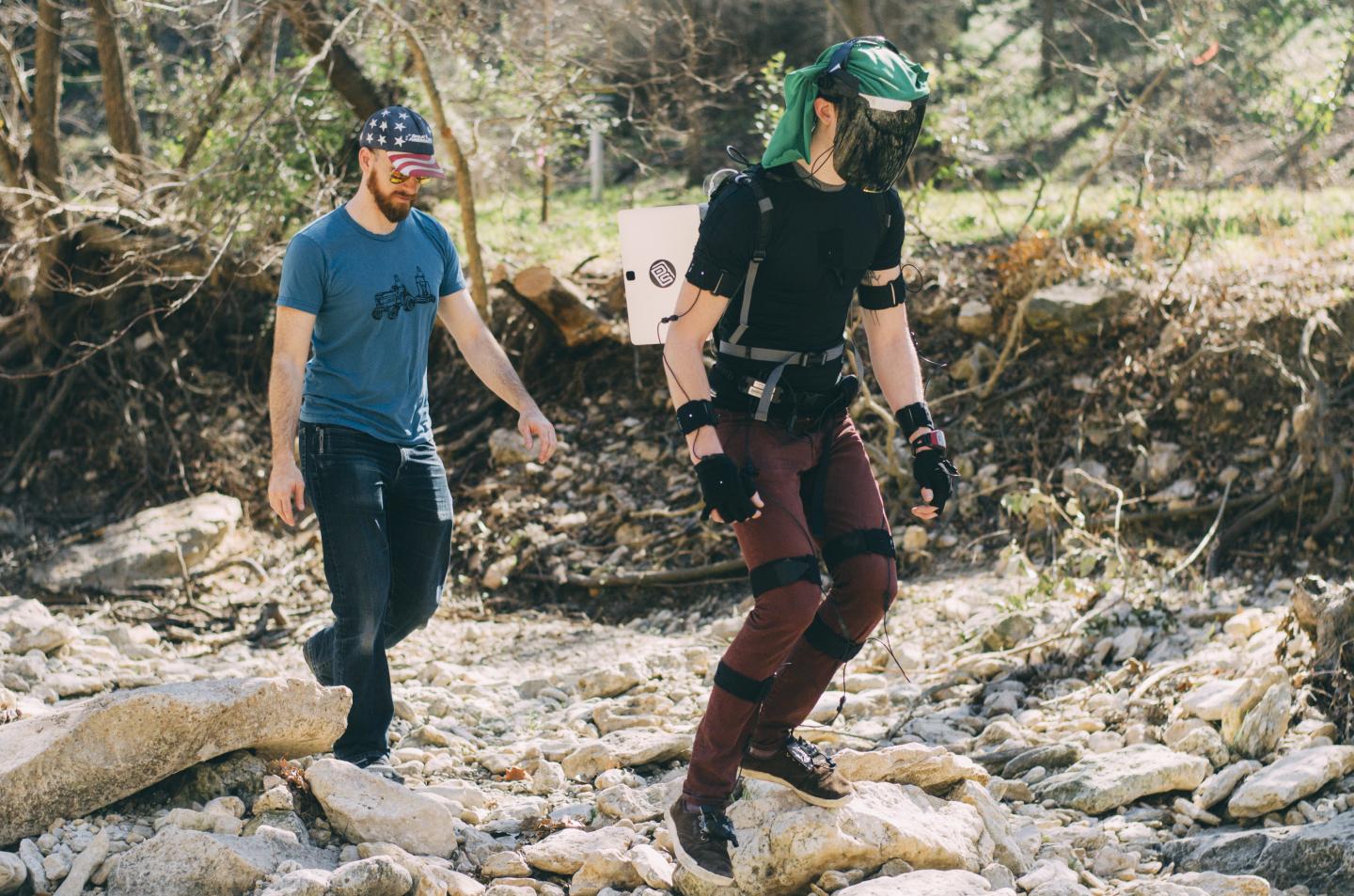
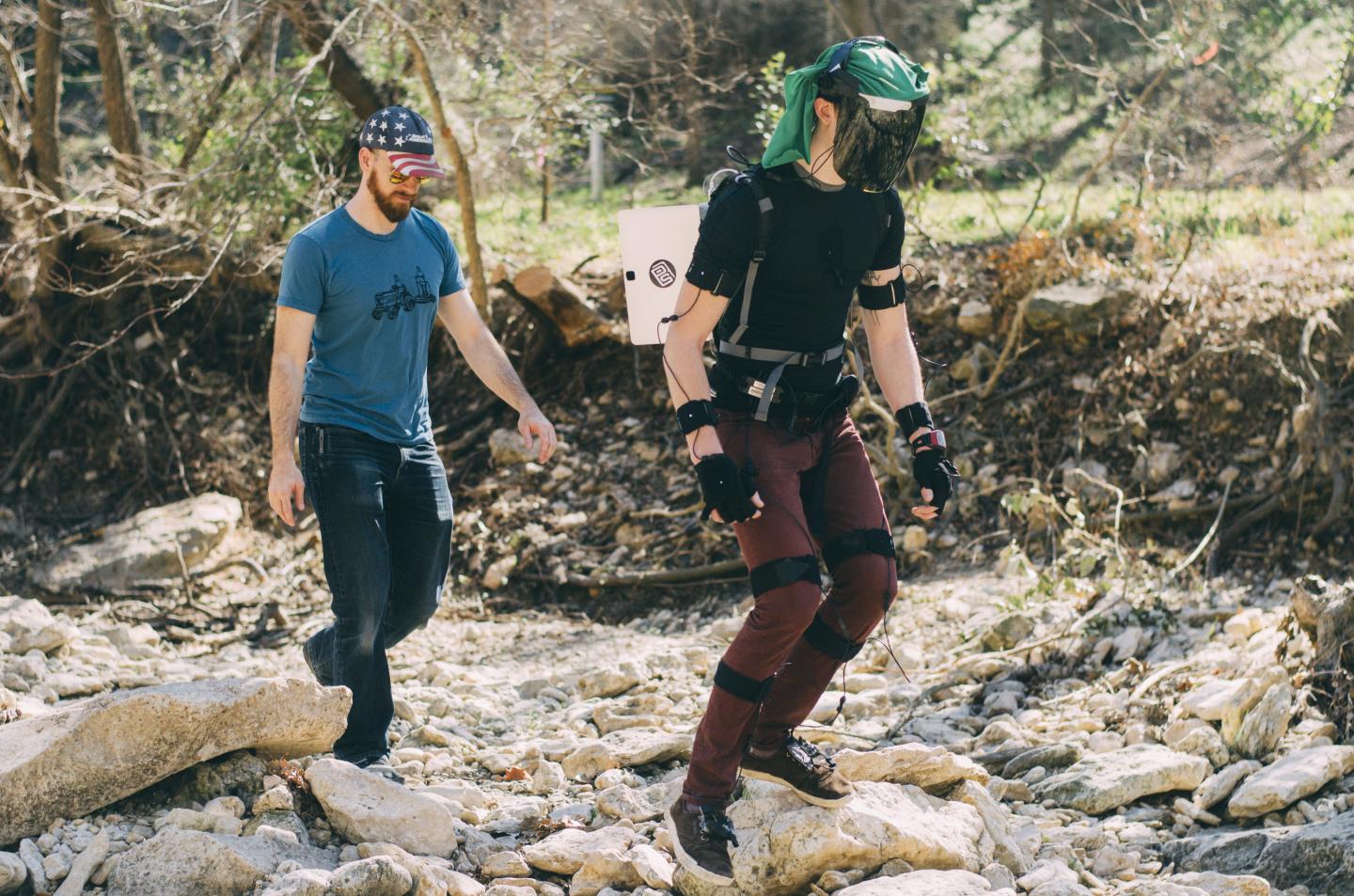
Credit: Photo by Michelle Chiou
Using new technologies to track how vision guides foot placement, researchers at The University of Texas at Austin come one step closer in determining what is going on in the brain while we walk, paving the way for better treatment for mobility impairments — strokes, aging and Parkinson's — and technology development — prosthetics and robots.
Walking on natural terrain takes precise coordination between vision and body movements to efficiently and stably traverse any given path. But until now, both vision and locomotion have been studied separately within controlled lab environments, limiting understanding of how various neural and biological systems work together to navigate the natural world.
"One of the beautiful things about visually guided walking is that it involves every level of our perceptuomotor hierarchy. To really understand it, you need to know how vision works, how planning works, how muscles work, how spines work, how physics work," said Jonathan Matthis, a postdoctoral researcher in the UT Austin Center for Perceptual Systems.
Matthis' research, published in Cell this April, combined new motion-capture and eye-tracking technologies to track distinct patterns between the two mechanisms. To do so, researchers jerry-rigged a welding mask around an eye tracker — to shade the infrared eye cameras from sunlight — and developed new methods to calibrate the eye tracker with a motion-tracking suit to record gaze and full-body kinematics as participants navigated through three types of terrain: flat, medium and rough terrain.
"Eye movements are incredibly informative as a window into the cognitive process," Matthis said. "By tracking eyes, we get a clear picture of the kind of information the central nervous system needs to complete any given task."
Researchers found that participants displayed distinct walking and gaze patterns in each of the terrains. Subjects walked quickly with longer strides on the flat terrain, looking down only about half of the time to briefly scan the upcoming path for obstacles.
On the medium and rough terrain, steps became shorter, slower and more variable, with participants looking at the ground more than 90 percent of the time to precisely fixate upcoming footholds. In the medium terrain, walkers focused primarily on where their foot would be in two steps. The rough terrain required walkers to split their gaze between their future foot placement in two and three steps to allow for longer-term path planning.
Despite these differences, an unexpected pattern emerged: In all three terrains, participants consistently looked 1.5 seconds ahead of their current location. This finding is similar to lookahead timing seen in research on other motor actions — stair climbing, driving and reaching — suggesting that this timing plays an important role in human movement.
"The constant lookahead time suggests that walkers are maintaining some sort of global locomotor strategy that is being tuned to each specific environment," Matthis said. "Walkers use gaze to ensure that they always know what will be coming up 1.5 seconds down the path.
"Good action decisions require not only good sensory data, but also a consideration of the costs and benefits of the action," Matthis said. "Taking this type of research out of the lab and into the real world allows us to observe human behavior in its natural environment. This gives us more opportunity to discover things we didn't expect, which will help us advance our scientific knowledge to the benefit of improving clinical treatment of gait-related disorders."
###
Media Contact
Rachel Griess
[email protected]
512-471-2689
@UTAustin
http://www.utexas.edu
Original Source
https://liberalarts.utexas.edu/public-affairs/news/12778