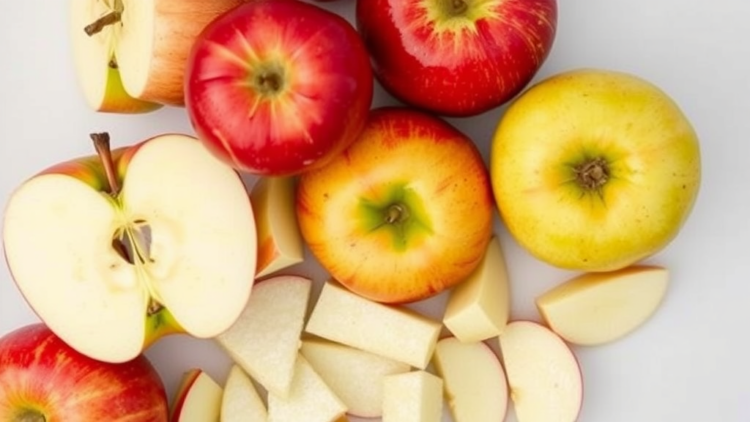
Every year, a substantial share of the apples grown across Europe never reaches a consumer. The European Union harvested roughly 11.5 million tons of apples in 2023, yet estimates suggest that more than 20 percent is lost during primary production, with further losses accumulating through processing, distribution, and consumption. Once apples become unsuitable for food or feed because of rot, mechanical damage, or infestation, they are typically discarded, ending their journey as low-value organic waste. A new study published in Biotechnology for Biofuels and Bioproducts argues that this stream of spoiled fruit could instead become the raw material for two of the most versatile building blocks in industrial chemistry: lactic acid and succinic acid. The research team, led by Laís Portugal Rios da Costa Pereira of the University of Kassel and the Leibniz Institute for Agricultural Engineering and Bioeconomy (ATB) in Potsdam, has demonstrated for the first time that waste apples can drive these fermentations not just in the laboratory, but at pilot scale.
The appeal of waste apples as a fermentation feedstock lies in their biochemical makeup. Spoiled Jonagold apples supplied by Werder Frucht GmbH and prepared at ATB were pressed into a sugar-rich mash containing about 71.6 grams per liter of fructose, 21.5 grams per liter of glucose, and 7.5 grams per liter of sucrose, along with a high moisture content of 88.9 percent. Unlike apple pomace, the fibrous solid residue left after juice extraction that has dominated previous research, the mash retains readily fermentable simple sugars and requires minimal pretreatment. The solid fraction, composed mainly of peel and seeds, was excluded from the study. This compositional simplicity matters because lignocellulosic residues typically demand energy-intensive pretreatment to release their sugars and often generate inhibitory by-products that slow microbial growth.
Before fermentation could begin, the researchers needed to prepare the mash as a workable medium. They tested several commercial enzyme preparations, including Pectinase L40, Cellic CTec3 HS, Dextrozyme GA, and Viscoferm, at the mash’s natural pH of 4.5 and a temperature of 50 degrees Celsius. Surprisingly, none of the enzymes significantly increased the total reducing sugar content compared with an untreated control, a result the team attributes to the absence of starch in ripe apples and the low levels of cellulose and hemicellulose in the dry matter. However, Cellic CTec3 HS produced a marked reduction in viscosity, which is critical for fermentation because thick media impede mass transfer, create gradients of pH, temperature, and nutrients, and complicate downstream separation. The researchers ultimately selected a low-dose combination of Pectinase L40 and Cellic CTec3 HS, each at 0.5 milliliters of enzyme per kilogram of biomass, to liquefy the mash for subsequent microbial screening.
With a liquefied substrate in hand, the team screened microbial candidates for both target products. For lactic acid, five strains of Heyndrickxia coagulans, formerly known as Bacillus coagulans, were drawn from ATB’s internal collection of 700 isolates. Optical density measurements in apple mash medium, with and without yeast extract supplementation, identified strains A35, A138, and A203 as the strongest performers. For succinic acid, the researchers compared Actinobacillus succinogenes DSM 22257 against several strains of Basfia succiniproducens, confirming earlier reports that A. succinogenes converts both pentose and hexose sugars to succinic acid with superior yields. Subsequent bioreactor screening at 0.25 liters showed that all three H. coagulans strains produced lactic acid at similar concentrations, between 71.8 and 75.5 grams per liter, with yields of 0.91 to 0.94 grams per gram of sugar consumed. Strain A203, however, achieved the highest productivity at 3.5 grams per liter per hour and showed no lag phase, making it the clear choice for scale-up.
Nutrient availability emerged as a decisive factor in both fermentations. When yeast extract was omitted, lactic acid production by H. coagulans A203 collapsed to 32.3 grams per liter after 49 hours, with productivity falling to 0.7 grams per liter per hour. The effect was even more dramatic for A. succinogenes, whose succinic acid output dropped from 35.6 to 6.7 grams per liter without supplementation. These results indicate that apple mash, despite its abundant sugars, lacks sufficient nitrogen and growth factors to sustain industrial fermentation performance. The authors note that replacing yeast extract with cheaper agro-industrial nitrogen sources, such as wine lees or tomato pomace, represents a promising avenue for reducing production costs, since nutrient supply is one of the main economic burdens in biobased organic acid manufacturing.
The central innovation of the study lies in what the researchers removed from the process rather than what they added. Conventional bioprocesses typically separate the enzymatic hydrolysis and fermentation stages with centrifugation to remove solids and sterilization, usually at 121 degrees Celsius under pressure, to eliminate contaminants. Each of these steps adds capital cost, energy demand, and processing time. Instead, the team performed enzymatic liquefaction and fermentation sequentially in the same vessel. For lactic acid, no sterilization was needed at all because H. coagulans A203 is thermophilic, growing optimally at 50 degrees Celsius, a temperature that suppresses most contaminating microbes and shortens the fermentation window. For succinic acid, where A. succinogenes prefers a mesophilic 37 degrees Celsius, the researchers inserted a simplified thermal inactivation step, heating the mash to 80 to 85 degrees Celsius for 15 minutes, which denatures the proteins and disrupts the membranes of most spoilage organisms without the energy burden of full autoclaving.
After validating this simplified procedure at 1-liter laboratory scale, where it matched the performance of the conventional approach with no significant differences in concentration, yield, or productivity, the team moved to pilot scale. Lactic acid fermentation was carried out in a 30-liter working volume using 30 kilograms of apple mash in a Biostat UD bioreactor. The process delivered 73.8 grams per liter of lactic acid with a yield of 0.91 grams per gram of sugar consumed and a productivity of 2.7 grams per liter per hour. Remarkably, the final product exhibited an optical purity of 99.7 percent L-lactic acid, a strong indicator that contamination never took hold, since contaminating bacteria typically produce a mixture of L- and D-isomers. The overall product yield reached 0.78 grams of lactic acid per gram of apple mash on a dry basis, and the bacteria also consumed the malic acid naturally present in the fruit.
The succinic acid pilot run, conducted with 20 kilograms of apple mash in a 25-liter working volume, produced 36.8 grams per liter of succinic acid with a yield of 0.69 grams per gram and a productivity of 1.0 gram per liter per hour, alongside acetic and formic acids as natural by-products of A. succinogenes metabolism. Notably, the strain fixed carbon dioxide during succinate formation, an inherent environmental advantage of the process. These figures compare favorably with previous pilot-scale succinic acid fermentations using other food wastes: oat pomace with acid whey yielded only 19.6 grams per liter at 0.27 grams per liter per hour, while industrial candy waste reached 38.99 grams per liter. The lactic acid results similarly outperformed earlier work on apple pomace hydrolysate, which achieved just 40.72 grams per liter at a productivity of 0.58 grams per liter per hour, and mixed food waste, which produced 68.5 grams per liter at a yield of only 0.38 grams per gram of total solids.
Beyond the headline numbers, the study carries significant implications for how biorefineries handle agri-food waste. Retaining solids in the reactor eliminates an intermediate solid-liquid separation step, meaning only a single separation is needed after fermentation, when microbial biomass must be removed regardless of process configuration. Avoiding intermediate autoclaving also prevents heat-induced degradation of sugars and proteins, limiting the formation of unwanted by-products that complicate downstream purification, which is widely regarded as the economic bottleneck of large-scale bioproduction. Economically, waste apples serve as a zero- or low-cost feedstock that displaces commercial sugars and sidesteps the expensive pretreatment required for lignocellulosic biomass. Environmentally, the simplified process reduces energy consumption and carbon dioxide emissions, the high moisture content of the mash minimizes water input, and diverting spoiled fruit from landfill avoids methane generation.
The authors frame their work as a template for integrating agri-food residues into a circular bioeconomy, in line with the European Union’s Bioeconomy Strategy and Waste Framework Directive. They point toward future advances in intelligent biorefineries that use artificial intelligence and machine learning to adapt fermentation conditions to feedstock variability, as well as genetically engineered microbial strains designed to boost fermentation rates and product diversity. For now, the demonstration that a pilot-scale bioreactor can convert 30 kilograms of rotten apples into nearly 74 grams per liter of high-purity lactic acid marks a tangible step toward turning one of agriculture’s most familiar waste streams into a dependable industrial resource.
Subject of Research: Pilot-scale biotechnological production of lactic and succinic acids from waste apples
Article Title: Upcycling waste apples into platform chemicals: pilot-scale production of lactic and succinic acids
Article References: Portugal Rios da Costa Pereira, L., Schneider, R., Olszewska-Widdrat, A., Sturm, B., & Kaetzl, K. (2026). Upcycling waste apples into platform chemicals: pilot-scale production of lactic and succinic acids. Biotechnology for Biofuels and Bioproducts, 19(1), Article 67. https://doi.org/10.1186/s13068-026-02807-w
Image Credits: AI Generated
DOI: 10.1186/s13068-026-02807-w
Keywords: waste apples, lactic acid, succinic acid, fermentation, pilot scale, biorefinery, circular bioeconomy, Heyndrickxia coagulans, Actinobacillus succinogenes, agri-food waste, platform chemicals, bioplastics
Cite Scienmag News
APA MLA Chicago
Drew Townsend. (September 12, 2026). Waste Apples Turned Into Lactic and Succinic Acids at Pilot Scale. Scienmag. https://scienmag.com/waste-apples-turned-into-lactic-and-succinic-acids-at-pilot-scale/
Drew Townsend. “Waste Apples Turned Into Lactic and Succinic Acids at Pilot Scale.” Scienmag, 12 September 2026, https://scienmag.com/waste-apples-turned-into-lactic-and-succinic-acids-at-pilot-scale/. Accessed 12 September 2026.
Drew Townsend. “Waste Apples Turned Into Lactic and Succinic Acids at Pilot Scale.” Scienmag. September 12, 2026. https://scienmag.com/waste-apples-turned-into-lactic-and-succinic-acids-at-pilot-scale/
Copy citation Download RIS
Tags: Actinobacillus succinogenesagri-food wasteapple waste valorizationbiobased chemicals from food industry wastebioplasticsbioprocessing of agricultural residuesbiorefinerybiotechnological utilization of apple byproductscircular bioeconomyconversion of spoiled apples into lactic and succinic acidsEuropean apple waste managementfermentationfermentation technology for organic acid synthesisHeyndrickxia coagulansindustrial production of organic acids from fruit wastelactic acidpilot scalepilot scale biorefinery processesplatform chemicalsrenewable raw materials for bioplasticssuccinic acidsustainable bioproducts from fruit wastewaste apple fermentationwaste apples