• HOME
  • NEWS
  • EXPLORE
    • CAREER
      • Companies
      • Jobs
    • EVENTS
    • iGEM
      • News
      • Team
    • PHOTOS
    • VIDEO
    • WIKI
  • BLOG
  • COMMUNITY
    • FACEBOOK
    • INSTAGRAM
    • TWITTER
Tuesday, June 9, 2026
BIOENGINEER.ORG
No Result
View All Result
  • Login
  • HOME
  • NEWS
  • EXPLORE
    • CAREER
      • Companies
      • Jobs
        • Lecturer
        • PhD Studentship
        • Postdoc
        • Research Assistant
    • EVENTS
    • iGEM
      • News
      • Team
    • PHOTOS
    • VIDEO
    • WIKI
  • BLOG
  • COMMUNITY
    • FACEBOOK
    • INSTAGRAM
    • TWITTER
  • HOME
  • NEWS
  • EXPLORE
    • CAREER
      • Companies
      • Jobs
        • Lecturer
        • PhD Studentship
        • Postdoc
        • Research Assistant
    • EVENTS
    • iGEM
      • News
      • Team
    • PHOTOS
    • VIDEO
    • WIKI
  • BLOG
  • COMMUNITY
    • FACEBOOK
    • INSTAGRAM
    • TWITTER
No Result
View All Result
Bioengineer.org
No Result
View All Result
Home NEWS Science News

Warming up to cryopreservation

Bioengineer by Bioengineer
March 1, 2017
in Science News
Reading Time: 2 mins read
0
Share on FacebookShare on TwitterShare on LinkedinShare on RedditShare on Telegram
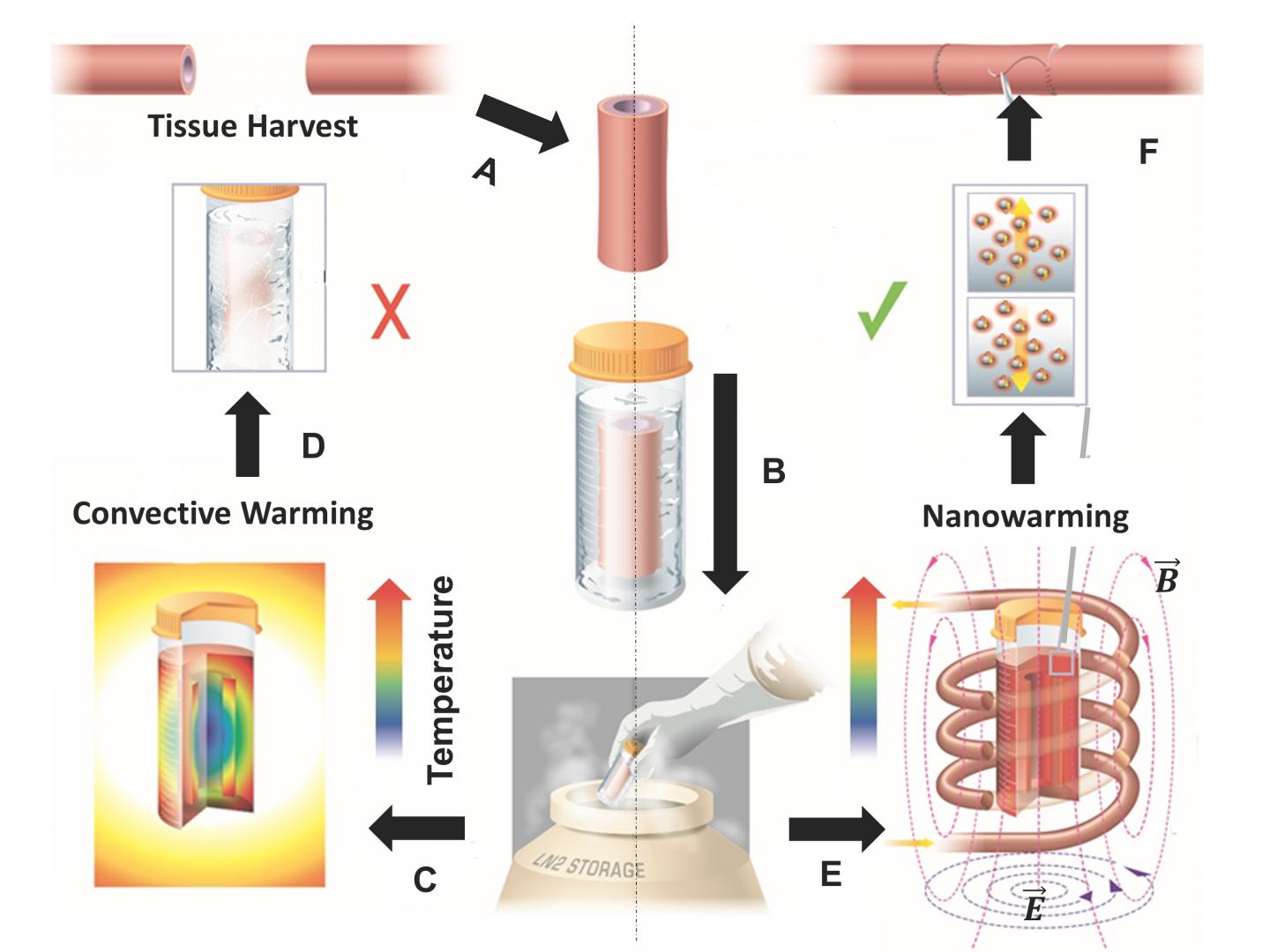
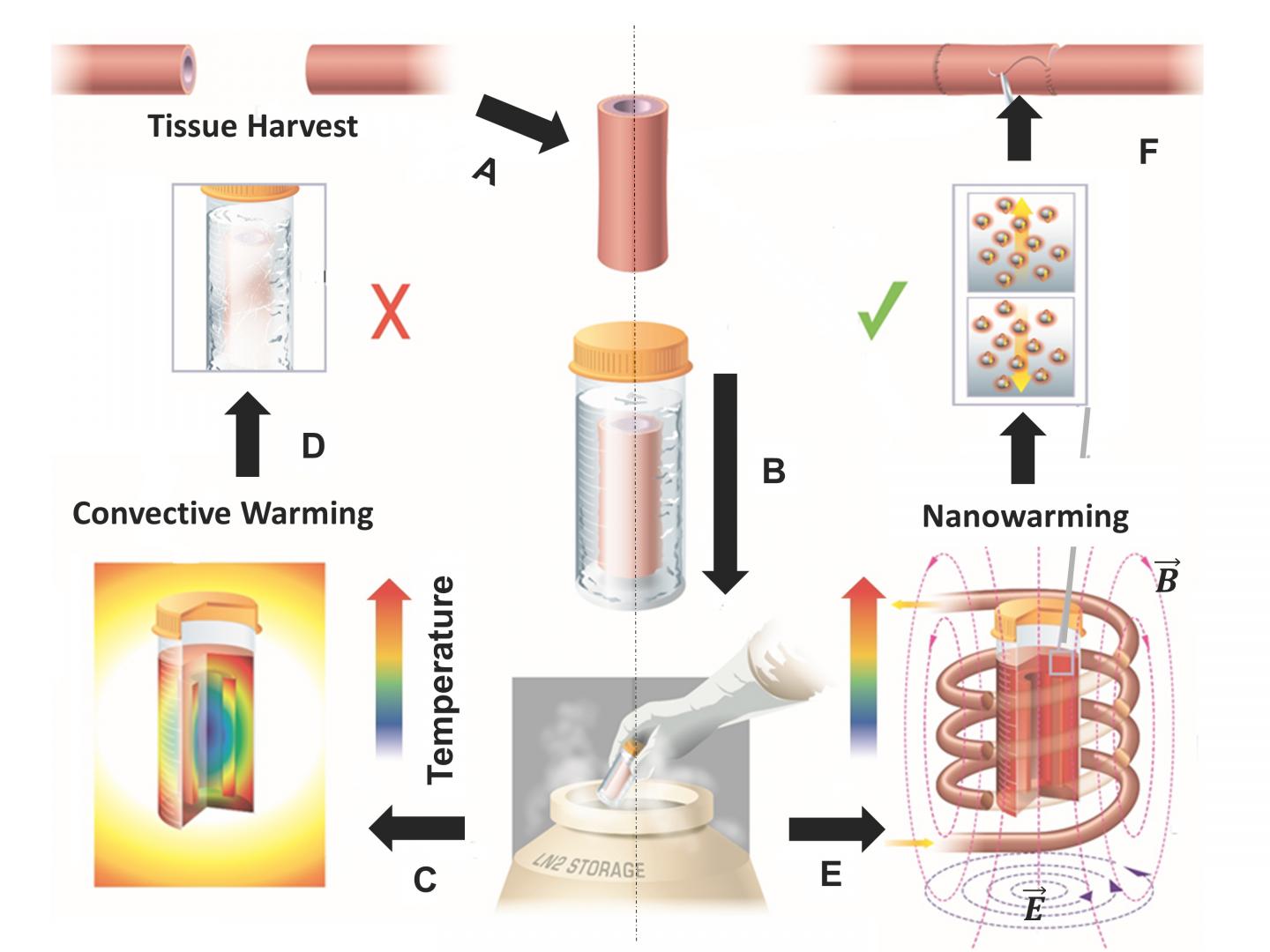
IMAGE

Credit: Manuchehrabadi et al., Science Translational Medicine (2017)

Overcoming a major hurdle in transplant medicine, a new study reveals that nanotechnology can be used to rapidly rewarm cryogenically treated samples without damaging delicate frozen tissues, which may someday help make organ cryopreservation a reality. More than 60% of the hearts and lungs donated for transplantation must be discarded annually, because these tissues cannot be kept on ice for longer than four hours. According to recent estimates, if only half of unused organs were successfully transplanted, transplant waiting lists could be eliminated within two years. Long-term preservation methods like vitrification – which involves super-cooling biological samples to a glassy state – could establish tissue storage banks and reduce transplant rejection rates, greatly facilitating the process to find matching donors when needed. Unfortunately, while sophisticated cryopreservation methods exist to keep samples cold, tissues often suffer damage and even crack during the thawing process. Navid Manuchehrabadi and colleagues developed a unique approach to quickly warm up frozen tissues without compromising their cellular viability. The researchers mixed silica-coated iron oxide nanoparticles into a solution and generated uniform heat throughout the samples by applying an external magnetic field. After rewarming, none of the tissues displayed signs of harm, unlike control samples rewarmed slowly over ice. What's more, the nanoparticles were successfully washed away from the sample following thawing. The scientists also tested their set-up using frozen human skin cells, segments of pig heart tissue, and sections of pig arteries in larger-sized volumes amounting to 50 milliliters. Although scaling up the system to accommodate whole organs will require further optimization, the authors say the technology might be applied beyond cryogenics, including delivering lethal pulses of heat to cancer cells.

###

Media Contact

Science Press Package Team
[email protected]
202-326-6440
@AAAS

http://www.aaas.org

############

Story Source: Materials provided by Scienmag

Share12Tweet8Share2ShareShareShare2

Related Posts

Sleep, Health, and Frailty Linked to Depression in Elders

June 9, 2026
Optimizing Portable CdTe Alpha Detector for Radon Monitoring — Technology and Engineering

Optimizing Portable CdTe Alpha Detector for Radon Monitoring

June 9, 2026

South and Southeast Asia Pioneer Global Efforts in Sugary Drink Taxation

June 9, 2026

Scientists Discover Hidden Defects Associated with Increased Coeliac Disease Risk

June 9, 2026
Please login to join discussion

POPULAR NEWS

  • ESMO 2025: mRNA COVID Vaccines Enhance Efficacy of Cancer Immunotherapy

    323 shares
    Share 129 Tweet 81
  • Multi-Hospital Study Reveals Long Covid Burden Is Twice as High as Current Estimates

    89 shares
    Share 35 Tweet 22
  • Saying Goodbye to PGY-6: Pediatric Fellowship Realities

    86 shares
    Share 34 Tweet 22
  • Common Food Preservatives Associated with Elevated Blood Pressure and Increased Heart Disease Risk

    58 shares
    Share 23 Tweet 15

About

We bring you the latest biotechnology news from best research centers and universities around the world. Check our website.

Follow us

Recent News

Sleep, Health, and Frailty Linked to Depression in Elders

Optimizing Portable CdTe Alpha Detector for Radon Monitoring

South and Southeast Asia Pioneer Global Efforts in Sugary Drink Taxation

Subscribe to Blog via Email

Enter your email address to subscribe to this blog and receive notifications of new posts by email.

Join 82 other subscribers
  • Contact Us

Bioengineer.org © Copyright 2023 All Rights Reserved.

Welcome Back!

Login to your account below

Forgotten Password?

Retrieve your password

Please enter your username or email address to reset your password.

Log In
No Result
View All Result
  • Homepages
    • Home Page 1
    • Home Page 2
  • News
  • National
  • Business
  • Health
  • Lifestyle
  • Science

Bioengineer.org © Copyright 2023 All Rights Reserved.