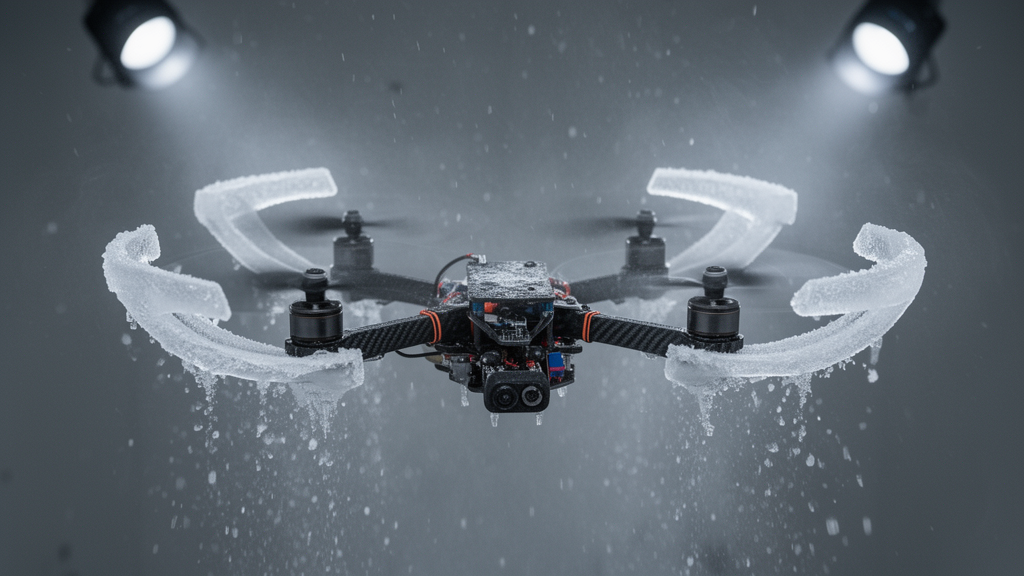
Propeller icing tests conducted on a representative small unmanned aerial vehicle propulsion assembly indicate that warmer subfreezing air temperatures accelerate thrust loss more rapidly than colder conditions. The experimental findings, derived from systematic controlled bench tests, demonstrate that temperatures just below freezing promote the rapid buildup of irregular glaze ice with protruding lobster-tail formations along the leading edge of the blades. These rough protrusions disrupt the aerodynamic profile of spinning propellers far more severely than the smoother, more uniform rime ice layers that deposit at much lower ambient temperatures. In laboratory trials, moving from minus twenty degrees Celsius up to minus five degrees Celsius significantly shortened the operational window before propulsion performance degraded beyond safe hover thresholds.
Small unmanned aerial vehicles frequently operate at low altitudes and moderate airspeeds where atmospheric moisture remains suspended as supercooled liquid droplets. These flight regimes regularly traverse freezing fog, low-hanging stratus clouds, and subzero precipitation. When supercooled water droplets strike the forward surfaces of an unheated drone, they impinge, spread, and solidify across critical aerodynamic structures. In fixed-wing craft, airframe icing degrades lift and escalates profile drag; on rotary-wing drones, ice accumulation acts directly upon the rotating blades, precipitating rapid losses in available thrust, steep surges in electrical power consumption, and mechanical vibrations that can jeopardize controlled flight. While larger aircraft possess onboard de-icing systems or sufficient power margins to withstand mild icing, lightweight reconnaissance drones possess tight thrust-to-weight ratios that leave little tolerance for aerodynamic degradation.
To rigorously examine how atmospheric and mechanical variables interact during propeller icing, researchers evaluated a complete motor-propeller subsystem derived from a commercial quadcopter. The test assembly was sourced from a FIMI X8 SE 2022 v2 drone, a platform featuring a nominal empty weight of 0.77 kilograms and a maximum takeoff rating of 1.31 kilograms. The propulsion unit comprised a 1200 kV model 2008 brushless direct-current motor, featuring an internal stator measuring 20 millimeters in diameter and 8 millimeters in axial length, paired directly with a two-bladed plastic propeller spanning 8.5 inches in diameter with a 3.5-inch pitch. Before every experimental run, the plastic blades were thoroughly cleaned using isopropyl alcohol wipes and dried under oil-free compressed air to ensure uniform surface wettability and eliminate grease or ambient particulate contamination.
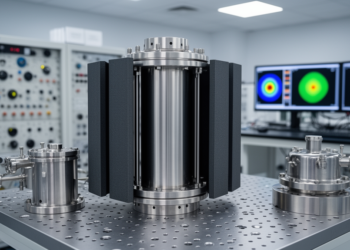
Controlled icing simulations took place within an enclosed refrigerated testing chamber measuring 2500 millimeters in length, 860 millimeters in width, and 820 millimeters in height. The climate chamber regulated internal air temperatures across a working range from minus twenty-two degrees Celsius to six degrees Celsius with an accuracy of plus or minus 0.2 degrees Celsius. Supercooled moisture was generated by an electronically heated two-phase spray nozzle located 1.8 meters upstream of the spinning propeller. Pressurized air atomized incoming water, with water delivery rates monitored and regulated through a calibrated rotameter having an uncertainty within 5 percent. The drone motor arm was positioned on a single-ended load beam cell with a 2-kilogram-force rated capacity, exhibiting a linear measurement response between 75 and 350 gram-force with relative error under 5 percent and repeatability within 2 percent.
Each experimental procedure began by soaking the stationary motor and propeller assembly at the designated test temperature for one to two hours to establish complete thermal equilibrium across the components. Following thermal conditioning, an automated microcontroller network built around Arduino and Raspberry Pi hardware initiated propeller rotation by transmitting a fixed pulse-width modulation command to an electronic speed controller powered by an independent 12-volt direct-current source. Propeller rotational velocity, load-cell thrust, and controller electrical power were recorded continuously at a sampling rate of one hertz. After allowing a thirty-second baseline mechanical stabilization interval, the spray nozzle was activated to introduce the cloud of supercooled water droplets, which exhibited a median volume diameter of 38 micrometers determined via oil-immersion microphotography.
The experimental matrix systematically evaluated three operational variables: air temperature across minus five, minus ten, and minus twenty degrees Celsius; liquid water content spanning 0.15, 0.30, 0.45, and 0.60 grams per cubic meter; and rotational speeds of 3500, 5300, 6300, and 7000 revolutions per minute. Throughout the testing phase, the natural accumulation of ice drag induced minor rotational deceleration, though rotational frequency drops never exceeded 15 percent in any run. The observed thrust trajectories were compared against an established critical degradation threshold defined by the ratio between baseline hovering thrust and maximum un-iced takeoff thrust. This critical index represents the operational boundary beyond which flight controllers can no longer compensate for lost aerodynamic lift through motor throttle increases.
When evaluating thermal effects under a constant rotational speed of 5300 revolutions per minute and a liquid water content of 0.3 grams per cubic meter, warming the air from minus twenty to minus five degrees Celsius shortened the time required to reach the critical degradation limit from approximately five minutes down to three minutes. At minus five degrees Celsius, supercooled droplets cannot shed their latent heat of fusion instantaneously upon contact, causing the liquid to spread along the blade chord before freezing into rough, irregular glaze ice. These formations produced lobster-tail shaped structures that projected radially outward near the propeller tips. In contrast, at minus ten and minus twenty degrees Celsius, impinging droplets froze almost instantly into smoother rime ice, resulting in reduced aerodynamic boundary disruption and a stabilized thrust decline rate.
During tests conducted at minus five degrees Celsius, continuous data logging detected an abrupt recovery spike in measured thrust between 350 and 400 seconds into the spray exposure, accompanied by a simultaneous drop in electrical power demand. Physical inspection and high-resolution photographic analysis confirmed that this transient behavior stemmed from natural ice shedding. Centrifugal acceleration acting on the accumulated ice mass near the blade tip eventually overcame the interfacial bond strength, dislodging ice fragments from the leading edge and temporarily restoring the propeller profile. Aerodynamic drag increased electrical power consumption by approximately 30 percent over 600 seconds at minus five degrees Celsius, though relative power escalation remained substantially smaller than the corresponding percentage loss in aerodynamic thrust.
Varying liquid water content at a fixed temperature of minus ten degrees Celsius and 5300 revolutions per minute demonstrated that higher cloud droplet densities accelerated thrust loss up to an asymptote. While increasing the water content four-fold reduced the time to reach the critical threshold by a factor of three, the initial thrust degradation rate stabilized when moisture levels reached and exceeded 0.45 grams per cubic meter. Mathematical fitting using a sigmoid function effectively modeled this saturation regime between zero and 0.7 grams per cubic meter.
Altering rotational velocity revealed a contrasting behavioral pattern where degradation severity expanded steadily without exhibiting a saturation plateau. At 3500 revolutions per minute, ice accretion remained minimal, and generated thrust persisted above the critical degradation line across the entire ten-minute exposure. However, operating at 5300 revolutions per minute or higher drove propulsion performance past the critical limit within five minutes, accompanied by a 16 percent increase in electrical power consumption at 7000 revolutions per minute. A power-law curve captured the relationship between rotational speed and initial thrust decline rate up to 7000 revolutions per minute, demonstrating that higher rotational velocities capture larger volumes of incoming water per unit time and accelerate ice accumulation.
The study also reconciled conflicting observations in previous drone icing research by identifying an experimental artifact related to fluid dynamics calibrations. Several earlier studies had reported that higher propeller speeds mitigated thrust degradation. The authors showed that when rotational frequency increases, the propeller induces a larger volumetric air flux through its swept disk. If the water injection rate is held constant rather than calibrated to match the increased airflow, the effective liquid water content drops, creating an artificial appearance of reduced icing severity. When water mass flow was actively matched to maintain constant liquid water content across all rotational speeds, the degradation rate rose monotonically with frequency.
While these empirical functions provide predictive tools for calculating thrust degradation and safety thresholds, the authors noted several physical limitations in the scope of the experimental campaign. The bench trials assessed a single small-scale motor and propeller geometry under moderate atmospheric conditions without controlling for natural rotational blade heating. More severe sub-zero environments below minus twenty degrees Celsius or extreme liquid water concentrations common to polar regions and mountain peaks remain to be evaluated across larger commercial propulsion hardware. Future research must expand systematic measurements to heavier multirotor propulsion assemblies to establish whether the observed saturation thresholds and power-law scaling exponents remain universal across different vehicle scales.
Subject of Research: Aerodynamic thrust degradation and ice accretion mechanisms in small unmanned aerial vehicle propulsion systems
Article Title: Effects of icing on the performance of small unmanned aerial vehicle propulsion
Article References: Usachev, I. A., Sergeichev, I. V., Liang, G., & Grishaev, V. G. (2026). Effects of icing on the performance of small unmanned aerial vehicle propulsion. Results in Engineering, 32, Article 114071. https://doi.org/10.1016/j.rineng.2026.114071
Image Credits: AI Generated
DOI: 10.1016/j.rineng.2026.114071
Keywords: unmanned aerial vehicles, propeller icing, aerodynamic degradation, thrust loss, glaze ice, rime ice, ice accretion, drone propulsion, liquid water content, rotational frequency, small drones, flight safety, subfreezing wind tunnel, electric speed controller, icing wind tunnel, blade aerodynamics, ice shedding
News Source: Denise Maddox. (November 12, 2026). Warmer Subfreezing Temperatures Accelerate Propeller Thrust Loss on Small Drones. Scienmag.