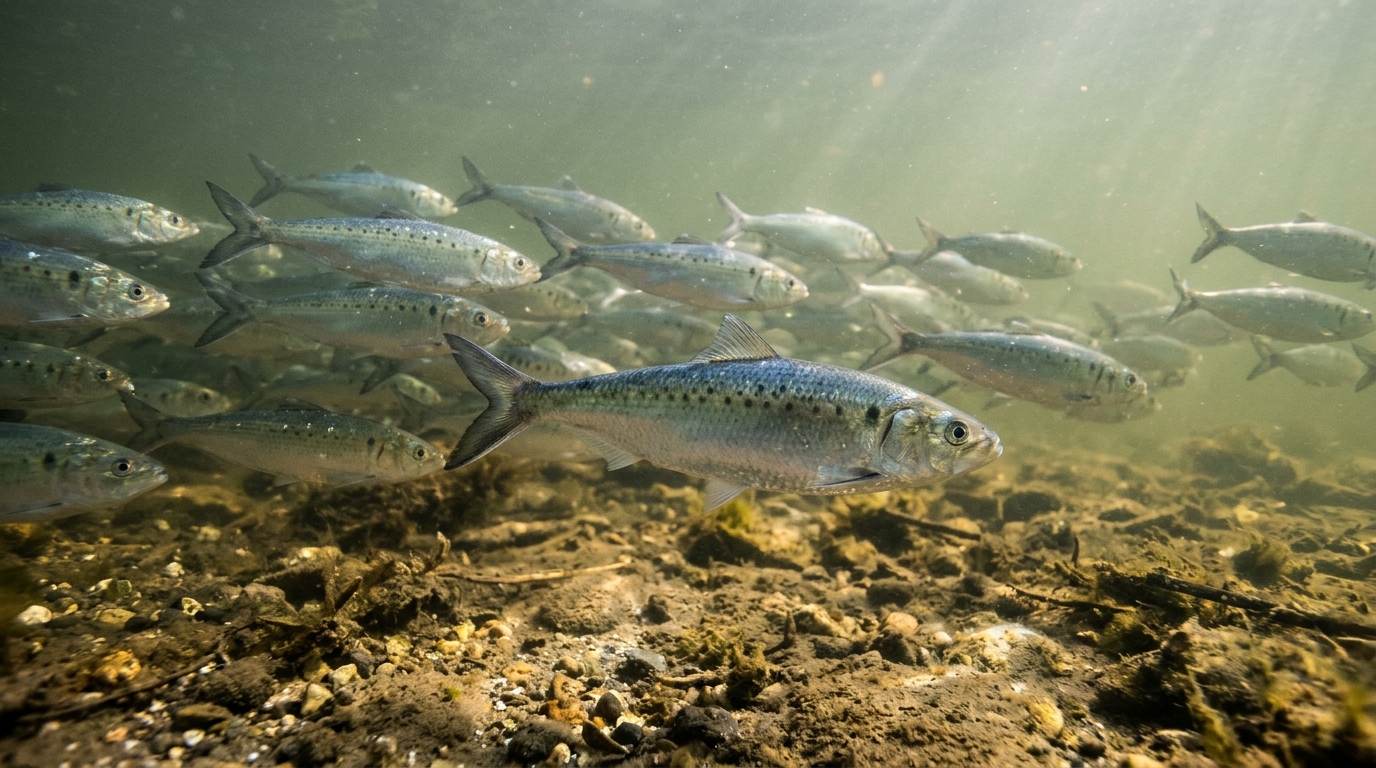
Adult twaite shad (Alosa fallax) in the Schelde Estuary initiate their upstream spawning run substantially earlier when spring water temperatures rise, according to a multi-year acoustic telemetry investigation conducted across Belgium and the Netherlands. The research tracked migratory movements over six consecutive years to resolve how environmental conditions govern the species’ anadromous life cycle. Scientists observed that the onset of upstream migration occurred on a mean date of April 12. Crucially, the initiation of this inland journey was strongly driven by thermal conditions in early spring, with twaite shads migrating approximately seven days earlier for every single degree Celsius increase in average March water temperatures.
The findings address an urgent conservation priority for diadromous fish, whose populations have suffered widespread declines across the globe. Developing effective conservation strategies for these migratory fishes requires a comprehensive and accurate understanding of their movement patterns and habitat use during reproduction. While electronic tracking through telemetry provides an established methodology for monitoring fish behaviour in aquatic environments, adult twaite shad present distinct research challenges.
To overcome these handling constraints and capture authentic movement behaviors across the full reproductive cycle, the research team implemented a multi-year tracking design between 2019 and 2024. To eliminate any confounding behavioral alterations caused by capture, surgical procedures, or handling stress, the investigators restricted their formal tracking analysis to 61 individuals that returned to the estuary during subsequent spawning seasons after the tagging year. This methodological approach allowed researchers to document the entire unimpeded spawning cycle, encompassing upstream migration, residency at the spawning grounds, and subsequent downstream departure.
While March water warming emerged as a primary migratory trigger, linear mixed models revealed that the onset of upstream movement is governed by intricate interactions among multiple environmental parameters. In addition to water temperature, statistical models showed that ambient levels of dissolved oxygen and water conductivity significantly shaped when fish initiated their journey.
During active transit through the Schelde Estuary, the tracked shads exhibited selective tidal stream transport to optimize both their upstream and downstream movements. Upstream migrants traveled at an average rate of 17.75 kilometers per day, synchronizing their primary swimming activity with incoming flood tides to harness incoming currents. Following spawning, downstream migration proceeded at a substantially faster average speed of 28.51 kilometers per day.
Once individuals reached their destination at the spawning grounds, their spatial distribution remained relatively concentrated, with shads occupying a 50 percent core area measuring 8.68 plus or minus 11.98 kilometers. However, the acoustic tracking array also recorded unexpected broad-scale movements among several tagged fish. Certain individuals performed large-scale downstream oscillations extending more than 40 kilometers away from the main spawning reach before traveling back upstream.
By demonstrating that tagged individuals successfully survive, leave the estuary, and return in subsequent years to complete normal reproductive runs, the researchers confirmed that acoustic telemetry can safely provide detailed ecological evidence to guide the management and conservation of declining twaite shad populations.
Subject of Research: Acoustic telemetry tracking of twaite shad spawning migration dynamics
Article Title: Unraveling the movement behaviour during the anadromous spawning cycle of adult twaite shad (Alosa fallax (Lacépède, 1803)) in the Schelde Estuary by multi-year acoustic telemetry
Article References: Verhelst, P., Jaspaert, H., Breine, J., Casals, D., Labrière, A., Oldoni, D., Reubens, J., & Pauwels, I. (2026). Unraveling the movement behaviour during the anadromous spawning cycle of adult twaite shad (Alosa fallax (Lacépède, 1803)) in the Schelde Estuary by multi-year acoustic telemetry. Movement Ecology. https://doi.org/10.1186/s40462-026-00721-2
Image Credits: AI Generated
DOI: 10.1186/s40462-026-00721-2
Keywords: twaite shad, Alosa fallax, Schelde Estuary, acoustic telemetry, anadromous fish, spawning migration, water temperature, selective tidal stream transport, flood tide, ebb tide, linear mixed models, dissolved oxygen, conductivity, handling stress, surgical transmitter implantation, iteroparous species, core area use
News Source: Drew Townsend. (November 16, 2026). Warmer Spring Waters Accelerate Twaite Shad Migration In Schelde Estuary. Scienmag.