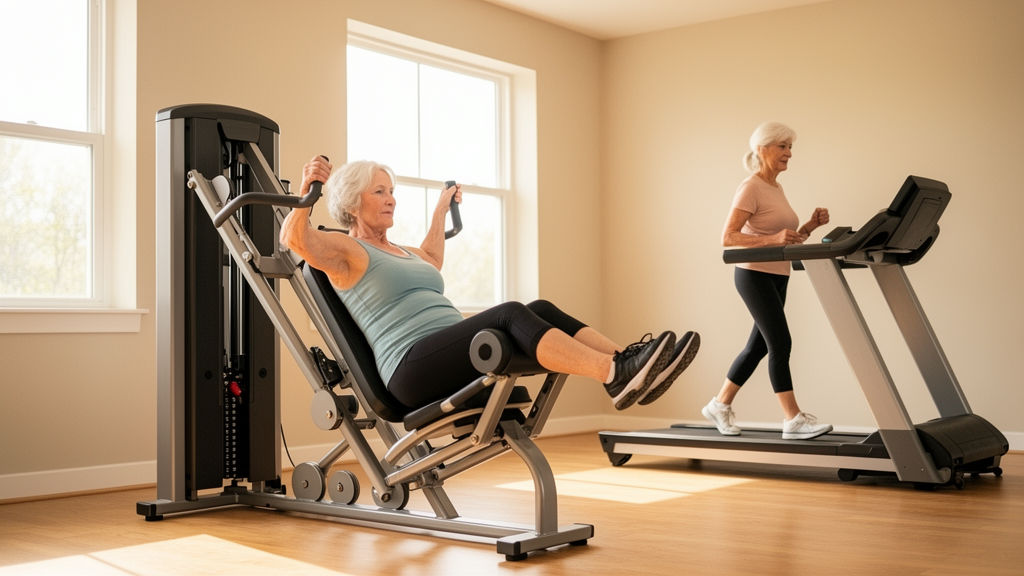
Falls remain the leading cause of injury and injury-related death among older women in the United States, and a new analysis of nearly 9,000 women aged 75 to 105 suggests that how confident they feel about their own balance may be a powerful, modifiable signal of risk. The study, published in BMC Geriatrics, drew on data from the Women’s Health Initiative Strong and Healthy (WHISH) trial, one of the largest physical activity interventions ever conducted in women over 75. Its central finding is striking: women who walked more, did more strength training, sat less, and reported better physical function were far less likely to have low balance confidence, a psychological state that researchers measure with a simple but well-validated questionnaire.
Balance confidence is not the same thing as balance ability. The Activities-specific Balance Confidence (ABC) Scale asks participants to rate, on a percentage scale from 0 to 100, how confident they are that they will not lose their balance while performing 16 everyday tasks, from walking up stairs to reaching on tiptoes to crossing a parking lot. A score below 67 percent defines low balance confidence, a threshold associated in prior research with fear of falling, activity restriction, and elevated fall risk. Because falls are the leading cause of injury and injury death among older American women, understanding which behaviors track with low confidence has direct public health relevance, even before causality is established.
The research team, led by Corey M. Rovzar of the Stanford Prevention Research Center, analyzed cross-sectional data from 8,916 women enrolled in the WHISH physical activity intervention arm. Participants ranged in age from 75 to 105, with a mean age of 84.9 years, and 47.3 percent were 85 or older, a notable feature because most exercise studies exclude the oldest adults. The women self-reported their weekly participation in strength training and walking, their daily sitting time, and their physical function, and completed the ABC Scale. The team then used analysis of variance, chi-squared tests, and modified Poisson regression with robust variance to estimate prevalence ratios, adjusting for age, education, body mass index, and race and ethnicity.
The headline numbers are dramatic. Overall, 35.1 percent of the women had low balance confidence, but that figure masked a steep age gradient: 23.9 percent among women aged 75 to 84, and 47.6 percent among women 85 and older. In other words, nearly half of the oldest women in the cohort lacked confidence in their ability to stay upright during routine activities. Against that baseline, the behavioral associations stood out. Women who reported at least two hours per week of strength training had a 24 percent lower prevalence of low balance confidence, with a prevalence ratio of 0.76 and a 95 percent confidence interval of 0.71 to 0.81.
Walking was associated with an even larger effect. Women who walked at least 4.25 hours per week had a 59 percent lower prevalence of low balance confidence, with a prevalence ratio of 0.41 and a confidence interval of 0.37 to 0.45. The association with physical function was the strongest of all: women with a high physical function score of 90 or above had an 88 percent lower prevalence of low balance confidence, a prevalence ratio of 0.12 with a confidence interval of 0.10 to 0.14 and a p-value below 0.0001. Sitting time moved the needle in the opposite direction. Women who sat eight or more hours per day had a 24 percent higher prevalence of low balance confidence, with a prevalence ratio of 1.24 and a confidence interval of 1.17 to 1.32.
The statistical machinery behind these estimates deserves a technical note. Modified Poisson regression with robust variance is a method designed for binary outcomes in cross-sectional studies, allowing researchers to estimate prevalence ratios directly rather than odds ratios, which can overstate effect sizes when outcomes are common. Because low balance confidence affected roughly a third of the cohort, prevalence ratios provide a more faithful picture of magnitude than odds ratios would. The models were adjusted for age, education, BMI, and race and ethnicity, and the team examined associations separately among women aged 75 to 84 and those 85 and older. The associations were more pronounced among the younger group but remained present among the oldest women, suggesting that the behavioral signal does not vanish with advanced age.
The direction of causality, however, is the critical caveat. This is a cross-sectional study, meaning behavior and balance confidence were measured at the same point in time. It is entirely plausible that women who feel unsteady walk less and sit more because they are afraid of falling, rather than the reverse. The authors are explicit on this point, noting that longitudinal studies are needed to establish temporality. Prior literature offers some support for the intervention hypothesis: randomized trials of exercise in older adults have shown improvements in balance confidence, and the ABC Scale has been shown to respond to training. But the WHISH analysis cannot rule out reverse causation, and the strong association with physical function could reflect either a shared underlying cause or a bidirectional relationship in which declining function erodes confidence, which then further restricts activity.
Even so, the findings carry practical weight. The thresholds used in the study are concrete and achievable: two hours of weekly strength training, roughly four and a quarter hours of walking, and less than eight hours of daily sitting. These are not extreme targets, and the fact that they track with balance confidence in women up to age 105 challenges the assumption that the oldest adults are beyond the reach of physical activity interventions. The WHISH trial itself was designed to test whether a physical activity intervention could preserve mobility in this population, and this analysis of its intervention arm provides a snapshot of how activity patterns and psychological confidence interweave in a group that has historically been understudied.
The scale of the cohort also matters for the reliability of the estimates. With 8,916 participants, the confidence intervals are narrow, and the age-stratified results are powered well enough to detect associations among women 85 and older, a group often excluded from exercise research on the grounds of feasibility. The WHISH intervention was funded by the National Heart, Lung, and Blood Institute through the Women’s Health Initiative program, and the trial was registered at ClinicalTrials.gov in 2015. The study protocol was approved by human subjects review committees at the Fred Hutchinson Cancer Research Center, Stanford University, and the University of California, San Diego, and all participants provided written informed consent.
For readers wondering what to take away, the study does not prescribe a specific exercise program, and it does not claim that walking or strength training causes confidence to rise. What it does show is that in a very large sample of women in their late seventies through mid-eighties and beyond, the women who moved more and sat less were dramatically less likely to lack confidence in their balance, and the women with the highest physical function scores were almost never in the low-confidence group. Falls are a leading cause of injury and injury death among older American women, and balance confidence sits at the intersection of physiology and psychology, shaping what people attempt and what they avoid. If future longitudinal work confirms that activity builds confidence, and not merely that confidence enables activity, the implications for fall prevention in the oldest women could be substantial.
Subject of Research: Cross-sectional associations of strength training, walking, sitting time, and physical function with low balance confidence among women aged 75 to 105 years in the WHISH intervention cohort
Article Title: Low balance confidence in relation to strength training, walking, sitting, and physical function among women aged 75–105 years: a cross-sectional study within the Women’s Health Initiative Strong and Healthy (WHISH) Intervention Cohort
Article References: Rovzar, C. M., Jhandi, S., Mackey, S., Laddu, D., Shen, S., La Croix, A., & Stefanick, M. L. (2026). Low balance confidence in relation to strength training, walking, sitting, and physical function among women aged 75–105 years: a cross-sectional study within the Women’s Health Initiative Strong and Healthy (WHISH) Intervention Cohort. BMC Geriatrics. https://doi.org/10.1186/s12877-026-08510-7
Image Credits: AI Generated
DOI: 10.1186/s12877-026-08510-7
Keywords: balance confidence, physical activity, strength training, walking, sedentary behavior, physical function, older women, falls, aging, Women's Health Initiative, ABC Scale, geriatrics
News Source: Ophelia Keating. (October 19, 2026). Walking and Strength Training Linked to Sharper Balance Confidence in Women Over 75. Scienmag.