Published in Cleaner Engineering and Technology in December 2026, the study introduces a method that calculates the greenhouse gas emissions of 3D-printed parts using only two geometric descriptors: part volume and part height. By shifting the calibration process to a generic reference voxel, the framework eliminates the need for geometry-specific model retraining, enabling rapid environmental screening of new designs during the early stages of product development.
The motivation for this research stems from the growing pressure to quantify embodied greenhouse gas emissions in industrial processes. While additive manufacturing is often viewed as a sustainable alternative to conventional manufacturing due to higher material utilization and reduced scrap, its net environmental performance is highly scenario-dependent. The energy demand and environmental impact of additive manufacturing can exceed those of conventional methods under certain conditions, making design- and process-specific life cycle assessment essential. However, conventional life cycle assessment requires substantial expertise, manual effort, and time, which slows down the iterative design process where geometry and process conditions are frequently revised.
To address these bottlenecks, the authors proposed the voxel-based life cycle assessment framework, which uses a 1-cubic-millimeter voxel as the functional unit. Unlike previous data-driven approaches that embed geometric information in high-dimensional feature vectors and require frequent retraining as process conditions change, this framework uses closed-form voxel-to-part expansion. The geometry of the target part is summarized by volume and height rather than complex shape features, allowing the model to map voxel-level quantities to part-level total environmental impacts with reduced data requirements. This approach is described as geometry-agnostic, meaning it can be applied across different solid-part geometries without geometry-specific training within the calibrated process-parameter window.
The methodology involved three distinct stages: voxel-level data extraction, voxel-level output prediction, and closed-form voxel-to-part expansion. Data collection was simulation-based, using the single-laser configuration of a Nikon SLM 280 laser powder bed fusion system as the reference system. The build-time simulation was performed using EOS Build software, while life cycle impact assessment was conducted in SimaPro using the ecoinvent database and the Intergovernmental Panel on Climate Change 2021 Global Warming Potential over 100 years method. The system boundary was defined as gate-to-gate, including pre-processing, main processing, and post-processing operations, while excluding upstream raw material production and downstream use phases.
Reference data for the 1-cubic-millimeter voxel were generated using a full-factorial grid of 225 combinations of four process parameters: laser power, scan speed, hatch distance, and layer thickness. These parameters were varied within the ranges available in the EOS Build simulation software to provide sufficient variation for modeling their effects on environmental impact. The parameter levels were not selected to identify an optimal processing condition or to maximize specific material properties, but rather to represent a computational process-parameter space. For each combination, laser-exposure time, recoating time, and main-process environmental impact were evaluated to form the voxel-level dataset used for predictive modeling.
The predictive models for laser-exposure time and voxel-level environmental impact were developed using second-order polynomial ridge regression. The laser-exposure time model combined a physics-based ideal time expression with a regression-derived calibration factor, preserving the physical structure while learning only the correction factor. The recoating time was obtained from a layer-wise analytical expression without regression, based on the assumption that the time per layer is constant. The environmental impact model used laser-exposure time, recoating time, and laser power as inputs, inheriting physics-based time scaling from the underlying models while capturing residual nonlinearities. This structure improved interpretability and reduced sensitivity to the heavy-tailed distribution of laser-exposure times compared to direct regression.
The framework was validated using twelve solid geometries, comprising three simple shapes and nine application-relevant parts, which were not used to train the voxel-level models. The part-level reference values were obtained by directly simulating the complete build time of each part using EOS Build and applying the same life cycle inventory and impact assessment procedures. The reported accuracy represents agreement with this simulation-informed reference rather than direct measurements of the validation parts. For the simple geometries, the absolute percentage error averaged 0.35%, with a maximum of 0.79%. For the application-relevant parts, which had larger volumes and more complex features, the mean absolute percentage error was 0.96%, with a maximum error of 2.32%.
Process-parameter adaptivity was further examined using a clamp geometry with a scan-speed sweep. Laser power, hatch distance, and layer thickness were fixed while scan speed was varied. Across these conditions, the mean absolute percentage error was 1.81%, and the maximum error was 2.05%. The results indicate that the framework can be used for comparative assessment of process settings without refitting the models. Once the voxel-level models and expansion equations were specified, the global warming potential for new parts could be obtained by evaluating a few equations using part volume, height, and the four process parameters.
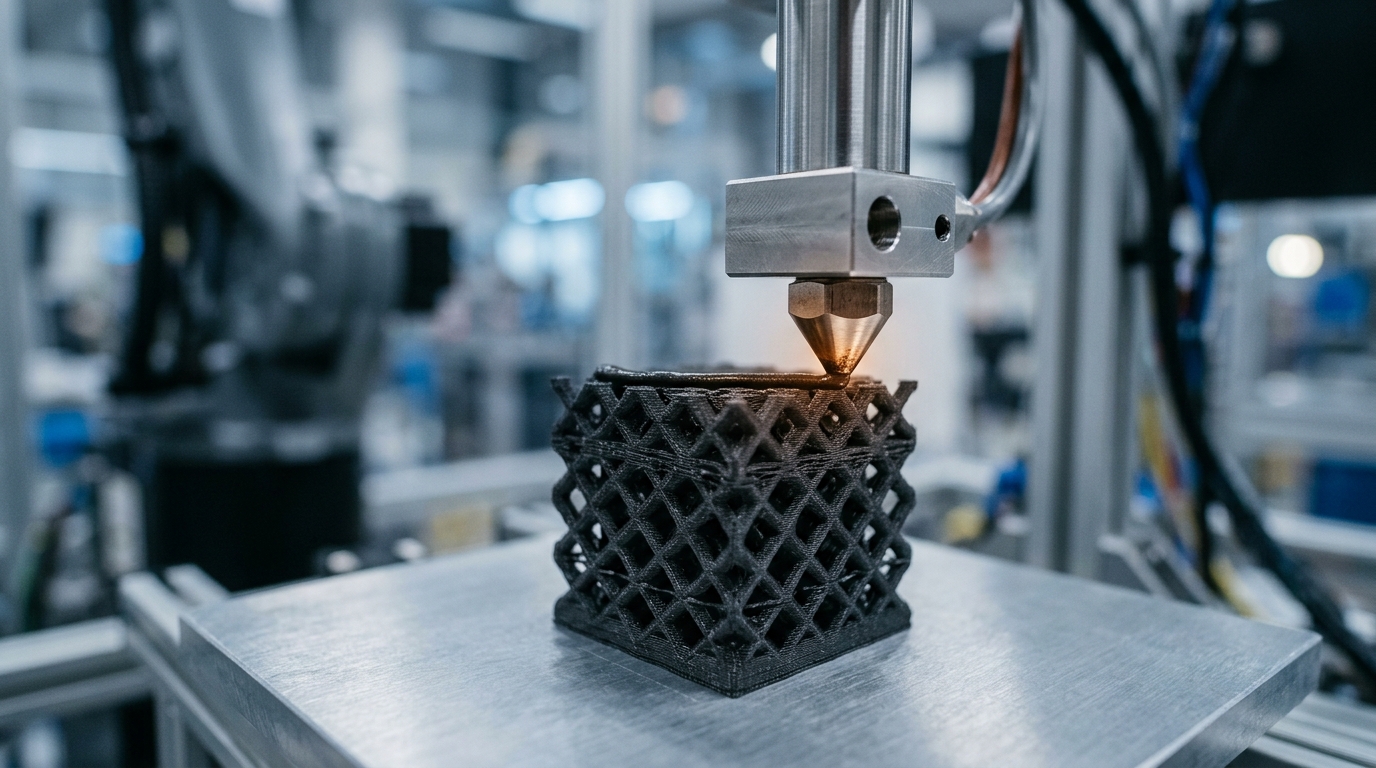
However, the study identified limitations in the volume-height abstraction when applied to complex topologies. An octet-truss lattice with approximately 20% of the corresponding solid volume was used to examine topology-dependent behavior. The framework predicted a part-level global warming potential of 16.27 kilograms of carbon dioxide equivalent, whereas the simulation-informed reference was 15.59 kilograms, resulting in an overestimation of approximately 4.36%. The simulation showed that the lattice exhibited approximately 35.1% shorter laser-exposure time than a solid geometry with identical volume and height. The current scaling relations cannot distinguish this topology-dependent behavior because both geometries share the same volume and height, indicating that thin-walled, strut-dominated, lattice, and porous structures remain outside the validated domain.
The residual analysis revealed a systematic relationship between prediction error and part volume. The signed error showed a positive Pearson correlation of 0.90 with part volume, suggesting greater underestimation at larger volumes. This may be because laser-exposure time scales with volume, whereas recoating time scales with height, causing the contribution of laser-time residuals to part-level prediction error to increase as part volume increases relative to height. The study notes that direct experimental validation of build time and electricity consumption, formal uncertainty propagation, and dedicated validation of additional geometries and laser powder bed fusion configurations are priorities for establishing broader applicability. The framework currently considers a single machine, a single scan strategy, and solid parts under a gate-to-gate boundary, and scaling should be revalidated for multi-laser configurations and alternative processes.
Subject of Research: Development of a voxel-based automated life cycle assessment framework for laser powder bed fusion additive manufacturing.
Article Title: Voxel-based automated life cycle assessment framework for additive manufacturing: a case study on laser powder bed fusion
Article References: Lee, J., Koo, J., Kim, J. E., & Kim, N. (2026). Voxel-based automated life cycle assessment framework for additive manufacturing: a case study on laser powder bed fusion. Cleaner Engineering and Technology, 35, Article 101344. https://doi.org/10.1016/j.clet.2026.101344
Image Credits: AI Generated
DOI: 10.1016/j.clet.2026.101344
Keywords: additive manufacturing, life cycle assessment, laser powder bed fusion, sustainability, carbon footprint, voxel modeling, green manufacturing, process optimization, Voxel-based, automated, life, cycle
News Source: Denise Maddox. (November 7, 2026). Voxel-Based Framework Automates Carbon Footprint Calculation for 3D Printing. Scienmag.