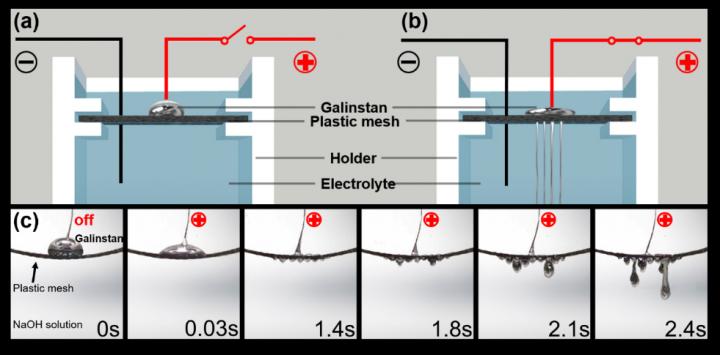
Credit: ©Science China Press
Superfluids were first discovered as a special quantum state of liquid helium, later dubbed as “Superfluid helium” once chilled past -269 degree celsius, starts to manifest properties that do not occur in other fluids. Penetration through a solid with nano-pores is one of the three fascinating macroscopic phenomena that are well known in superfluids such as liquid helium. It is zero viscosity that endows the liquid helium superfluid with zero flow resistance or frictionless flow, leading to the amazing property. Nevertheless, the superfluid penetration effect emerges only in the so-called quantum states or quantum fluids at extremely low temperatures of almost zero Kelvin. In contrast, conventional liquid droplets such as water and oils can diffuse into a solid with macro-pores at room temperature as a result of the capillary effect, but their surface tension makes them unable to penetrate through the porous material.
Room-temperature liquid metals, such as liquid gallium and its eutectic alloys, have attracted a great deal of attention in many research fields due to their unique properties. In recent years, liquid metal has attracted the attention of scientists with its low-temperature liquid state, high surface tension, electricity, and heat conductivity characteristics, and provided new ideas for the development of flexible electronic devices and software robots.
One particular noteworthy property is its ability to change its surface tension through the application of a voltage in a solution coupled with the fact that the surface tension of liquid gallium and its alloys is quite high, which makes it an ideal platform to study surface tension effects. As an important member of the liquid metal family, the gallium indium tin alloy droplet itself has great surface tension and exhibits the shape of the sphere in air or solution of NaOH. However, if a positive voltage is applied to the droplet while immersed in NaOH solution, the droplets rapidly form a surface oxide under the action of the electrochemical reaction, so that the surface tension is reduced to almost zero. Because of this, the droplets will spread along the surface.
Inspired by the near-zero surface tension, a team led by Professor Xiaolin Wang at the Institute of Superconducting and Electronic Materials, Australian Research Council Centre of Excellence in Future Low Energy Electronics Technologies, University of Wollongong, Australia, has discovered a voltage induced “superfluid” like penetration effect in Galium based liquid metals at room temperature for the first time. Prof Wang’s team demonstrated the liquid metal penetration effect in various porous materials such as tissue paper, thick and fine sponges, fabrics, and meshes. The penetration effect mimics one of the three well-known superfluid properties of liquid helium superfluid that only occur at near-zero Kelvin. The underlying mechanism is that the high surface tension of liquid metal can be significantly reduced to near-zero due to the voltage induced oxidation of the liquid metal surface in a solution. It is the extremely low surface tension and gravity that cause the liquid metal to superwet the solid surface, leading to the penetration phenomena.
The team has demonstrated two possible applications such as healing and the cutting off of electrical wiring using liquid metal in a sealed environment.
The related results are published in the National Science Review (NSR) with the title of “Voltage Induced Penetration Effect in Liquid Metals at Room Temperature”.
The penetration phenomena is another important finding for the team following the discovery of other liquid metal phenomena such as non-contact patterning, simultaneous deformation, and solidification of supercooled liquid metal, and heart beating. These findings offer new opportunities for novel microfluidic applications and could promote further exploration for more exotic fluidic states of liquid metals.
###
See the article:
Frank F. Yun, Zhenwei Yu, Yahua He, Lei Jiang, Zhao Wang, Haoshuang Gu, Xiaolin Wang
Voltage Induced Penetration Effect in Liquid Metals at Room Temperature
Natl Sci Rev (November 2019); doi: 10.1093/nsr/nwz168
http://doi.
The National Science Review is the first comprehensive scholarly journal released in English in China that is aimed at linking the country’s rapidly advancing community of scientists with the global frontiers of science and technology. The journal also aims to shine a worldwide spotlight on scientific research advances across China.
Media Contact
Xiaolin Wang
[email protected]
Related Journal Article
http://dx.