


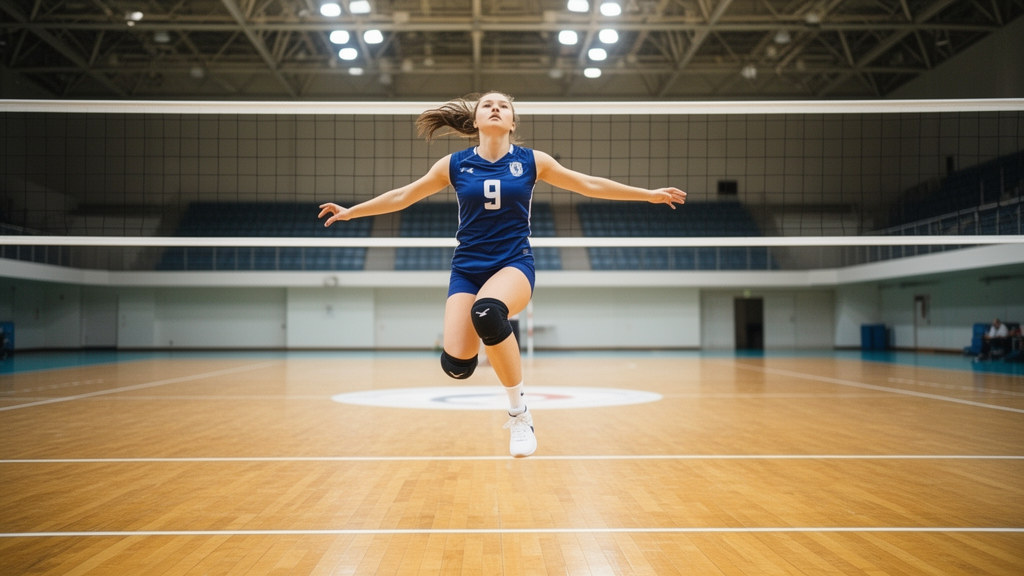
Elite female volleyball players show measurable differences between their dominant and non-dominant legs in both balance control and landing mechanics, according to a new study published in BMC Sports Science, Medicine and Rehabilitation. The research, led by Guangliang Fu, Nan Zhang and colleagues, combined laboratory balance and landing tests with an exploratory finite element analysis based on MRI-derived knee models, offering a rare tissue-level glimpse of knee loading during a sport-specific task.
The participants were twenty female National Level I volleyball athletes recruited from multiple teams and training centres in Tianjin, China, with a mean age of 23.25 years (standard deviation 5.42, range 17 to 28). Each athlete completed 30-second single-leg standing trials with eyes open and eyes closed, as well as standardised forward single-leg landings from a 40-centimetre box. The researchers performed paired between-limb comparisons with Holm adjustment for multiple testing, a statistical safeguard that reduces the risk of false-positive findings.
The clearest static-balance asymmetry appeared only when vision was removed. Under eyes-closed standing, the dominant limb showed lower anteroposterior centre-of-pressure amplitude than the non-dominant limb, 64.25 versus 74.52 millimetres, with a Holm-adjusted p value of 0.003 and an effect size dz of 1.00. Anteroposterior centre-of-pressure velocity was also lower on the dominant side, 57.35 versus 65.23 millimetres per second (Holm-adjusted p = 0.004; dz = 0.94). In other words, when players could not rely on sight, their dominant leg held steadier postural control.
During the landing task, the picture reversed in part. Peak vertical ground reaction force, time to peak vertical ground reaction force, and loading rate did not differ significantly between limbs, meaning the overall external impact was broadly symmetric. The asymmetries emerged in joint movement and stability indices instead. The non-dominant limb showed greater knee flexion-extension range of motion, 51.82 versus 43.61 degrees (Holm-adjusted p = 0.001; dz = 1.10), and a lower anteroposterior stability index, 0.10 versus 0.15 (Holm-adjusted p < 0.01; dz = 1.20). The dominant limb, by contrast, showed greater frontal-plane knee range of motion, 6.18 versus 3.25 degrees (Holm-adjusted p = 0.004; dz = 0.93).
The authors summarised these patterns as task-dependent: static asymmetry emerged only under eyes-closed conditions, with lower anteroposterior sway in the dominant limb, while during landing the non-dominant limb displayed greater sagittal-plane ankle and knee range of motion and lower ground-reaction-force-based stability indices, and the dominant limb displayed greater frontal-plane knee motion.
The study’s most novel component was an illustrative bilateral finite element analysis. Because external biomechanics alone cannot describe tissue-level knee loading, the team built MRI-derived knee models for one athlete and applied limb-specific experimental landing inputs from that same participant. In this single-participant simulation, the largest peak stresses occurred in the medial tibial cartilage. Peak von Mises stress was higher in the dominant knee than in the non-dominant knee, 46.2 versus 42.6 megapascals, and maximum principal stress followed the same pattern, 45.4 versus 41.5 megapascals. Stress concentrations were primarily observed in the weight-bearing cartilage and meniscal regions.
At peak vertical ground reaction force, the modelling therefore suggested higher cartilage and meniscal stresses in the dominant knee. The authors are careful to frame this as an illustrative, exploratory analysis of one participant rather than a population-level result. Finite element models depend on the geometry of a single individual’s knee and on the landing inputs fed into them, so the stress values should be read as a demonstration of method rather than a general claim about all volleyball players.
The broader significance lies in the combination of approaches. Volleyball involves frequent unilateral support, take-off, and landing tasks that may be associated with task-dependent bilateral differences in lower-limb postural control and landing mechanics. By pairing whole-body measurements, centre-of-pressure sway, ground reaction forces, joint range of motion and stability indices, with subject-specific tissue-level simulation, the study illustrates how limb dominance may express itself differently depending on the task: quieter closed-eye balance on the dominant leg, but greater frontal-plane knee motion and, in one modelled case, higher cartilage stress on that same side during landing.
For the sport itself, the findings describe a measurable asymmetry profile in high-level female volleyball athletes rather than prescribing a fix. The static-balance advantage of the dominant limb appeared only without visual input, the landing-force measures were symmetric, and the joint-motion and stability differences were concentrated in specific planes and indices. The MRI-based finite element component adds a tissue-level dimension that external motion and force measurements cannot provide, while remaining explicitly exploratory. As an open-access article published on 29 October 2026 and shared early as a citable accepted manuscript, the study offers a template for future work that could extend the paired biomechanical-plus-modelling approach to larger groups of athletes.
Subject of Research: Bilateral asymmetry in balance and knee landing mechanics in volleyball athletes
Article Title: Bilateral asymmetry in static and dynamic balance and knee joint mechanical responses during single-leg landing in volleyball athletes
Article References: Fu, G., Zhang, N., Bao, C., Feng, X., & Meng, Q. (2026). Bilateral asymmetry in static and dynamic balance and knee joint mechanical responses during single-leg landing in volleyball athletes. BMC Sports Science, Medicine and Rehabilitation. https://doi.org/10.1186/s13102-026-02025-9
Image Credits: AI Generated
DOI: 10.1186/s13102-026-02025-9
Keywords: volleyball, biomechanics, balance, landing mechanics, knee joint, finite element analysis, center of pressure, limb dominance, MRI, sports science, Bilateral, asymmetry
News Source: Ophelia Keating. (October 29, 2026). Volleyball Study Finds Leg Dominance Shapes Balance and Landing Knee Loads. Scienmag.



