• HOME
  • NEWS
  • EXPLORE
    • CAREER
      • Companies
      • Jobs
    • EVENTS
    • iGEM
      • News
      • Team
    • PHOTOS
    • VIDEO
    • WIKI
  • BLOG
  • COMMUNITY
    • FACEBOOK
    • INSTAGRAM
    • TWITTER
Wednesday, April 1, 2026
BIOENGINEER.ORG
No Result
View All Result
  • Login
  • HOME
  • NEWS
  • EXPLORE
    • CAREER
      • Companies
      • Jobs
        • Lecturer
        • PhD Studentship
        • Postdoc
        • Research Assistant
    • EVENTS
    • iGEM
      • News
      • Team
    • PHOTOS
    • VIDEO
    • WIKI
  • BLOG
  • COMMUNITY
    • FACEBOOK
    • INSTAGRAM
    • TWITTER
  • HOME
  • NEWS
  • EXPLORE
    • CAREER
      • Companies
      • Jobs
        • Lecturer
        • PhD Studentship
        • Postdoc
        • Research Assistant
    • EVENTS
    • iGEM
      • News
      • Team
    • PHOTOS
    • VIDEO
    • WIKI
  • BLOG
  • COMMUNITY
    • FACEBOOK
    • INSTAGRAM
    • TWITTER
No Result
View All Result
Bioengineer.org
No Result
View All Result
Home NEWS Science News Chemistry

“Volcano-shaped” trend enables rational design of polysulfide catalysts in lithium–sulfur batteries

Bioengineer by Bioengineer
June 16, 2022
in Chemistry
Reading Time: 3 mins read
0
Schematic diagram of design principles for high-efficient lithium–sulfur catalysts
Share on FacebookShare on TwitterShare on LinkedinShare on RedditShare on Telegram

A joint research team led by Prof. ZHANG Huigang from the Institute of Process Engineering (IPE) of the Chinese Academy of Sciences (CAS) and Dr. LU Jun from Argonne National Laboratory, U.S.A., has found a “volcano-shaped” relationship between polysulfide adsorption and catalytic activity in lithium–sulfur (Li–S) batteries.
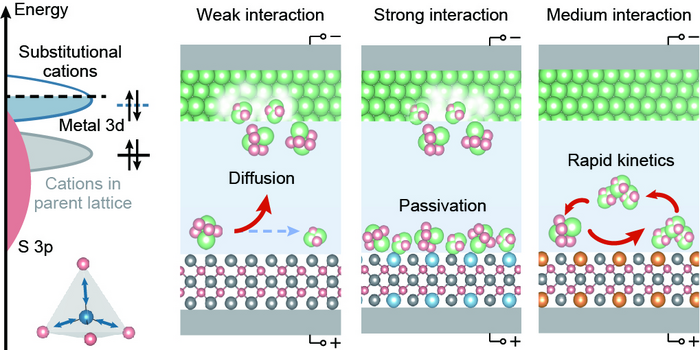
Schematic diagram of design principles for high-efficient lithium–sulfur catalysts

Credit: SHEN Zihan

A joint research team led by Prof. ZHANG Huigang from the Institute of Process Engineering (IPE) of the Chinese Academy of Sciences (CAS) and Dr. LU Jun from Argonne National Laboratory, U.S.A., has found a “volcano-shaped” relationship between polysulfide adsorption and catalytic activity in lithium–sulfur (Li–S) batteries.

The study was published in Nature Catalysis on June 16.

According to Prof. ZHANG, this volcano-shaped relationship may modify the long-standing principle that “strong adsorption of polysulfides leads to good catalytic activity.”

The Li–S system shows great potential for next-generation batteries due to its high energy density. However, the sluggish kinetics of polysulfide conversion reactions leads to the “shuttling effect” and limits rate capability and cyclability, which hinder practical applications.

Recently, many experimental studies have reported that catalytic conversion of polysulfides plays a critical role in enhancing kinetics and suppressing polysulfide shuttling. Despite significant improvement in the electrochemical performance of Li–S batteries, studies on catalysts have heavily relied on trial and error and the governing principle has remained elusive.

In this study, the researchers demonstrated that, although a strong adsorption of polysulfides may lower the activation barrier for polysulfide conversion, it in turn impedes the desorption of products. This is due to the scaling principle since polysulfides (from Li2S8 to Li2S2/Li2S) are sequentially adsorbed onto the same sites during charge/discharge.

To regulate the adsorption energy and maximize catalytic efficiency, they doped transition metal into the crystallographic framework of ZnS. The dopants were placed in stressed states and their d-orbitals were tuned accordingly. As a result, the adsorption energy had a linear relationship with the d-band center of dopants, but catalytic activity showed a “volcano-shaped” trend.

Such a discovery indicates that a long-standing assumption of strengthening adsorption to enhance catalysis is invalid when desorption is rate limiting. “Catalysts and absorbents in a Li–S battery should be designed separately to improve the performance of Li–S batteries,” said Prof. ZHANG.

This study offers a rational basis for understanding the catalytic process of Li–S batteries at atomic or molecular levels and for designing new catalysts.

It was supported by the National Key Research and Development Program of China, the National Natural Science Foundation of China, and the U. S. Department of Energy (DOE).


Journal

Nature Catalysis

DOI

10.1038/s41929-022-00804-4

Article Title

Cation-doped ZnS catalysts for polysulfide conversion in lithium–sulfur batteries

Article Publication Date

16-Jun-2022

Share12Tweet8Share2ShareShareShare2

Related Posts

Scientists Unveil Innovative Catalyst Boosting Syngas-to-Light Olefins Conversion Efficiency

Scientists Unveil Innovative Catalyst Boosting Syngas-to-Light Olefins Conversion Efficiency

April 1, 2026
Insilico at AACR: Showcasing Four Groundbreaking Posters Highlighting the Potential of Generative AI

Insilico at AACR: Showcasing Four Groundbreaking Posters Highlighting the Potential of Generative AI

April 1, 2026

Creating Desktop Particle Accelerators to Open New Frontiers in Scientific Research

April 1, 2026

Photochargeable Semiconductor Powers Efficient Amine Coupling

April 1, 2026

POPULAR NEWS

  • blank

    Revolutionary AI Model Enhances Precision in Detecting Food Contamination

    96 shares
    Share 38 Tweet 24
  • Imagine a Social Media Feed That Challenges Your Views Instead of Reinforcing Them

    1006 shares
    Share 398 Tweet 249
  • Promising Outcomes from First Clinical Trials of Gene Regulation in Epilepsy

    51 shares
    Share 20 Tweet 13
  • Popular Anti-Aging Compound Linked to Damage in Corpus Callosum, Study Finds

    43 shares
    Share 17 Tweet 11

About

We bring you the latest biotechnology news from best research centers and universities around the world. Check our website.

Follow us

Recent News

Scientists Unveil Innovative Catalyst Boosting Syngas-to-Light Olefins Conversion Efficiency

UCLA Researchers Highlight the ‘Body Gap’ in AI: Why Lacking Human Experience Could Impact Safety

NIH Scientists Develop Pain-Relief Drug with Low Addiction Risk

Subscribe to Blog via Email

Enter your email address to subscribe to this blog and receive notifications of new posts by email.

Join 78 other subscribers
  • Contact Us

Bioengineer.org © Copyright 2023 All Rights Reserved.

Welcome Back!

Login to your account below

Forgotten Password?

Retrieve your password

Please enter your username or email address to reset your password.

Log In
No Result
View All Result
  • Homepages
    • Home Page 1
    • Home Page 2
  • News
  • National
  • Business
  • Health
  • Lifestyle
  • Science

Bioengineer.org © Copyright 2023 All Rights Reserved.