• HOME
  • NEWS
  • EXPLORE
    • CAREER
      • Companies
      • Jobs
    • EVENTS
    • iGEM
      • News
      • Team
    • PHOTOS
    • VIDEO
    • WIKI
  • BLOG
  • COMMUNITY
    • FACEBOOK
    • INSTAGRAM
    • TWITTER
Saturday, May 16, 2026
BIOENGINEER.ORG
No Result
View All Result
  • Login
  • HOME
  • NEWS
  • EXPLORE
    • CAREER
      • Companies
      • Jobs
        • Lecturer
        • PhD Studentship
        • Postdoc
        • Research Assistant
    • EVENTS
    • iGEM
      • News
      • Team
    • PHOTOS
    • VIDEO
    • WIKI
  • BLOG
  • COMMUNITY
    • FACEBOOK
    • INSTAGRAM
    • TWITTER
  • HOME
  • NEWS
  • EXPLORE
    • CAREER
      • Companies
      • Jobs
        • Lecturer
        • PhD Studentship
        • Postdoc
        • Research Assistant
    • EVENTS
    • iGEM
      • News
      • Team
    • PHOTOS
    • VIDEO
    • WIKI
  • BLOG
  • COMMUNITY
    • FACEBOOK
    • INSTAGRAM
    • TWITTER
No Result
View All Result
Bioengineer.org
No Result
View All Result
Home NEWS Science News

Viticulture gets a boost with yield predicting, threat detecting robots

Bioengineer by Bioengineer
October 30, 2019
in Science News
Reading Time: 2 mins read
0
IMAGE
Share on FacebookShare on TwitterShare on LinkedinShare on RedditShare on Telegram

IMAGE

Credit: Chris Kitchen, Cornell University


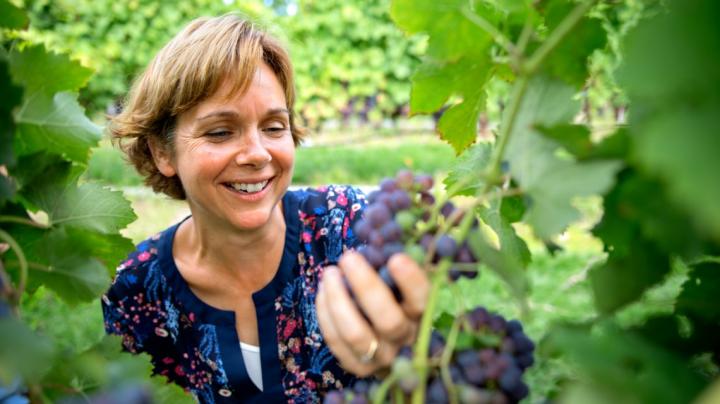
ITHACA, N.Y. – For grape growers, accurately predicting each season’s yield is key to a successful harvest. Underpredict, and you won’t have enough labor on hand or you’ll run out of storage space; overpredict, and you could fall through on promises to your distributors.

Two Cornell University researchers are tackling the age-old problem using 21st century tools: inexpensive, touch-sensitive soft robots that can help growers predict yield and detect fungal threats.

Justine Vanden Heuvel, associate professor of horticulture in the College of Agriculture and Life Sciences (CALS), researches strategies to help grape growers improve their environmental and economic sustainability. Kirstin Petersen, assistant professor of electrical and computer engineering, studies bio-inspired and soft robotics.

Other researchers have used sophisticated and expensive cameras to predict grape yield late in the season, Petersen said. This method works well in areas with smaller vines and limited foliage, like Napa Valley, California, but it’s less effective in areas like New York state, with its heavy rainfall and vigorous vegetative growth that can block a camera’s view of grape clusters.

However, with their combined expertise in plant growth and machine learning, the researchers realized that they could predict yield very early in the season, when the flower clusters first emerge.

“There’s a specific cohesion about how the leaves grow and where the clusters appear,” Petersen said. “Before berries even form, we can go out and do this with something as simple as a smartphone and a flashlight, which is incredible.”

Their method gives growers more time to plan and is more affordable than existing technologies.

In another project, Vanden Heuvel and Petersen are collaborating with Amit Lal, professor of electrical and computer engineering, to develop soft robots armed with high-resolution sensors. These sensors perform ultrasounds on the growing grapes that can detect things like differences in sugar content, berry firmness and fungal spores such as dreaded pathogens downy mildew and powdery mildew.

Petersen and Vanden Heuvel’s project is a perfect example of what the Cornell Initiative for Digital Agriculture (CIDA) wants to accomplish, said Tim Vanini, managing director of CIDA. After their initial work, the team was able to apply for and receive a $1.19 million grant from the National Institute of Food and Agriculture to keep developing their ideas and eventually test them in working vineyards.

###

Cornell University has dedicated television and audio studios available for media interviews supporting full HD, ISDN and web-based platforms.

Media Contact
Lindsey Hadlock
[email protected]
607-269-6911

Original Source

http://news.cornell.edu/stories/2019/10/digital-agriculture-workshop-highlights-radical-collaborations

Tags: Agricultural Production/EconomicsAgricultureRobotry/Artificial IntelligenceTechnology/Engineering/Computer Science
Share12Tweet8Share2ShareShareShare2

Related Posts

New Actinomycin Derivatives Target Malaria More Selectively

May 16, 2026

Mobile App Enhances Exercise for Older Adults’ Cognition

May 16, 2026

Botulinum Toxin Reduces Urinary Retention Post-Hemorrhoidopexy

May 16, 2026

Blood Metal Exposure Linked to Puberty Timing

May 16, 2026
Please login to join discussion

POPULAR NEWS

  • Research Indicates Potential Connection Between Prenatal Medication Exposure and Elevated Autism Risk

    843 shares
    Share 337 Tweet 211
  • New Study Reveals Plants Can Detect the Sound of Rain

    730 shares
    Share 291 Tweet 182
  • Salmonella Haem Blocks Macrophages, Boosts Infection

    62 shares
    Share 25 Tweet 16
  • Breastmilk Balances E. coli and Beneficial Bacteria in Infant Gut Microbiomes

    58 shares
    Share 23 Tweet 15

About

We bring you the latest biotechnology news from best research centers and universities around the world. Check our website.

Follow us

Recent News

New Actinomycin Derivatives Target Malaria More Selectively

Mobile App Enhances Exercise for Older Adults’ Cognition

Botulinum Toxin Reduces Urinary Retention Post-Hemorrhoidopexy

Subscribe to Blog via Email

Enter your email address to subscribe to this blog and receive notifications of new posts by email.

Join 82 other subscribers
  • Contact Us

Bioengineer.org © Copyright 2023 All Rights Reserved.

Welcome Back!

Login to your account below

Forgotten Password?

Retrieve your password

Please enter your username or email address to reset your password.

Log In
No Result
View All Result
  • Homepages
    • Home Page 1
    • Home Page 2
  • News
  • National
  • Business
  • Health
  • Lifestyle
  • Science

Bioengineer.org © Copyright 2023 All Rights Reserved.