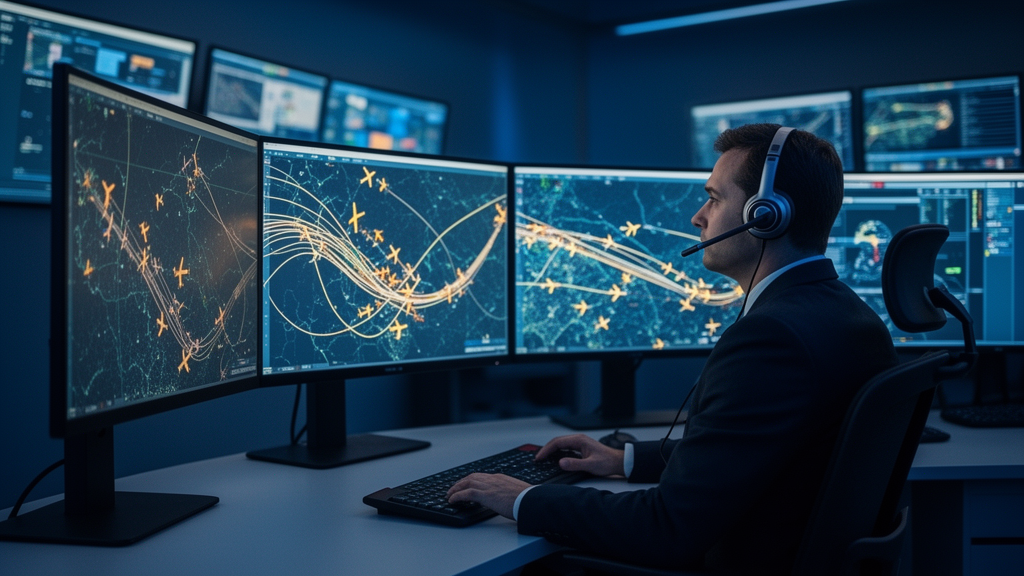
In high-density airspace where human operators must coordinate flight paths to prevent mid-air collisions, introducing visual explainable artificial intelligence significantly lowers mental workload while boosting willingness to adopt automated advisory tools. According to an experimental investigation conducted at the École Nationale de l’Aviation Civile in Toulouse, France, air traffic controllers monitoring automated conflict resolution displayed measurable reductions in neurophysiological strain when algorithmic suggestions were paired with visual HeatMap overlays rather than opaque black-box recommendations. Published in the journal Brain Informatics, the study utilized synchronized electroencephalography recordings alongside standardized psychometric surveys to capture both implicit neurocognitive reactions and explicit subjective judgments across distinct tiers of operational experience.
Modern air traffic control increasingly relies on sophisticated automated assistance to parse expanding volumes of radar tracks, weather reports, and flight plans. Traditional operations position air traffic control officers as direct tactical deciders, but the integration of machine learning and evolutionary search models is shifting operators into supervisory overseers who monitor automated trajectory solutions. While regulatory frameworks, including guidelines issued by the European Union Aviation Safety Agency, mandate that high-stakes automation remain transparent and explainable, empirical validations of specific visual explanation interfaces have remained sparse within operational aviation environments. The research team sought to determine whether providing rich visual context regarding why a machine chose a specific flight path modification would lighten cognitive processing burdens or conversely clutter displays and induce information overload.
To rigorously examine these dynamics, researchers designed an empirical protocol involving twenty-one healthy volunteers categorized into two distinct operational groups based on professional background. The expert cohort comprised eleven certified controllers, primarily active instructors and specialized research personnel averaging fifteen years of operational duty predominantly within en-route control sectors. In contrast, the student cohort consisted of ten advanced trainees completing their final preparatory semester at the aviation academy, possessing comprehensive academic and high-fidelity simulator instruction but lacking full operational licensing. Testing both cohorts allowed the investigators to evaluate how deeply entrenched professional habits, cognitive heuristics, and generational familiarity with autonomous software modulate human receptivity toward artificial intelligence explanations.
The experimental task centered on a conflict detection and resolution challenge driven by an underlying genetic algorithm. In automated air traffic management, genetic algorithms operate as metaheuristic optimization engines inspired by natural selection, iteratively evaluating candidate flight trajectories against three rigorous operational criteria: the duration of spatial conflicts, total trajectory length, and the required number of tactical heading adjustments. The algorithm selects promising candidates across successive generations, executing computational crossover and mutation operations to converge on an optimized conflict-free flight path. In the baseline BlackBox configuration, the system presented participants solely with the final optimized trajectory vector, indicating turn sequences and minimum separation distances without revealing alternative spatial paths.
In the contrasting explainable HeatMap condition, the interface illuminated not only the algorithm’s chosen solution but also the broader candidate solution space evaluated during optimization. The system generated continuous contour density maps by accumulating candidate trajectories convolved with a Gaussian kernel, visually demarcating safe maneuvering envelopes in green where aircraft separation exceeded seven nautical miles and hazardous zones in red where separation deteriorated below standard safety buffers. This explanatory presentation enabled controllers to instantly evaluate contrastive counterfactuals, clarifying why an aircraft could not execute alternative turns or how delaying a maneuver might compromise separation buffers, directly integrating explanatory reasoning into standard radar-style spatial displays.
Neurophysiological data collection was executed within the ACHIL en-route simulator using the wearable Mindtooth electroencephalography headset, which recorded continuous electrical brain potentials across eight scalp locations referenced to the right mastoid. Signals were band-pass filtered between two and thirty Hertz, corrected for ocular blinks using the O-Clean algorithm, and segmented into one-second artifact-free epochs. Individual alpha frequencies were established during an initial baseline eyes-closed calibration period. From these bands, the researchers derived an objective cognitive workload neurometric defined as the ratio of frontal theta power to posterior parietal alpha power, alongside an approach-withdrawal acceptance metric calculated from bilateral frontal alpha asymmetries to track implicit motivational engagement.
Following each experimental scenario, participants completed targeted questionnaires employing five-point Likert scales, evaluating solution agreement, comprehensibility, trust, situational awareness, willingness to use, and perceived operational performance impact. Items exhibiting robust inter-item correlations were aggregated into composite indices, establishing statistically coherent scales for overall willingness to adopt the tool and perceived performance enhancement. Qualitative semi-structured post-test debriefings were also transcribed to contextualize the numerical metrics, examining subjective reactions concerning visual clutter, potential loss of vigilance, and procedural trust calibration.
Repeated-measures analysis of variance revealed a statistically significant main effect of explainability on neurophysiologically measured mental workload, demonstrating that controllers experienced lower cognitive demands when evaluating HeatMap explanations compared to BlackBox outputs. Crucially, the statistical interaction between explainability condition and expertise level was not significant, indicating that the visual HeatMap representation mitigated cognitive strain across both seasoned instructors and novice students alike. Self-reported willingness to use the system echoed this physiological finding, showing a significant positive main effect for the HeatMap interface across the entire participant cohort, reinforcing that visual spatial envelopes facilitate rapid comprehension without necessitating laborious analytical deduction.
In contrast to workload and willingness metrics, explicit assessments regarding whether the automated tool enhanced work performance exhibited no significant within-subject effect between explainable and black-box conditions. Instead, work performance evaluations demonstrated a prominent between-subjects main effect driven entirely by expertise level. Less experienced student controllers rated the software as significantly more beneficial to their operational speed, accuracy, and overall workflow than veteran controllers. Qualitative interviews illuminated this divergence: expert controllers expressed hesitation over relinquishing tactical control, noting that automated solvers did not always capture nuanced multi-aircraft delay balancing, whereas student trainees displayed greater openness to integrating algorithmic recommendations into their developing operational strategies.
Neurometric assessments of approach-withdrawal motivation revealed a statistical trend approaching significance toward heightened implicit acceptance during explainable scenarios, with post-hoc Duncan testing indicating a pronounced positive trend specifically among student controllers interacting with HeatMap visualizations. However, the researchers emphasized essential methodological qualifications, noting that the exploratory study was restricted to twenty-one en-route simulator participants without real-time behavioral logging of intervention speeds or conflict resolution error rates. The authors concluded that while visual explanations reliably unburden working memory across diverse skill levels, future aviation automation must incorporate role-tailored and adaptable transparency interfaces to reconcile the contrasting expectations of veteran supervisors and emerging operators.
Beyond immediate workload reductions, the trial highlights a critical conceptual distinction between transparency and explainability that increasingly guides European aviation oversight. While transparency describes an intrinsic system property where internal mechanics and algorithmic logic can be inspected without mediation, explainability relies on post-hoc interfaces that translate complex computational outputs into accessible visual representations for human operators. The study authors emphasized that safety-critical environments like air traffic control do not always benefit from unmediated algorithmic transparency, as exposing the raw mechanics of deep learning architectures or evolutionary algorithms can overwhelm controllers with irrelevant computational data. Instead, delivering context-aware, user-centered explanations, such as visual heatmaps that clarify why specific flight adjustments were favored over others, provides the actionable clarity necessary to foster trust and regulatory alignment without adding unneeded mental strain.
The operational applicability of these visual interfaces is also shaped by the distinct structural demands of different air traffic management domains. Controllers managing airport towers work under acute temporal constraints, requiring immediate, concise, and tactical cues where elaborate graphical overlays could obscure urgent spatial information or delay critical interventions. In contrast, en-route sector controllers oversee expansive airspaces across broader planning horizons, where managing traffic flows benefits substantially from elaborative exploratory displays. Because the study’s expert cohort primarily possessed en-route experience within simulated sectors, the researchers noted that visual trajectory density maps directly complemented this strategic workflow. However, applying explainable systems to tower or terminal approach operations would likely necessitate simpler visual conventions, such as color-coded warning alerts or minimal graphical boundaries, to avoid cluttering real-time monitoring displays.
From a theoretical perspective, the findings provide novel insights into the emergence of we-agency during human-machine collaboration. In high-stakes teamwork, we-agency denotes the subjective feeling of shared control over actions executed alongside an operating partner. Because automated algorithms operate outside normal human sensorimotor routines, operators often struggle to establish this sense of joint control, fostering detachment or outright rejection of automated guidance. The researchers observed that HeatMap-based visual scaffolding helped bridge this gap by enabling controllers to mentally simulate the machine’s evaluative reasoning, facilitating a rudimentary form of co-agency. This effect proved particularly visible among novice student controllers, whose greater cognitive flexibility and lack of entrenched procedural habits made them more receptive to adopting algorithmic recommendations as cooperative decisions rather than external impositions.
To build upon these exploratory outcomes, the authors highlighted the need to examine controllers across a broader continuum of professional experience. The sharp dichotomy between seasoned instructors and graduating students excluded intermediate personnel, such as newly certified controllers during their initial years of independent sector duty, who often balance reliance on decision aids against developing personal control styles. Future investigations must also evaluate hybrid explanation formats that combine concise textual rationales with visual contour maps, comparing them directly against purely graphical displays across varying traffic densities. By testing adaptable systems in shadow-mode and operational environments, designers can develop flexible interfaces that calibrate explanation depth to individual operator expertise, sector demands, and shifting cognitive loads.
Subject of Research: Effects of visual explainable artificial intelligence on cognitive workload and acceptance in air traffic control
Article Title: Explainable artificial intelligence in air traffic control: effects of expertise on workload, acceptance, and usage intentions
Article References: Cartocci, G., Veyrié, A., Cavagnetto, N., Hurter, C., Degas, A., Ferreira, A., Ahmed, M. U., Begum, S., Barua, S., Inguscio, B. M. S., Ronca, V., Borghini, G., Di Flumeri, G., Babiloni, F., & Aricò, P. (2026). Explainable artificial intelligence in air traffic control: effects of expertise on workload, acceptance, and usage intentions. Brain Informatics, 13(1), Article 6. https://doi.org/10.1186/s40708-025-00287-6
Image Credits: AI Generated
DOI: 10.1186/s40708-025-00287-6
Keywords: Air Traffic Control, Explainable Artificial Intelligence, Cognitive Workload, Electroencephalography, HeatMap Visualizations, Genetic Algorithms, Human-AI Interaction, Aviation Safety, User Acceptance, Conflict Detection and Resolution, Neurometrics, Air Traffic Management, Operator Expertise, Decision Support Systems, Frontal Alpha Asymmetry, Mindtooth EEG
News Source: Denise Maddox. (November 13, 2026). Visual Explainable AI Cuts Air Traffic Controller Workload in Simulation Study. Scienmag.