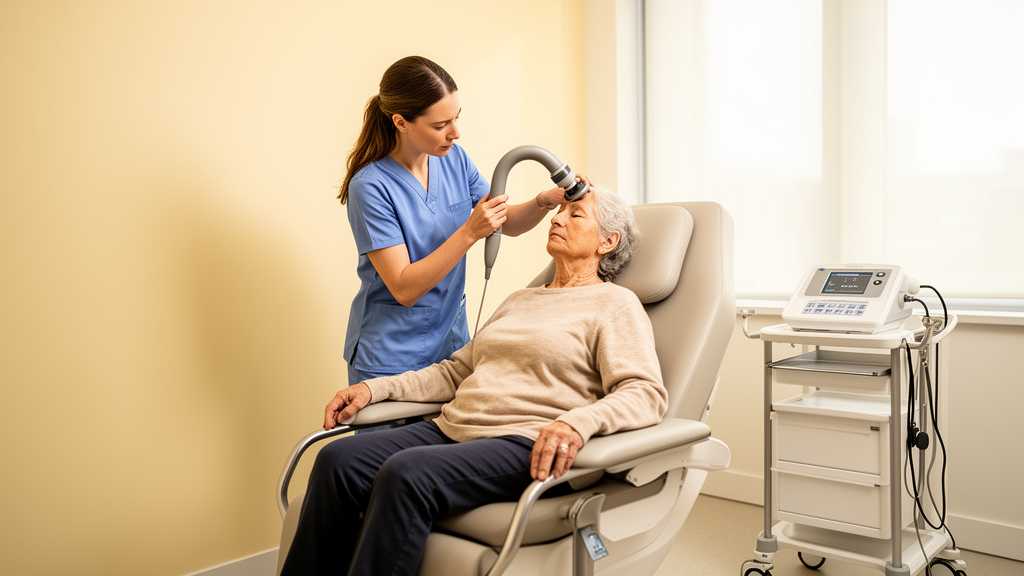
A randomized, double-blind, sham-controlled clinical trial has found that applying high-frequency repetitive transcranial magnetic stimulation over the left dorsolateral prefrontal cortex was associated with short-term cognitive improvement in patients with post-stroke cognitive impairment. Researchers evaluated 75 randomized patients, including 68 participants in a modified intention-to-treat clinical analysis, to investigate whether non-invasive brain stimulation could alleviate post-stroke cognitive deficits across varying task demands.
Repetitive transcranial magnetic stimulation, commonly referred to as rTMS, has previously shown promise in improving cognitive function among individuals experiencing post-stroke cognitive impairment. Despite earlier indications of benefit, the specific effects of rTMS under varying cognitive demands and its associated neurophysiological changes had remained incompletely characterized, prompting the clinical investigation reported in BMC Medicine.
In the study protocol, participants were randomly allocated to receive either active rTMS or sham stimulation targeted over the left dorsolateral prefrontal cortex for a duration of 2 weeks. The modified intention-to-treat analysis ultimately evaluated 34 patients in the active rTMS group and 34 patients in the sham stimulation group to ensure a balanced comparison across both treatment arms.
The principal clinical outcome measured by the research team was the change in Montreal Cognitive Assessment scores. In addition to this primary assessment, secondary clinical outcomes included evaluations of mood and general mental state using the Hamilton Depression Rating Scale and the Mini-Mental State Examination, alongside behavioral performance during an n-back working memory task.
Compared with sham stimulation, active rTMS was associated with a greater improvement in global cognitive function, demonstrating a statistically significant group-by-time interaction on the Montreal Cognitive Assessment of beta equals 1.76, with a 95 percent confidence interval ranging from 0.69 to 2.84 and a p-value of 0.001. Participants receiving active stimulation also showed significant improvements in their Mini-Mental State Examination scores and depressive symptoms on the Hamilton Depression Rating Scale.
Behavioral assessments during the working memory test revealed condition-specific differences, showing improvements in reaction time and accuracy during the 1-back condition but not during the 0-back condition. However, formal statistical interaction tests evaluating group by time by condition were not statistically significant, meaning the trial did not establish differential treatment effects between the differing task conditions.
To explore underlying physiological mechanisms, the investigators conducted exploratory electroencephalography and functional near-infrared spectroscopy analyses. The team specifically assessed electroencephalography spectral power, phase-locking value-based functional connectivity, and task-evoked oxygenated hemoglobin concentration changes measured by functional near-infrared spectroscopy.
None of the formally tested neurophysiological comparisons—including electroencephalography spectral power, phase-locking value functional connectivity, or task-evoked functional near-infrared spectroscopy oxygenated hemoglobin measures—remained statistically significant after applying false discovery rate correction. The authors concluded that the neurophysiological findings remain exploratory and emphasized that future validation in larger, adequately powered clinical studies is required.
Subject of Research: Prefrontal rTMS for post-stroke cognitive impairment
Article Title: Cognitive and behavioral effects of prefrontal rTMS in post-stroke cognitive impairment: a randomized sham-controlled trial
Article References: Li, W., Zhao, X., Wen, Y., Li, W., Liu, J., Wu, J., & Guo, G. (2026). Cognitive and behavioral effects of prefrontal rTMS in post-stroke cognitive impairment: a randomized sham-controlled trial. BMC Medicine. https://doi.org/10.1186/s12916-026-05418-2
Image Credits: AI Generated
DOI: 10.1186/s12916-026-05418-2
Keywords: repetitive transcranial magnetic stimulation, rTMS, post-stroke cognitive impairment, stroke recovery, dorsolateral prefrontal cortex, Montreal Cognitive Assessment, Mini-Mental State Examination, Hamilton Depression Rating Scale, working memory, n-back task, electroencephalography, fNIRS, clinical neurology, randomized controlled trial, neurorehabilitation, cognitive rehabilitation
News Source: Cassandra Pierce. (November 13, 2026). Prefrontal rTMS Shows Short-Term Cognitive Gains in Post-Stroke Trial. Scienmag.