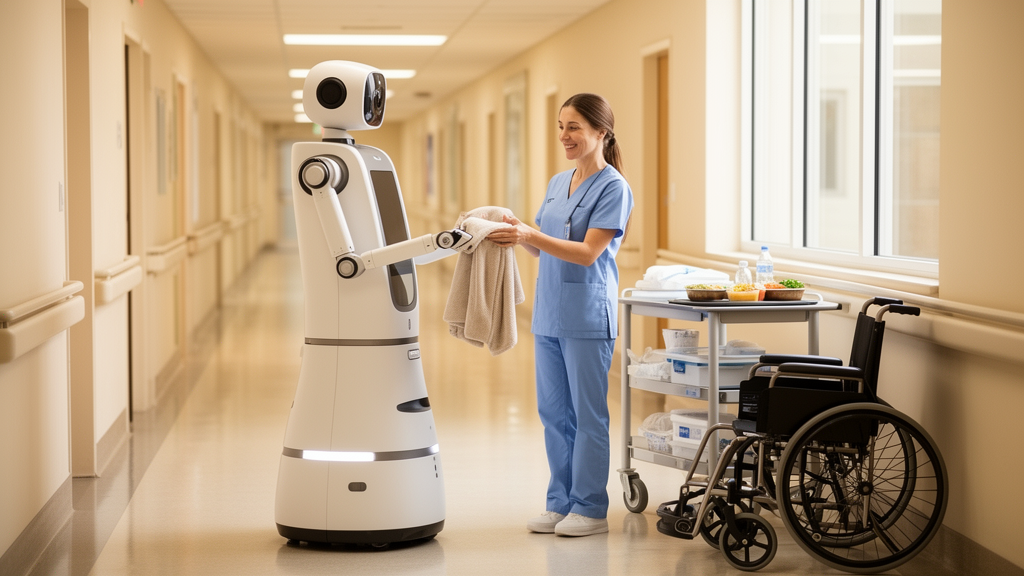
A vision language model has been used as the reasoning core of a multifunctional healthcare robot that performed object delivery, documentation, visual monitoring, patient education, and medication reminders in a real patient room. The system, described in a study published in Frontiers in Robotics and AI, was built on a TIAGo Pro robot and evaluated in an unoccupied patient room at the Innovation Design Unit of Nebraska Medicine. Rather than introducing a new model, the researchers organized existing vision language model agent techniques into a multiagent architecture in which a main agent routes natural language requests to dedicated task agents, each defined by editable natural language phase descriptions.
The motivation comes from a well-documented strain on health workforces. The World Health Organization estimated a global shortage of about 5.8 million nurses in 2023, with shortages expected to persist through the end of the decade. A survey of more than 43,000 U.S. healthcare workers found that 56 percent of nurses reported burnout and 41 percent intended to leave their job. A clinician’s shift involves administering medication, assessing patients, documenting care, handling supplies, and communicating with patients and staff, often with frequent switching and interruption. Most existing healthcare robots, however, perform only a single function, such as delivery, disinfection, patient transport, lifting, or social interaction, so covering a wider range of work requires deploying multiple separate platforms.
A smaller set of robots, including Hobbit, Lio, and HoLLiECares, performs several tasks on one platform, but the new study identifies common limitations among them. Each task is hard-coded through state machines, behavioral scripts, or separate pipelines, so clinicians cannot adapt behavior to a particular room, patient, or care team without a developer modifying code. These systems also lack a shared layer of common robot skills, making design harder to scale, and they respond through fixed commands and preset routines rather than reasoning over visual, contextual, and verbal information.
The proposed architecture addresses this with what the authors call phase-prompt task design. A clinician writes a short task description and a sequence of natural language phases that describe what the robot should accomplish at each stage and how to use available tools. At runtime, a main agent interprets a request from a clinician or patient and dispatches it to the appropriate task agent, which executes the task by calling tools one at a time, reasoning over the phase description, the user command, and the results of previous tool calls before deciding the next action. This differs from the team’s earlier simulation work, in which the system generated the sequence of all skill calls at once before execution.
A shared Model Context Protocol tool layer underpins the whole system. The researchers developed 28 functions as MCP tools, organized into navigation, motion and manipulation, communication and recording, speech and transcription, retrieval, and perception. These tools were built mostly on the TIAGo Pro ROS 2 Humble software stack, connecting a Python-based agent runtime to ROS 2 actions, services, topics, and control interfaces. Backend services support computationally heavy components, including a Cosmos Reason2 visual grounding server and a SAM2 segmentation server used for object localization, a Whisper server for transcription, and a Supabase vector database storing vetted patient education documents for a retrieval-augmented generation pipeline.
Because each task is written as editable text rather than fixed program logic, task behavior can be adapted without rewriting robot code. For the demonstration room, the researchers modified the final phases of the object delivery task so the robot turned toward the delivery table, checked the view with its head camera, measured the table position, approached it, and placed the object down, changing the task from 15 to 19 tool calls. The authors note that initial task authoring may still require developer support, since phase descriptions must be written with awareness of the available robot tools, and that a task requiring an entirely new capability would still need a developer to implement and validate a new low-level tool.
The evaluation focused on orchestration rather than clinical performance. No human participants were involved, clinicians did not create or modify task specifications as part of the evaluation, and the four simpler tasks, which move the robot to a location and call their defined tools without manipulation, completed across all models and all ten trials each. The object delivery task, with six phases and about twenty tool calls, was the only task long enough to expose differences between the three reasoning models compared: the commercial gpt-5.4-mini and the open-weight qwen3.5-122b-a10b and qwen3.5-35b-a3b, each run ten trials with the same prompt and scene.
The results separated the models on reliability rather than speed. The 122B Qwen model completed all six phases in every trial. Gpt-5.4-mini completed nine of ten trials, in one case skipping the approach step in the final phase, opening the gripper before reaching the delivery point, and still reporting the delivery as successful. The 35B Qwen model completed six of ten trials, stopping at the third phase near the move_head step in four trials and likewise reporting a hallucinated success. Across the comparison, the 122B model produced no false success reports, gpt-5.4-mini produced one, and the 35B model produced four. The authors emphasize that in a medication delivery setting a false report of success is more dangerous than a visible failure, because the user may not immediately know the task remains unfinished.
Timing told a secondary story. Average language model time across roughly twenty calls was 41.6 seconds for the 122B Qwen model, 48.4 seconds for the 35B model, and 66.5 seconds for gpt-5.4-mini, though the authors caution that the models ran through a routing service, so serving path affects response time and the differences should not be read as a property of model size. Total task time was similar at 155 to 166 seconds because robot motion dominates and varies between trials. Both failure modes shared a pattern: the models dropped required tool calls in the middle or late part of the sequence, stopped issuing calls, and generated a final success response that the runtime, which terminates execution when the model returns a response without a tool call, treated as normal completion. The experiments identify the execution-level failure mechanism but do not establish the internal model-level cause; the authors state that a larger study across models, sequence lengths, and runtime configurations would be needed to determine whether the failures arise from model capability, accumulated context, tool-calling behavior, or their interaction.
The study’s limitations are explicit. Clinical performance, including the quality of documentation summaries, monitoring reports, and patient education responses, was outside the scope, and the prototype retrieval, reporting, and scheduling components should not be interpreted as validated clinical systems. Trials occurred in a single unoccupied room with predefined task specifications and locations, so the results support structured task execution under predefined conditions rather than clinical performance or autonomous care decision making. The patient education task also spoke its answer without checking that a person was present, a noted design limitation. Future work the authors propose includes explicit task state tracking with phase completion checks, execution monitors that intercept premature termination responses, wider sensing beyond the narrow head camera, object-grounding tools that request clarification for ambiguous targets, and hybrid designs in which learned visuomotor policies operate only within bounded local action spaces while phase structure and safety checks remain explicit. Within those boundaries, the study supports the architecture as a practical reasoning core for a multifunctional healthcare robot and identifies task state consistency across tool calls as the key reliability issue for vision language model agents performing long, multi-step tasks.
Subject of Research: A vision language model based multiagent architecture enabling a robot to perform multiple healthcare tasks through natural language phase specifications
Article Title: VLM-based multi-agent architecture for multifunctional robotic health attendant (RHA) using phase-prompt task design
Article References: Kim, K., Windle, J., Windle, T., Christian, M., Haas, C., & Lowndes, B. (2026). VLM-based multi-agent architecture for multifunctional robotic health attendant (RHA) using phase-prompt task design. Frontiers in Robotics and AI, 13, 1928137. https://doi.org/10.3389/frobt.2026.1928137
Image Credits: AI Generated
DOI: 10.3389/frobt.2026.1928137
Keywords: healthcare robotics, vision language models, multiagent architecture, Model Context Protocol, natural language task design, robotic health attendant, TIAGo Pro, tool calling, patient room robot, reliability, false success reports, phase-prompt design
News Source: Denise Maddox. (October 29, 2026). Vision-Language Robot Attendant Handles Five Hospital Tasks, But Reliability Lags. Scienmag.