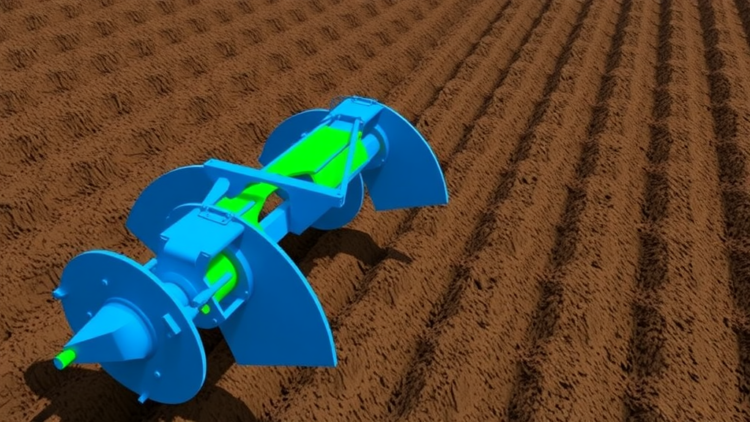
Farmers have long faced a stubborn trade-off: till the soil deeply enough to loosen compacted layers and boost root growth, and you risk destroying the delicate structure that makes soil fertile in the first place. Now a pair of researchers reports that this trade-off may not be inevitable. In a study published in Discover Soil, Nelson Richard Makange of Sokoine University of Agriculture and Changying Ji of Nanjing Agricultural University used the discrete element method (DEM) to simulate, with remarkable precision, how a combined subsoiler and rotary tiller manipulates soil, and their results suggest that the right blade geometry can break hard subsoil while keeping topsoil and subsoil layers largely intact.
The stakes are considerable. Tillage is among the most energy-intensive operations in crop production, and improper machinery use during land preparation can irreversibly damage soil structure. Deep ploughing demands enormous power to fracture compacted horizons, which is why manufacturers have developed machines that pair a passive subsoiler shank with an active, powered rotary tiller. The rotary component pulverizes the soil the subsoiler cracks open, mixes in fertilizer, crop residues and organic amendments, and reduces the number of field passes needed. Fewer passes mean less compaction, less fuel, less labor and less time in the field. But until now, designers have lacked a reliable way to predict exactly what such combined implements do to the soil profile before the steel ever touches the ground.
DEM offers that window. The technique, pioneered in the geotechnical literature since the late 1970s, treats soil not as a continuous medium but as millions of individual particles, solving the equations of motion for each one as they collide, slide and cohere. In this study, the team modeled the soil bed in Altair EDEM 2022 software using the hysteretic spring with linear cohesion contact model, which adds a cohesion resistance to the normal contact forces between particles to mimic the behavior of real clay. The implement itself was designed in PTC Creo Parametric 3D modeling software and imported into the simulation environment, allowing the researchers to replicate the exact geometry of the subsoiler-cum-rotary tiller used in physical tests.
Calibration was the critical step. Because no universally accepted procedure exists for selecting the micromechanical parameters that govern particle interactions, the team anchored their model to laboratory measurements. They worked with clay soil from the experimental soil bin at Nanjing Agricultural University, containing 47.0 percent clay, 36.5 percent silt and 15.5 percent sand, with an average bulk density of 1.5 grams per cubic centimeter. Direct shear tests under unconsolidated undrained conditions yielded cohesion, internal friction angle and shear strength via the Mohr-Coulomb equation, while a digital penetrometer measured penetration resistance at ten locations. Using the angle of repose method and reverse parametrization, the researchers iteratively adjusted restitution and friction coefficients until the simulated soil formed a natural pile at 36.87 degrees, matching the physical material’s behavior.
The validation results are striking. Across eighteen soil bin experiments, the mean horizontal tillage resistance measured by sensors on the three-point linkage of a motorized trolley was 1,950.474 newtons, while vertical resistance averaged 295.92 newtons. The DEM model reproduced these values with a relative error of just 0.4 percent for horizontal resistance and 4.9 percent for vertical resistance. Horizontal resistance predictions achieved a coefficient of determination of 0.9997 with a normalized root mean square error of 0.04, while vertical resistance reached an R-squared of 0.9. An unpaired t-test found no statistically significant difference between simulated and measured values for either component, meaning the virtual experiment was statistically indistinguishable from the real one.
The model also predicted the shape of the furrow left behind. Soil profilometer measurements of the tilled profile matched the simulation with a relative error of 4.3 percent, an R-squared of 0.9936 and a normalized RMSE of 0.23. Both experiment and simulation produced U-shaped furrows with loose soil at the bottom, a profile considered favorable for seed coverage. The average top width of the soil profile was 0.405 meters in the soil bin versus 0.3875 meters in the simulation, and bottom widths were 0.26 and 0.25 meters respectively, a close correspondence that underscores the model’s fidelity.
Perhaps the most consequential finding concerns soil mixing. By coloring the simulated topsoil and subsoil particles differently, the researchers could watch, in effect, inside the soil as the machine passed through. The L-shaped rotary blades promoted predominantly horizontal and downward soil movement with limited upward throw, allowing topsoil particles to migrate toward deeper layers without wholesale inversion of the profile. Even at a tillage depth of 30 centimeters, the natural layering remained discernible, a critical advantage over conventional rotary systems that churn the profile indiscriminately. The mixing of the two layers increased with cutting depth, as expected given the larger soil volume involved, but the vertical-axis rotation design avoided dragging subsoil to the surface, preserving stratification that underpins fertility and moisture retention.
The study also mapped how operating parameters drive energy demand. Both horizontal and vertical resistance rose as tillage depth increased from 0.15 to 0.30 meters, because deeper operation cuts, disperses and moves a greater volume of soil. Resistance likewise grew when forward speed increased from 1.5 to 2.5 kilometers per hour, since faster-moving soil particles gain acceleration, raising normal loads on the tool and thus frictional resistance. The substantial gap between horizontal and vertical forces, roughly 1,800 to 2,060 newtons versus 264 to 323 newtons, shows that far more energy is spent dragging the implement forward than penetrating downward. Notably, the rotary tiller’s rotational motion generated a forward thrust component that offset part of the draft requirement, one reason combined active-passive implements outperform conventional systems in energy efficiency.
The practical implications reach from the design office to the farm field. For manufacturers, the validated model provides a virtual testing platform to optimize blade shape, operating depth and rotational speed across diverse soil conditions without costly physical prototyping. The evidence points toward vertical-axis rotary tillers equipped with L-shaped blades as the configuration of choice for deep tillage that respects soil architecture. For farmers, the combined implement approach promises reduced operational time and fuel consumption while maintaining soil quality, addressing economic and environmental goals simultaneously. As the authors conclude, DEM can serve as an accurate, consistent and fast method for predicting the final soil condition and the resistances required for tillage operations, and with proper blade selection, deep tillage and soil structure conservation need no longer be opposing goals.
Subject of Research: Discrete element simulation of rotary mixing effects on soil structure and tillage resistance for a combined subsoiler and rotary tiller
Article Title: Evaluation of rotary mixing effects on soil structure and tillage resistance using discrete element method
Article References: Makange, N. R., & Ji, C. (2026). Evaluation of rotary mixing effects on soil structure and tillage resistance using discrete element method. Discover Soil, 3(1), Article 148. https://doi.org/10.1007/s44378-026-00308-8
Image Credits: AI Generated
DOI: 10.1007/s44378-026-00308-8
Keywords: discrete element method, tillage resistance, rotary tiller, subsoiler, soil structure, soil bin experiments, EDEM simulation, blade geometry, deep tillage, soil profile, precision agriculture, soil-tool interaction
Cite Scienmag News
APA MLA Chicago
Alan Morgan. (September 12, 2026). Virtual Soil Lab: Simulations Reveal How Rotary Blades Can Till Deep Without Destroying Soil Structure. Scienmag. https://scienmag.com/virtual-soil-lab-simulations-reveal-how-rotary-blades-can-till-deep-without-destroying-soil-structure/
Alan Morgan. “Virtual Soil Lab: Simulations Reveal How Rotary Blades Can Till Deep Without Destroying Soil Structure.” Scienmag, 12 September 2026, https://scienmag.com/virtual-soil-lab-simulations-reveal-how-rotary-blades-can-till-deep-without-destroying-soil-structure/. Accessed 12 September 2026.
Alan Morgan. “Virtual Soil Lab: Simulations Reveal How Rotary Blades Can Till Deep Without Destroying Soil Structure.” Scienmag. September 12, 2026. https://scienmag.com/virtual-soil-lab-simulations-reveal-how-rotary-blades-can-till-deep-without-destroying-soil-structure/
Copy citation Download RIS
Tags: agricultural machinery optimizationblade geometrydeep soil loosening techniquesdeep tillagediscrete element methoddiscrete element method in agricultureEDEM simulationenergy-efficient tillage practicesimpact of tillage on soil fertilityprecision agriculturerotary tillerrotary tiller blade designsoil bin experimentssoil compaction managementsoil physics modelingsoil profilesoil structuresoil structure preservationSoil tillage simulationsoil-tool interactionsubsoilersubsoiler and rotary tiller integrationsustainable soil cultivationtillage resistance