• HOME
  • NEWS
  • EXPLORE
    • CAREER
      • Companies
      • Jobs
    • EVENTS
    • iGEM
      • News
      • Team
    • PHOTOS
    • VIDEO
    • WIKI
  • BLOG
  • COMMUNITY
    • FACEBOOK
    • INSTAGRAM
    • TWITTER
Wednesday, November 18, 2026
BIOENGINEER.ORG
No Result
View All Result
  • Login
  • HOME
  • NEWS
  • EXPLORE
    • CAREER
      • Companies
      • Jobs
        • Lecturer
        • PhD Studentship
        • Postdoc
        • Research Assistant
    • EVENTS
    • iGEM
      • News
      • Team
    • PHOTOS
    • VIDEO
    • WIKI
  • BLOG
  • COMMUNITY
    • FACEBOOK
    • INSTAGRAM
    • TWITTER
No Result
View All Result
Bioengineer.org
No Result
View All Result
Home NEWS Science News Health

Virtual Reality Training Improves Learning Outcomes Across Health Professions Curricula

by
November 10, 2026
in Health
Reading Time: 2 mins read
0
Virtual Reality Training Improves Learning Outcomes Across Health Professions Curricula

Virtual Reality Training Improves Learning Outcomes Across Health Professions Curricula

Share on FacebookShare on TwitterShare on LinkedinShare on RedditShare on Telegram

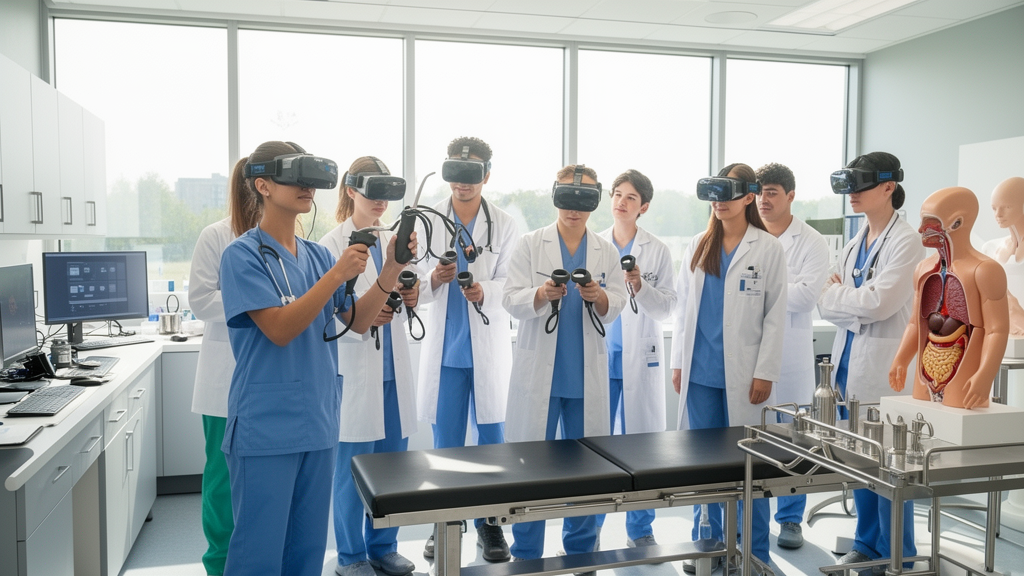
Virtual reality instruction is associated with higher average scores in objectively assessed learning outcomes compared with traditional instructional methods across health professions curricula, according to a systematic review and meta-analysis of twenty-three randomized controlled trials comprising twenty-four independent datasets and 1,202 participants.

The investigation evaluated whether virtual reality delivers consistent advantages across different educational constructs, addressing the limitations of traditional instructional formats in health professions education. Educational outcomes were categorized into two distinct areas: procedural and technical performance, and cognitive and theoretical knowledge.

Researchers systematically searched PubMed, Embase, Scopus, ERIC, and Cochrane Central from inception through August 28, 2026, to identify randomized controlled trials comparing virtual reality with traditional teaching formats. Standardized mean differences were calculated using Hedges’ g through DerSimonian–Laird random-effects models, between-study heterogeneity was quantified using the I-squared statistic, and 95% prediction intervals were computed.

Virtual reality training significantly improved procedural and technical performance compared with traditional methods across thirteen datasets, yielding a standardized mean difference of 0.90 (95% confidence interval 0.43 to 1.37; p = 0.0002; I-squared = 80%; 95% prediction interval: -0.82 to 2.62). For cognitive and knowledge outcomes, virtual reality demonstrated a significant improvement across eleven datasets, with a standardized mean difference of 0.43 (95% confidence interval 0.20 to 0.66; p = 0.0002; I-squared = 54%; 95% prediction interval: -0.21 to 1.07). The difference between the two educational domains was statistically significant (p = 0.005), while the secondary overall pooled effect across all twenty-four datasets was also significant, showing a standardized mean difference of 0.65 (95% confidence interval 0.40 to 0.90; p < 0.00001; I-squared = 74%).

Study quality and evidence strength were formally assessed using established methodological frameworks. Risk of bias across the included randomized controlled trials was evaluated using the Cochrane RoB 2 tool. Under the GRADE framework, the certainty of evidence was rated as moderate for both the procedural and cognitive domains, downgraded solely for inconsistency.

Despite the observed gains, the authors noted that educational advantages may vary across future instructional settings because the calculated 95% prediction intervals crossed zero and substantial between-study heterogeneity was present. In addition, the systematic review was not prospectively registered, and no formal review protocol was prepared prior to study execution.

Subject of Research: Virtual reality instruction and objectively assessed learning outcomes in health professions education

Article Title: The effects of virtual reality on learning outcomes in health professions education: a systematic review and meta-analysis

Article References: Zhang, D., Zeng, J., Yu, F., Jiang, X., & Qian, T. (2026). The effects of virtual reality on learning outcomes in health professions education: a systematic review and meta-analysis. BMC Medical Education. https://doi.org/10.1186/s12909-026-10705-w

Image Credits: AI Generated

DOI: 10.1186/s12909-026-10705-w

Keywords: virtual reality, health professions education, systematic review, meta-analysis, randomized controlled trials, procedural skills, cognitive outcomes, medical education, effects, virtual, reality, learning

News Source: Courtney Benton. (November 10, 2026). Virtual Reality Training Improves Learning Outcomes Across Health Professions Curricula. Scienmag.

Tags: cognitive outcomeseffectshealth professions educationlearningMedical EducationMeta-analysisprocedural skillsrandomized controlled trialsrealitysystematic reviewvirtualvirtual reality
Share12Tweet7Share2ShareShareShare1

Related Posts

Meta-Analysis Identifies Four Causal Risk Factors for Bladder Cancer

Meta-Analysis Identifies Four Causal Risk Factors for Bladder Cancer

November 18, 2026
Inhibiting Toll-like Receptor 2 Reduces Age-Related Pancreatic Islet Inflammation and Fibrosis

Inhibiting Toll-like Receptor 2 Reduces Age-Related Pancreatic Islet Inflammation and Fibrosis

November 18, 2026

Spain NTD Drug Study Reveals Severe Territorial Gaps Across Autonomous Communities

November 18, 2026

Guinea Health Study Reveals Severe Workforce Unemployment Despite Rising Professional Training

November 18, 2026

POPULAR NEWS

  • Spain NTD Drug Study Reveals Severe Territorial Gaps Across Autonomous Communities

    Spain NTD Drug Study Reveals Severe Territorial Gaps Across Autonomous Communities

    29 shares
    Share 12 Tweet 7
  • Guinea Health Study Reveals Severe Workforce Unemployment Despite Rising Professional Training

    29 shares
    Share 12 Tweet 7
  • Rootstock Signaling Networks Dynamically Reprogram Fruit Quality Across Horticultural Crops

    29 shares
    Share 12 Tweet 7
  • Review Uncovers How Group 2 Innate Lymphoid Cells Bridge Neuroimmune Communication

    29 shares
    Share 12 Tweet 7

About

We bring you the latest biotechnology news from best research centers and universities around the world. Check our website.

Follow us

Recent News

Meta-Analysis Identifies Four Causal Risk Factors for Bladder Cancer

Inhibiting Toll-like Receptor 2 Reduces Age-Related Pancreatic Islet Inflammation and Fibrosis

Spain NTD Drug Study Reveals Severe Territorial Gaps Across Autonomous Communities

Subscribe to Blog via Email

Enter your email address to subscribe to this blog and receive notifications of new posts by email.

Join 88 other subscribers
  • Contact Us

Bioengineer.org © Copyright 2023 All Rights Reserved.

Welcome Back!

Login to your account below

Forgotten Password?

Retrieve your password

Please enter your username or email address to reset your password.

Log In
No Result
View All Result
  • Homepages
    • Home Page 1
    • Home Page 2
  • News
  • National
  • Business
  • Health
  • Lifestyle
  • Science

Bioengineer.org © Copyright 2023 All Rights Reserved.