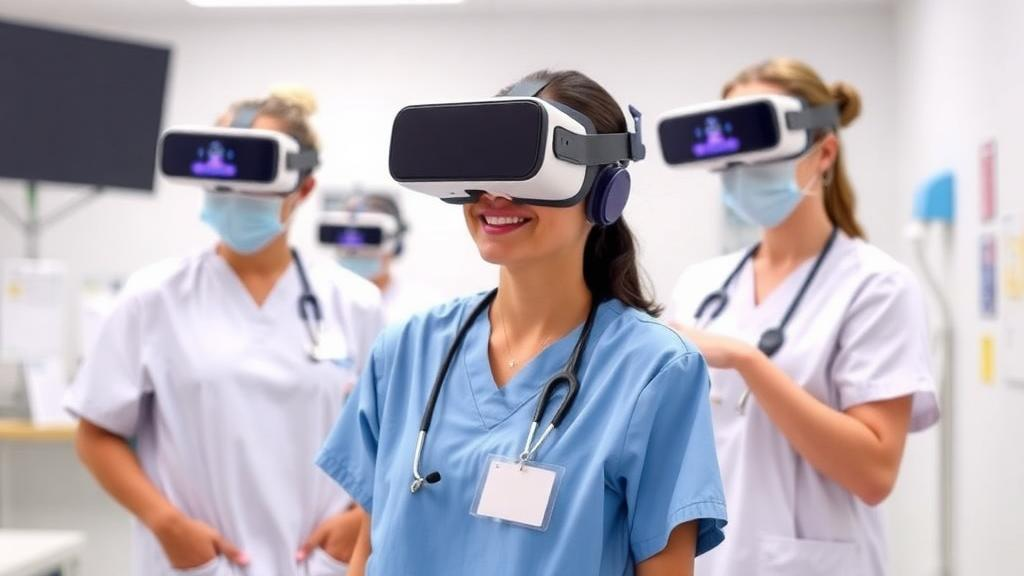
Virtual reality has moved steadily from the gaming world into hospital corridors and simulation labs, and a new systematic review now offers one of the most comprehensive assessments yet of what the technology actually delivers for working nurses. The analysis, published in BMC Nursing, pooled data from 30 studies involving in-service nurses and found that VR-based training may improve knowledge, practical skills, self-efficacy, and critical thinking compared with conventional instruction. But the authors, led by Shanmei Zhou of Chengdu University of Traditional Chinese Medicine, are careful to temper the enthusiasm: the strength of the underlying evidence varies dramatically across outcomes, and some of the most striking effect sizes come with serious statistical caveats.
The research team cast a wide net. They searched international databases including PubMed, Web of Science, Embase, and the Cochrane Library, alongside Chinese-language sources such as SinoMed, CNKI, Wanfang, and VIP, capturing all relevant studies published in English or Chinese up to April 2026. That dual-language strategy matters, because a substantial share of nursing simulation research emerges from China, and reviews limited to English-language literature risk missing a large portion of the global evidence base. The search identified 30 studies that met the inclusion criteria: 16 randomized controlled trials, which served as the primary evidence base, and 14 quasi-experimental studies, which the researchers synthesized separately as supplementary support.
Methodologically, the review followed the modern playbook for evidence synthesis. Randomized trials were assessed for risk of bias using the RoB 2.0 tool, while quasi-experimental studies were evaluated with ROBINS-I, a instrument designed for non-randomized intervention research. Effect sizes were pooled as standardized mean differences, or SMD, a statistic that expresses the gap between groups in units of standard deviation and allows studies using different measurement scales to be combined. An SMD of 0.8 is conventionally considered a large effect, so the numbers reported in this review are, on their face, remarkable.
The headline result concerns practical skills. VR training was associated with an SMD of 2.19 for practical skills, with a 95 percent confidence interval of 1.35 to 3.02, a difference far beyond what most educational interventions achieve. Knowledge outcomes showed an SMD of 1.74, with a confidence interval of 1.10 to 2.38, and critical thinking ability reached an SMD of 1.85, spanning 0.93 to 2.77. Self-efficacy, by contrast, showed a much more modest effect, with an SMD of 0.29 and a confidence interval of 0.03 to 0.54, suggesting that while VR may sharpen what nurses know and can do, its impact on their confidence in their own abilities is smaller and statistically more fragile.
Those large effects, however, come wrapped in warnings. The researchers observed high heterogeneity across studies for both knowledge and practical skills outcomes, meaning the individual studies varied widely in their reported effects, likely reflecting differences in VR platforms, training content, session duration, control conditions, and outcome measures. High heterogeneity makes a pooled estimate harder to interpret, because averaging across wildly different studies can produce a number that describes none of them well. Publication bias was also detected for the knowledge and skills outcomes, a signal that studies reporting null or negative results may be underrepresented in the published literature.
Yet the publication bias story has a reassuring twist. When the team applied the Duval and Tweedie trim-and-fill method, a statistical technique that estimates how many studies might be missing from an asymmetric funnel plot and recalculates the pooled effect after imputing them, it found no evidence of bias-related missing studies. The adjusted pooled effect sizes remained consistent with the original estimates. In other words, even after statistically accounting for the possibility of unpublished null results, the overall conclusions held, which lends some credibility to the large observed effects even if it cannot fully dispel the concern.
The GRADE assessment, a widely used framework for rating the certainty of evidence, tells a more sobering story. The certainty of evidence was rated as very low for knowledge level and practical skills, the two outcomes with the flashiest effect sizes. High heterogeneity, publication bias, and small sample sizes all contributed to downgrading. By contrast, the evidence for self-efficacy was rated high in certainty, and critical thinking received a moderate rating. This inversion, where the most impressive numbers rest on the weakest foundations, is a familiar pattern in educational research and underscores why GRADE-style appraisals have become essential reading for anyone interpreting meta-analyses.
Why might VR work at all for nursing education? The technology’s core advantage is deliberate, repeatable practice in scenarios that are dangerous, rare, or emotionally charged in real clinical settings. A nurse can intubate a deteriorating virtual patient, respond to a simulated cardiac arrest, or rehearse infection-control protocols dozens of times without risk to a single real person. Immersive headsets and haptic feedback engage visual, auditory, and kinesthetic channels simultaneously, which learning scientists argue strengthens procedural memory and decision-making under pressure. For in-service nurses, who juggle shift work and cannot easily attend classroom sessions, VR also offers flexibility, allowing training to be scheduled around clinical duties and standardized across departments.
The modest self-efficacy finding is worth pondering. Self-efficacy, the belief in one’s own capability to execute tasks, is a well-established predictor of clinical performance and resilience. If VR builds competence but not confidence, the technology may be delivering half of what simulation educators hope for. One possibility is that highly realistic virtual environments expose nurses to their own errors in vivid detail, which is pedagogically valuable but psychologically humbling. Another is that the measurement instruments for self-efficacy are less sensitive to change than skills checklists, compressing observed effects. The high certainty rating for this outcome suggests the small effect is trustworthy, even if the mechanism remains unclear.
For hospital administrators and nursing educators watching the rapid commercialization of medical VR, the practical takeaway is one of cautious optimism. The evidence suggests VR training can outperform conventional approaches across multiple dimensions, and the trim-and-fill analysis strengthens the case that these benefits are not simply artifacts of selective publishing. But the very-low certainty ratings for knowledge and skills mean institutions should treat the largest claimed gains as provisional, demand well-designed randomized trials with larger samples and standardized outcome measures, and avoid assuming that any VR package will replicate the pooled results. The authors themselves conclude that the findings should be interpreted with caution, a reminder that in the fast-moving world of immersive education technology, the gap between what a headset can do and what the evidence can prove is still being measured.
Subject of Research: Effectiveness of virtual reality training for in-service nurses
Article Title: Effectiveness of virtual reality in training of in-service nurses : a systematic review and a meta-analysis
Article References: Zhou, S., Du, H., Qiu, X., Li, Y., & Hua, G. (2026). Effectiveness of virtual reality in training of in-service nurses : a systematic review and a meta-analysis. BMC Nursing. https://doi.org/10.1186/s12912-026-05423-z
Image Credits: AI Generated
DOI: 10.1186/s12912-026-05423-z
Keywords: virtual reality, nursing education, meta-analysis, systematic review, in-service nurses, simulation training, clinical skills, self-efficacy, critical thinking, GRADE, publication bias, healthcare training
News Source: Ophelia Keating. (October 6, 2026). Virtual Reality Training Boosts Nurses’ Skills, Landmark Review Finds. Scienmag.