


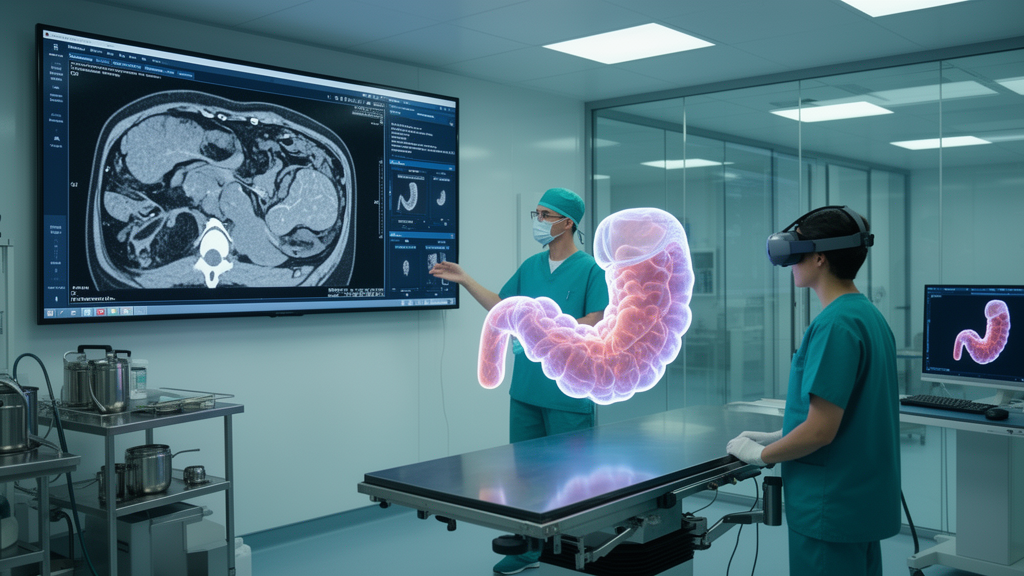
Virtual reality headsets may promise surgeons an immersive, three-dimensional look inside the body, but a new randomized trial suggests that the technology, at least in one common implementation, can make pancreatic cancer surgery planning harder rather than easier. The conventional display won on nearly every measure that matters for surgical decision-making.
The study, conducted at Charité – Universitätsmedizin Berlin and Universitätsklinik Münster and registered prospectively in the German Clinical Trials Register (DRKS00033932), focused on resectability assessment: the judgment of whether a pancreatic tumor can be safely removed, should be treated first with drugs, or is too advanced for surgery. That judgment rests on the relationship between the tumor and major blood vessels, classified under National Comprehensive Cancer Network guidelines. It is a decision with enormous consequences, because it helps determine whether a patient undergoes potentially curative surgery, receives neoadjuvant therapy, or is managed without an operation.
The problem the researchers set out to address is real. Previous studies have found only fair-to-moderate agreement about pancreatic cancer resectability even among experienced raters, with one multicenter study reporting that a third of cases received all three possible resectability classifications from different observers. Between 10 and 36 percent of patients deemed radiologically resectable ultimately do not undergo resection, a gap that underscores the limits of current imaging-based assessment. Virtual reality, which allows physicians to view medical data as a stereoscopic three-dimensional model, manipulate resection planes from any perspective, and fade surrounding tissue by adjusting opacity, seemed a plausible route to better agreement. Several VR DICOM viewers have already received FDA 510(k) clearance and European CE marking, making the question of optimal visualization strategy increasingly urgent.
In the trial, the ten participating surgeons, all board-certified with hepatopancreatobiliary subspecialty training and practicing at centers performing more than 75 pancreas surgeries annually, were randomized one-to-one to the two visualization methods, with stratification by surgical experience level. The VR group used Medical Holodeck software on a Meta Quest 3 headset, rendering the CT volumes with a transfer function set to −125 to 225 Hounsfield Units to approximate standard abdominal windowing. The comparison group reviewed the same scans as sequential two-dimensional slices using OsiriX MD on a laptop connected to a 4K monitor. An expert pancreatic radiologist who regularly participates in multidisciplinary tumor boards independently evaluated all cases using cross-sectional imaging, providing the reference standard for accuracy comparisons.
The results favored the conventional approach decisively. For the overall resectability classification, the five surgeons using cross-sectional imaging achieved substantial inter-rater agreement, with a Fleiss’ kappa of 0.609, while the VR group showed only slight agreement, at kappa 0.127. A prevalence-robust sensitivity metric, Gwet’s AC1, corroborated the pattern, yielding 0.684 for the conventional group versus 0.249 for VR. Diagnostic accuracy against the expert reference standard was also higher with conventional imaging: 84.7 percent overall compared with 79.7 percent for VR. The most pronounced divergence appeared in resectability determination itself, where the conventional group matched the expert reference in 83.3 percent of cases against 58.3 percent for VR, a 25 percentage point difference that reached statistical significance (p = 0.033).
Surgeons also felt markedly less sure of themselves in the headset. On a seven-point confidence scale, the conventional imaging group reported a mean of 6.32 (standard deviation 0.77), while VR users averaged 4.85 (standard deviation 1.15), a difference that was statistically significant (p = 0.028). Notably, this confidence gap did not come at the price of speed: total assessment times were nearly identical between groups, with a median of 313.5 seconds for VR versus 327.5 seconds for conventional imaging, and no task-level comparison reached statistical significance. The VR participants, in other words, perceived the anatomy but apparently found the representations insufficiently clear for confident interpretation, without spending extra time trying to resolve their uncertainty.
The detailed anatomical assessments revealed where the immersive display struggled most. Arterial contact judgments showed striking disparities: splenic artery contact reached almost perfect agreement with conventional imaging (kappa 0.932) versus substantial agreement with VR (kappa 0.627), and coeliac trunk contact achieved substantial agreement with conventional displays (kappa 0.639) but only slight agreement in VR (kappa 0.191). Portal vein contact was similarly weaker in VR. Accuracy against the expert reference followed the same pattern for most vessels, with the conventional group ahead on splenic artery, coeliac trunk, common hepatic artery, portal vein and superior mesensenteric vein contact. VR did show some strengths, outperforming conventional imaging on arterial variation classification (78.3 percent versus 71.7 percent) and matching it on vascular stenosis assessment, but tumor position localization was weaker in VR.
Direct observation of the participants and their feedback pointed to concrete usability problems. The VR renderings appeared at a fixed, overly distant position in a coronal orientation, forcing users to manually reposition and rotate each case toward the axial views they were accustomed to. The transfer function interface proved too complex for practical use, so participants could not adjust window settings, leaving renderings overly bright with poor calcification visibility. Two participants reported mild cybersickness but completed all assessments. The authors also emphasize a deeper confound: these surgeons had interpreted orders of magnitude more cross-sectional images than VR renderings during their careers, so the observed differences may reflect experience disparity and novelty rather than intrinsic limits of the technology.
The comparison with other recent work suggests that visualization strategy, not virtual reality itself, may be the decisive factor. A 2024 study by Kunz and colleagues reported substantial inter-rater agreement for VR-based resectability assessment (kappa 0.7, compared with kappa 0.04 for conventional imaging) using a fundamentally different approach: a hybrid display showing exclusively osseous structures and contrast-enhanced vessels, with cutting planes that generated opaque cross-sectional slices for orientational anchoring. That implementation preserved familiar radiological viewing conventions inside the immersive environment, a design balance the current authors deliberately excluded in order to create a controlled comparison. The authors caution that kappa values across the two studies are not directly comparable, given differences in study design, reference standards and participant composition, but they argue the contrast highlights the importance of how three-dimensional data are presented rather than whether a headset is used.
The team is careful to frame the findings as preliminary and hypothesis-generating. With only ten surgeons and twelve cases, statistical power is limited and the kappa estimates are fragile; a single expert radiologist served as the reference standard, which cannot capture inter-expert variability; residual imbalances persisted despite stratified randomization, since the VR group happened to have greater surgical experience and universal prior VR exposure; and only one VR platform was tested. The study also measured agreement and accuracy as surrogate endpoints, and improved agreement does not automatically translate into better surgical outcomes, which would require separate prospective evaluation. Still, the message for a field in which VR software certification is becoming routine is pointed: immersive three-dimensional display alone does not guarantee better surgical planning, and future implementations may need hybrid designs that combine volumetric navigation with the cross-sectional conventions radiologists and surgeons have spent their careers mastering.
Subject of Research: Virtual reality volumetric rendering versus cross-sectional imaging for assessing pancreatic cancer resectability
Article Title: Virtual reality volumetric rendering versus cross-sectional imaging for pancreatic cancer resectability assessment: a pilot randomized controlled reader study
Article References: Eisenträger, K., Saribeyoglu, K., Fehrenbach, U., Felsenstein, M., Timmermann, L., Pereira, P. L. M., Schöning, W., Strücker, B., Pratschke, J., Pascher, A., Malinka, T., Sauer, I. M., Morgul, H., & Queisner, M. (2026). Virtual reality volumetric rendering versus cross-sectional imaging for pancreatic cancer resectability assessment: a pilot randomized controlled reader study. Bioelectronic Medicine, 12(1), Article 7. https://doi.org/10.1186/s42234-026-00202-2
Image Credits: AI Generated
DOI: 10.1186/s42234-026-00202-2
Keywords: virtual reality, pancreatic cancer, resectability, CT imaging, surgical planning, inter-rater agreement, reader study, randomized controlled trial, hepatopancreatobiliary surgery, medical visualization, NCCN guidelines, diagnostic accuracy
News Source: Ophelia Keating. (October 29, 2026). Virtual Reality Falls Short of Standard Scans in Pancreatic Cancer Surgery Planning Trial. Scienmag.



