


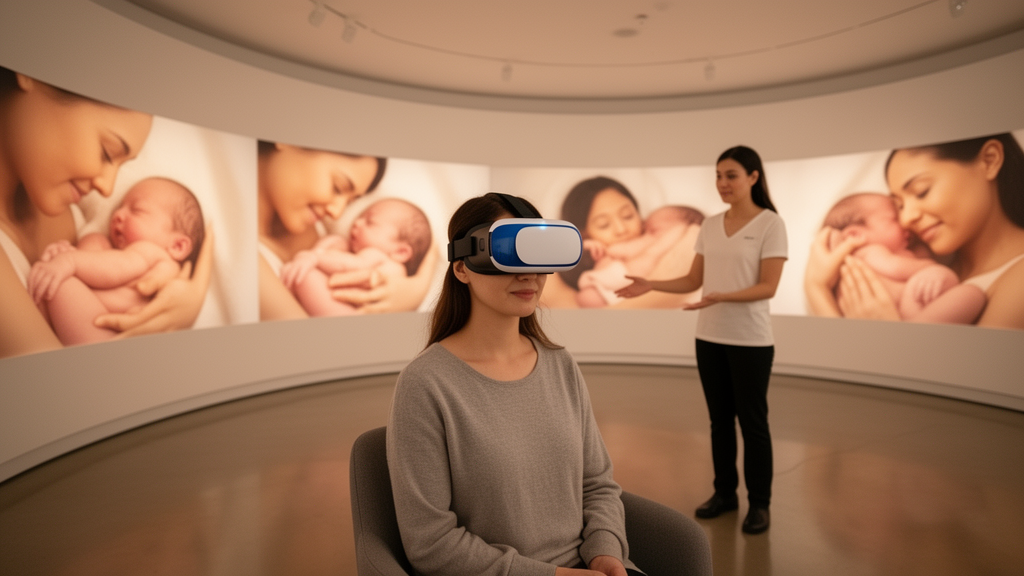
A randomized controlled trial conducted in Türkiye found that a breastfeeding education program delivered inside a digital “breastfeeding museum” using Metaverse and virtual reality technology improved breastfeeding knowledge, self-efficacy, and postpartum breastfeeding success among first-time mothers. The study, published in BMC Pregnancy and Childbirth, enrolled primiparous pregnant women in their third trimester who were attending antenatal breastfeeding education classes for the first time and had no previous breastfeeding experience.
The trial ran between July 2023 and April 2024 across three hospitals in Türkiye. In total, 60 primiparous women were randomized, and data from 53 women were included in the final analyses: 28 in the intervention group and 25 in the control group. Women in the intervention group received Metaverse- and VR-supported breastfeeding education in the digital breastfeeding museum, while the control group received routine antenatal breastfeeding education. Outcomes were measured with the Breastfeeding Self-Efficacy Scale–Short Form (BSES-SF), the LATCH breastfeeding assessment tool, and a breastfeeding knowledge questionnaire at three time points: before the intervention, immediately after it, and after delivery. Data were analyzed using IBM SPSS version 29.0.2.0 with a significance threshold of α = 0.05.
Linear mixed-effects modeling showed a significant main effect of group (p = 0.003), a significant main effect of time (p < 0.001), and a significant group × time interaction (p = 0.031) for breastfeeding knowledge, indicating that the two groups changed differently over the study period. For breastfeeding self-efficacy, the main effects of group (p = 0.005) and time (p < 0.001) were significant, but the group × time interaction was not (p = 0.100), meaning both groups improved over time without a statistically distinguishable difference in their trajectories.
Pairwise comparisons quantified the between-group gaps. Breastfeeding knowledge scores were significantly higher in the intervention group than in the control group both immediately after the intervention (adjusted mean difference: 13.25, 95% CI: 8.74–17.76) and postpartum (adjusted mean difference: 8.86, 95% CI: 4.58–13.13). Self-efficacy scores followed the same pattern, with the intervention group scoring significantly higher at post-intervention (adjusted mean difference: 7.08, 95% CI: 3.29–10.87) and postpartum (adjusted mean difference: 6.18, 95% CI: 1.53–10.84).
Breastfeeding success, assessed with the LATCH tool after birth, also favored the digital intervention. Multiple linear regression showed that women in the intervention group had significantly higher postpartum LATCH scores independent of maternal age, birth weight, gestational age, and mode of delivery (adjusted B = 2.206, 95% CI: 1.215–3.198; p < 0.001). Within the intervention group, BSES-SF and LATCH scores showed a moderate positive correlation after training (r = 0.502; p = 0.006) and a high-level positive correlation postpartum (r = 0.641; p < 0.001), suggesting that mothers who felt more confident about breastfeeding also tended to score higher on the clinical breastfeeding assessment.
The authors conclude that the Metaverse- and VR-supported education delivered through the digital breastfeeding museum contributed to improving breastfeeding knowledge, self-efficacy, and success among primiparous mothers, and they recommend that nurses make use of digital technologies in breastfeeding education. The study’s framing rests on a recognized public health problem: low breastfeeding rates remain a global concern, and organizations such as WHO and UNICEF recommend prenatal breastfeeding education, with developments in digital health offering new channels for delivering it.
Several caveats deserve emphasis. The trial was retrospectively registered (NCT07078825, registered on 25 July 2025), the analyzed sample was small at 53 women, and the published record is a version shared ahead of final production editing, subject to further edits before the Version of Record. The findings therefore come from a single randomized trial in one country with a modest sample size, and the self-efficacy trajectory did not differ significantly between groups over time despite higher absolute scores in the intervention arm. With those limits in mind, the trial offers controlled evidence that an immersive digital education format can outperform routine antenatal education on measured knowledge, confidence, and early breastfeeding outcomes in first-time mothers.
Subject of Research: A randomized controlled trial of Metaverse- and virtual reality-supported breastfeeding education for primiparous pregnant women in Türkiye
Article Title: The effect of Metaverse- and virtual reality–supported education in the digital breastfeeding museum on mothers’ breastfeeding knowledge level, self-efficacy, and success: a randomized controlled trial
Article References: Akkaya Gül, A., & Özyazıcıoğlu, N. (2026). The effect of Metaverse- and virtual reality–supported education in the digital breastfeeding museum on mothers’ breastfeeding knowledge level, self-efficacy, and success: a randomized controlled trial. BMC Pregnancy and Childbirth. https://doi.org/10.1186/s12884-026-10052-0
Image Credits: AI Generated
DOI: 10.1186/s12884-026-10052-0
Keywords: breastfeeding, virtual reality, Metaverse, digital health, randomized controlled trial, prenatal education, self-efficacy, LATCH, primiparous women, Türkiye, nursing, maternal health
News Source: Ophelia Keating. (October 29, 2026). Virtual Reality Breastfeeding Museum Boosts Knowledge and Confidence in First-Time Mothers. Scienmag.



