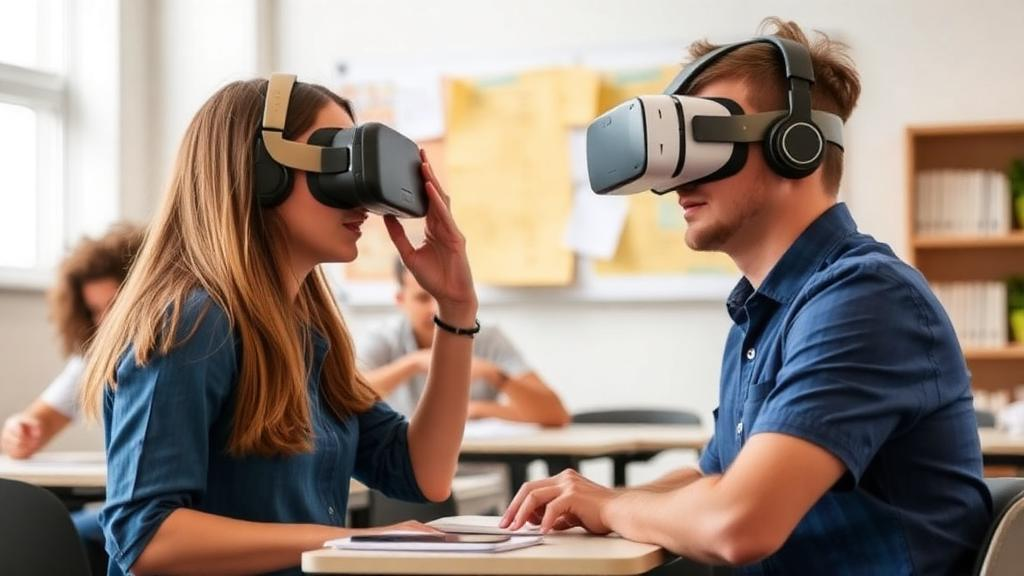
In a modest classroom in the Andalusian town of Priego de Córdoba, twenty-four thirteen- and fourteen-year-old students recently traded their textbooks for virtual reality headsets, and the results have caught the attention of education researchers across Europe. A team from the University of Jaén and the University of Córdoba, led by Diego Francisco García-Molina and Paula Triviño-Tarradas, has published a study in the journal Multimedia Tools and Applications describing how a carefully structured combination of the flipped classroom method and immersive virtual reality resources transformed the way second-year secondary students learned about the medieval history of their own town. The intervention, carried out within the regular Geography and History curriculum at the IES Fernando III high school, produced measurable gains in academic performance alongside striking improvements in how students perceived their own understanding, attention, and engagement.
The study addresses a challenge that has become a global imperative: improving digital teacher training at a moment when Information and Communication Technologies continue to reshape the educational landscape. As the authors note, educators increasingly need to embrace new pedagogical approaches rather than simply layering technology onto traditional lectures. Their answer was to combine two complementary innovations. The flipped classroom model, popularized by Bergmann and Sams, inverts the conventional sequence of instruction: students first encounter new material at home through videos and guided activities, and then use classroom time for interactive, teacher-supported work that would traditionally have been homework. Virtual reality, meanwhile, was deployed not as a gimmick but as a means of reconstructing a past that no longer exists physically, allowing students to walk through the medieval walls and castle of Priego de Córdoba in their original state.
The research design was deliberately grounded in local heritage, which gave the virtual content an emotional resonance that generic educational software often lacks. Priego de Córdoba, known in the Islamic period as Madinat Baguh, preserves only fragments of its medieval fortifications, and the castle visible today differs substantially from its original form. Using digital reconstruction techniques, the team created immersive scenarios showing the walls, the walkway, the access doors, the castle, and its keep as they stood during the Middle Ages, together with the modifications introduced after the Christian conquest. Students first worked through at-home video activities covering the town’s Islamic origins and its conquest by Fernando III, then located the virtual scenarios on an urban plan, and finally explored the reconstructed environments interactively, pressing on the screen to reveal characteristic medieval elements hidden within each scene.
The pedagogical sequence was structured across four activities. The first two were completed at home and required students to watch linked videos and answer questions about archaeological remains, the Muslim settlement of the town, the Christian conquest, the military order that subsequently guarded Priego, and the function of specific buildings. The third activity took place in the classroom, where students used an interactive urban scene projected by the teacher, alongside a printed urban plan, to locate the walls, walkway, gates, castle, and keep on a map of the municipality. The fourth activity was the virtual reality experience itself, in which students matched each immersive scenario to its location on the plan and then discovered interactive medieval features within the reconstruction. This progression, from passive video comprehension to active spatial reasoning and finally to embodied exploration, reflects the logic of Bloom’s revised taxonomy, moving students from remembering and understanding toward applying and analyzing.
Safety and ethics were treated with unusual rigor for a classroom study. Each student completed two VR sessions of approximately five minutes each, totaling ten minutes per participant, with short breaks as needed and continuous supervision by the instructor. Before donning the headset, students received instructions on correct placement, safe posture, and the importance of reporting any discomfort immediately. The instructor monitored for dizziness, nausea, headache, eye strain, blurred vision, disorientation, anxiety, and loss of balance, with protocols in place to stop the activity instantly if any symptom appeared. Students who chose not to continue with the immersive experience could perform an alternative non-immersive task targeting the same learning objectives, without any academic repercussions. Notably, no adverse events of any kind occurred during the study, and no medical attention was required. Written informed consent was obtained from parents or legal guardians, students gave age-appropriate assent, and all data were anonymized and handled in accordance with the GDPR and Spanish data protection law.
The academic results were compelling, though the authors are careful to frame them appropriately. Using a single-group quasi-experimental design, the researchers compared student performance on a first-quarter unit taught with conventional methods against performance on a second-quarter unit delivered with the flipped classroom plus virtual reality approach. Students obtained higher scores under the new methodology, and the Wilcoxon signed-rank test, a non-parametric statistical procedure suited to comparing paired scores from the same group, revealed a significant difference between the two conditions, with a Z statistic of minus 3.039 and a p-value of 0.002. The effect size, calculated as r equal to 0.62, is considered large by conventional standards, meaning the observed improvement was not merely statistically detectable but substantively meaningful. Perhaps most striking, the proportion of students achieving excellence grades rose from 37.5 percent under the traditional method to 87.5 percent under the combined FC plus VR approach.
The research team is candid about the limits of these numbers. Because the study involved a single group of just twenty-four students and lacked a randomized control group, the findings should be interpreted as observed differences within this particular sample rather than as definitive causal proof. Factors such as topic difficulty, seasonal effects, novelty, and the enthusiasm of participating in an innovative project could all have contributed to the gains. Nevertheless, the consistency between the quantitative outcomes and the qualitative evidence strengthens the overall picture. A survey of the student population and an interview with the subject teacher revealed overall satisfaction with the methodology, with respondents reporting higher levels of perceived understanding, attention, and engagement following the intervention. In educational research, where disengaged students are often the silent saboteurs of well-designed curricula, such alignment between performance and perception is a promising signal.
The study also situates itself within a broader body of evidence on immersive learning. Previous work has shown that virtual reality can aid recall, with research on virtual memory palaces demonstrating that immersion supports memory performance, and that desktop VR science simulations can be effective whether used at home or in class. Systematic reviews of augmented and virtual reality in primary and secondary education have documented growing interest in game-based immersive learning, while studies of the flipped classroom across disciplines, from mechanical engineering to medical education and veterinary science, have reported improvements in student perception and performance, alongside persistent challenges such as unequal access to technology and variable student attitudes toward learning from videos. The Spanish study adds a valuable data point by testing the combination of both approaches in a compulsory secondary education setting, a context where younger students and mandatory curricula pose distinct design constraints compared with the university settings where much of this literature has been generated.
What makes the Priego de Córdoba experiment resonate beyond its sample size is its vision of what digital teacher training can look like in practice. The intervention did not require exotic hardware or a wholesale redesign of the curriculum; it required a teacher willing to restructure class time, a set of locally meaningful digital reconstructions, and a disciplined safety protocol. The authors argue that the flipped classroom and virtual reality together represent a promising educational approach for secondary education, and their work contributes directly to ongoing international efforts to advance digital teacher training. For a town whose medieval walls survive only in fragments, the virtual reconstruction did more than teach history: it made the invisible past tangible, and in doing so it turned a routine Geography and History unit into the kind of learning experience that students, and their teachers, genuinely wanted to repeat. If replicated in larger, controlled studies, this model could offer schools everywhere a practical template for merging heritage, technology, and pedagogy.
Subject of Research: Flipped classroom and virtual reality resources in secondary school Geography and History education
Article Title: Application of the flipped classroom method and VR resources in a secondary school educational environment
Article References: García-Molina, D. F., Cáceres-Criado, I., Mercado-Colmenero, J. M., & Triviño-Tarradas, P. (2026). Application of the flipped classroom method and VR resources in a secondary school educational environment. Multimedia Tools and Applications, 85(9), Article 738. https://doi.org/10.1007/s11042-026-21891-6
Image Credits: AI Generated
DOI: 10.1007/s11042-026-21891-6
Keywords: virtual reality, flipped classroom, secondary education, educational technology, ICT, Geography and History, student engagement, digital teacher training, quasi-experimental study, immersive learning, Spain, academic performance
News Source: Denise Maddox. (October 5, 2026). Virtual Reality and Flipped Classrooms Boost Secondary School History Grades. Scienmag.