

• HOME
  • NEWS
  • EXPLORE
    • CAREER
      • Companies
      • Jobs
    • EVENTS
    • iGEM
      • News
      • Team
    • PHOTOS
    • VIDEO
    • WIKI
  • BLOG
  • COMMUNITY
    • FACEBOOK
    • INSTAGRAM
    • TWITTER
Sunday, June 28, 2026
BIOENGINEER.ORG
No Result
View All Result
  • Login
  • HOME
  • NEWS
  • EXPLORE
    • CAREER
      • Companies
      • Jobs
        • Lecturer
        • PhD Studentship
        • Postdoc
        • Research Assistant
    • EVENTS
    • iGEM
      • News
      • Team
    • PHOTOS
    • VIDEO
    • WIKI
  • BLOG
  • COMMUNITY
    • FACEBOOK
    • INSTAGRAM
    • TWITTER
  • HOME
  • NEWS
  • EXPLORE
    • CAREER
      • Companies
      • Jobs
        • Lecturer
        • PhD Studentship
        • Postdoc
        • Research Assistant
    • EVENTS
    • iGEM
      • News
      • Team
    • PHOTOS
    • VIDEO
    • WIKI
  • BLOG
  • COMMUNITY
    • FACEBOOK
    • INSTAGRAM
    • TWITTER
No Result
View All Result
Bioengineer.org
No Result
View All Result
Home NEWS Science News Health

Virginia Tech researcher probes the potential for preventing and reversing age-related memory loss

Bioengineer by Bioengineer
December 13, 2023
in Health
Reading Time: 2 mins read
0
Tim Jarome
Share on FacebookShare on TwitterShare on LinkedinShare on RedditShare on Telegram

About 40 percent of people over age 65 suffer some form of age-related memory loss, which puts them at higher risk for developing dementia and Alzheimer’s disease. However, there are currently no approved methods for preventing memory loss with age.
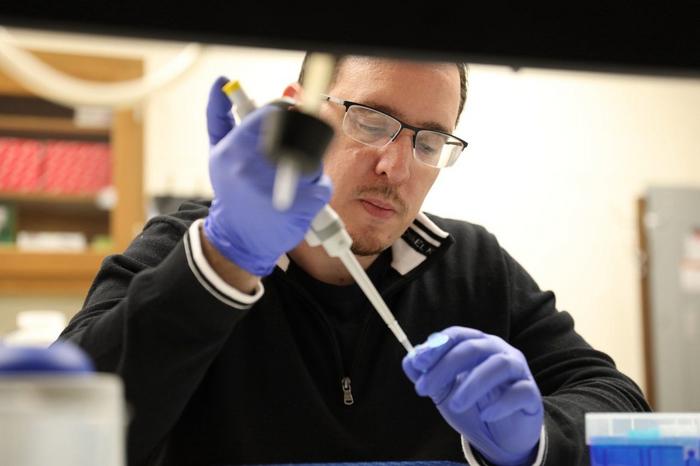
Tim Jarome

Credit: Photo by Max Esterhuizen for Virginia Tech.

About 40 percent of people over age 65 suffer some form of age-related memory loss, which puts them at higher risk for developing dementia and Alzheimer’s disease. However, there are currently no approved methods for preventing memory loss with age.

Tim Jarome, associate professor of neurobiology in the Virginia Tech College of Agriculture and Life Sciences’ School of Animal Sciences is hoping to change that, aided by a $433,000 grant from the National Institute on Aging, which is part of the National Institutes of Health.

Jarome and his research partner, Assistant Professor Sydney Trask of Purdue University’s Department of Psychological Sciences, aim to manipulate a protein complex called the proteasome in the hippocampus region of the brain to determine its role in memory loss.

“We’ve known for quite some time that proteasome function decreases over a person’s lifespan and that it’s likely related to memory loss, but it’s never been directly shown because no one’s been able to manipulate the proteasome,” Jarome said.

Using a gene-editing tool called CRISPR-Cas9, Jarome and his team have been the first researchers to successfully stimulate the proteasome within the hippocampus. In the next phase of their research, they will manipulate the proteasome to determine whether it can be increased to prevent and restore age-related memory loss.

“We hope this project will significantly advance our understanding of how proteasome dysfunction contributes to age-related cognitive decline,” Jarome said. “If successful, it has the potential to contribute to the development of novel therapeutic strategies to prevent or reverse memory loss associated with age and age-associated neurodegenerative disorders that impact the hippocampus.”

Their work carries significance for understanding and treating not only memory loss from natural aging but also degenerative brain diseases such as Alzheimer’s and dementia, which affect more than 10 percent of Americans over age 65.

“We hope this research will yield the first connection between proteasome dysfunction with age and memory loss with age and that we’ll be able to show that by controlling the proteasome we can control memory with age,” Jarome said. “If we can fix this one mechanism, we might be able to fix a lot of the things that are going wrong as we age that contribute to memory loss with age. It gives us a therapeutic target we can start to develop strategies around to stimulate and, hopefully, improve memory across the lifespan.”


Share12Tweet8Share2ShareShareShare2

Related Posts

Tracking Lanthanide-Labeled Microplastics in Plants

June 25, 2026

Neural Design Enables Zero-Shot Drug-Binding Proteins

June 25, 2026

Genomic Insights into Human Skin Fungi Diversity

June 25, 2026

Chiral Laser Gyroscopes Surpass Lock-In Limit

June 25, 2026

POPULAR NEWS

  • Saying Goodbye to PGY-6: Pediatric Fellowship Realities

    103 shares
    Share 41 Tweet 26
  • Multi-Hospital Study Reveals Long Covid Burden Is Twice as High as Current Estimates

    92 shares
    Share 36 Tweet 23
  • Detection of EDCs in Breast Milk and Infant Urine Up to Six Months Highlights Early Exposure Risks

    77 shares
    Share 31 Tweet 19
  • New Drug Candidate Developed at McMaster Shows Potential for Treating Brain Cancer

    58 shares
    Share 23 Tweet 15

About

We bring you the latest biotechnology news from best research centers and universities around the world. Check our website.

Follow us

Recent News

Tracking Lanthanide-Labeled Microplastics in Plants

POSTECH Researchers Slash Cost of Reconstituted Cell-Free Systems by 95%

AI and Physics Collaborate to Design Advanced Hydrogen Storage Materials

Subscribe to Blog via Email

Success! An email was just sent to confirm your subscription. Please find the email now and click 'Confirm' to start subscribing.

Join 82 other subscribers
  • Contact Us

Bioengineer.org © Copyright 2023 All Rights Reserved.

Welcome Back!

Login to your account below

Forgotten Password?

Retrieve your password

Please enter your username or email address to reset your password.

Log In
No Result
View All Result
  • Homepages
    • Home Page 1
    • Home Page 2
  • News
  • National
  • Business
  • Health
  • Lifestyle
  • Science

Bioengineer.org © Copyright 2023 All Rights Reserved.