In the dense forested borderlands of Cambodia, where malaria has stubbornly clung to remote villages despite decades of progress, a quiet experiment in community-based healthcare has been unfolding. A new mixed methods study published in BMC Health Services Research examines how village malaria workers, known as VMWs, took on a new responsibility in 2021: following up with patients treated for Plasmodium vivax malaria to make sure they completed their medication and stayed safe. The findings, drawn from more than two years of surveillance data and in-depth interviews across nine study sites, offer a rare and detailed look at how a national policy actually plays out on the ground, and why the people delivering care at the village level matter just as much as the guidelines they are handed.
The clinical backdrop is essential to understanding why follow-up matters at all. Plasmodium vivax is the more widespread of the two malaria parasites that still circulate in Cambodia, and it poses a unique treatment challenge. Unlike its deadlier cousin Plasmodium falciparum, P. vivax can hide in the liver as dormant forms called hypnozoites, reawakening weeks or months later to cause relapsing infections. The only widely available drug capable of clearing these dormant stages is primaquine, a medication that comes with a serious caveat: in patients with a deficiency of the enzyme glucose-6-phosphate dehydrogenase, or G6PD, primaquine can trigger potentially dangerous destruction of red blood cells. Ensuring that patients adhere to the full course of treatment, and monitoring them for adverse effects, is therefore a cornerstone of safe vivax case management. Without follow-up, health systems have no way of knowing whether patients finished their pills or whether the drug caused harm.
Recognizing this gap, Cambodia’s National Center for Parasitology, Entomology and Malaria Control tasked village malaria workers in 2021 with supporting health facility workers in conducting patient follow-up. VMWs are lay community members, typically elected or nominated by their own villages and trained to diagnose malaria with rapid tests and dispense basic treatment. Over the last two decades they have been credited with helping drive down malaria transmission in Cambodia’s most inaccessible areas, where health facilities may be hours away by foot or motorbike. Extending their role from diagnosis and treatment into post-treatment follow-up was a logical step, but one whose real-world implementation had never been systematically evaluated. The research team, led by Sarah A. Cassidy-Seyoum of the Menzies School of Health Research and Maastricht University, set out to fill that void.
The study’s design combined the numerical with the narrative. On the quantitative side, the researchers analyzed patient-specific surveillance data from nine study sites covering the period from January 2021 to March 2023, complemented by national aggregate figures. On the qualitative side, they conducted interviews and focus group discussions with a broad sweep of actors: national policymakers, sub-national program officials, health facility workers, village malaria workers, and patients themselves. The qualitative material was subjected to thematic analysis, and the two data streams were then interpreted together through an interpretivist theoretical framework of implementation science, drawing on concepts such as expectation, coherence, adoption, and a component of feasibility the authors call ‘doability’. This framework, which blends elements of existing implementation models, allowed the team to ask not just whether follow-up happened, but how the people doing it understood and shaped the intervention.
The headline numbers tell a story of rapid improvement. In 2021 and 2022 combined, 2,138 patients with P. vivax malaria received primaquine across the study sites. Of these, 39 percent were followed up in 2021, the first year of the policy. By 2022, that figure had climbed to 88 percent, a striking jump that suggests the system found its footing quickly. More than half of all follow-up contacts took place at the community level, meaning that village malaria workers, rather than facility-based staff, were carrying the bulk of the burden. For a program that relies on volunteers embedded in remote villages, this distribution is exactly what policymakers would have hoped for: the care reaching patients where they live, rather than requiring patients to travel for a check they might otherwise skip.
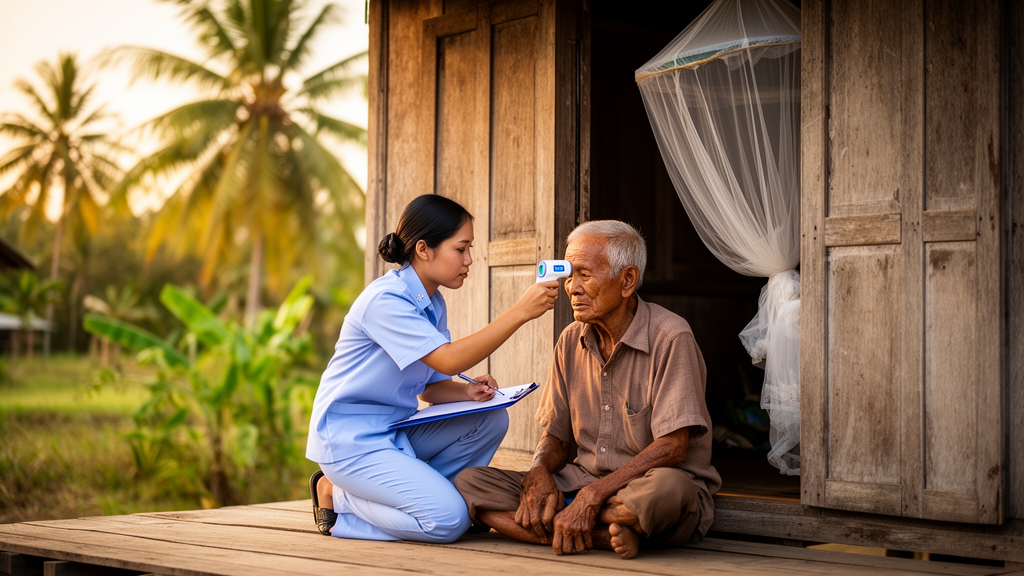
But the qualitative findings are where the study earns its keep, because they reveal that the uniform policy produced far from uniform practice. The researchers found that the way and extent to which follow-up was implemented varied considerably depending on the strategies individual VMWs adopted to make the intervention workable in their own circumstances. Some workers showed flexibility on which days patients were visited, adjusting schedules around farming seasons, festivals, or the patient’s own availability rather than rigidly adhering to a fixed timetable. Others reached patients indirectly through their family members when the patients themselves were away from home, using household networks as a proxy for direct contact. These were not deviations from the spirit of the policy so much as pragmatic adaptations to its letter, allowing VMWs to fulfill the intervention’s core purpose of enhancing adherence and treatment safety even when strict protocol compliance was impractical.
What emerged from the interviews was a picture of community health workers who had internalized not only the stated purpose of follow-up but also additional value they attributed to it. Beyond checking on medication adherence and watching for adverse effects, VMWs described comforting patients during an illness that can be frightening and debilitating, and conducting informal health education during their visits, teaching households about malaria prevention and the importance of completing treatment. In other words, the follow-up visit became more than a pharmacovigilance checkpoint; it became a touchpoint for broader community health engagement. The authors argue that this added value, alongside the adaptive strategies that made the intervention doable, explains why follow-up became so well embedded in the VMWs’ existing roles and responsibilities rather than being experienced as an unwelcome burden.
The theoretical framing matters here for what it implies about health policy more broadly. Implementation research has long grappled with the gap between how interventions are designed on paper and how they are enacted in practice, and the Cambodian follow-up program offers a vivid case study. The interpretivist lens used by the researchers treats VMWs not as passive conduits of policy but as active agents who interpret the intervention, negotiate its demands, and creatively solve the problems it presents. The study’s conclusion leans into this insight: rather than trying to standardize away the variation, the authors recommend that these adaptive strategies be integrated into policy and existing infrastructure, while encouraging and resourcing the kind of grassroots problem-solving that remains grounded in formal guidelines and training. The goal is to preserve both the intervention’s intended purpose and the added value that workers themselves bring to it.
The implications extend well beyond Cambodia’s borders. Plasmodium vivax remains one of the most stubborn obstacles to malaria elimination across the Asia-Pacific and the Americas precisely because of its relapsing liver stages, and radical cure with primaquine, increasingly guided by G6PD testing, is central to elimination strategies. Any such strategy depends on patients actually completing treatment and being monitored for safety, which in turn depends on health systems reaching people far from clinics. Community health workers are the backbone of that reach in dozens of countries, and the Cambodian experience suggests that their success hinges on factors that spreadsheets rarely capture: trust, flexibility, family networks, and a sense of ownership over the intervention’s purpose. For program designers, the message is that feasibility is not a fixed property of an intervention but something that frontline workers actively construct, visit by visit and patient by patient.
The study, funded by the Australian National Health and Medical Research Council and conducted in collaboration with Cambodia’s national malaria control program and its implementation partners, arrives at a moment when the Greater Mekong subregion is pushing hard toward malaria elimination. Cambodia has made remarkable strides, but the last mile is notoriously the hardest, and vivax malaria is the parasite most likely to stand in the way. By documenting both the measurable scale-up of follow-up coverage and the human ingenuity that made it possible, this research provides a template for other endemic countries considering similar community-based models. It also serves as a reminder that in global health, the distance between a policy document and a cured patient is often bridged by a village worker with a motorbike, a flexible schedule, and a clear sense of why the work matters.
Subject of Research: Implementation of community health worker follow-up for Plasmodium vivax malaria case management in Cambodia
Article Title: Community patient follow-up as a part of P. vivax case management in Cambodia: a mixed methods study
Article References: Community patient follow-up as a part of P. vivax case management in Cambodia: a mixed methods study. (n.d.). https://doi.org/10.1186/s12913-026-15274-8
Image Credits: AI Generated
DOI: 10.1186/s12913-026-15274-8
Keywords: malaria, Plasmodium vivax, Cambodia, community health workers, village malaria workers, primaquine, treatment adherence, implementation research, pharmacovigilance, health services research, malaria elimination, patient follow-up
News Source: Ophelia Keating. (October 15, 2026). Village Health Workers Make Malaria Follow-Up Work in Cambodia’s Remote Communities. Scienmag.