For minimally speaking autistic children, one of the most persistent and painful barriers is not a lack of desire to connect with other children, but a lack of accessible tools to do so. A new study published in the Journal of Autism and Developmental Disorders suggests that a video-based augmentative and alternative communication (AAC) technology known as visual scene displays, or VSDs, may meaningfully change that picture. Researchers Avinash Mishra and Jasmine Wang of Queens College, City University of New York, and Lindsay Scott of Northwestern University, found that when autistic children were given a speech-generating tablet application built around dynamic video scenes, their peer-directed symbolic communication rose sharply and stayed elevated even after the intervention ended. The findings, drawn from a carefully controlled single-case experimental design, offer some of the strongest evidence yet that embedding AAC technology inside genuine, reciprocal play with peers can unlock communication that traditional drill-based approaches often fail to reach.
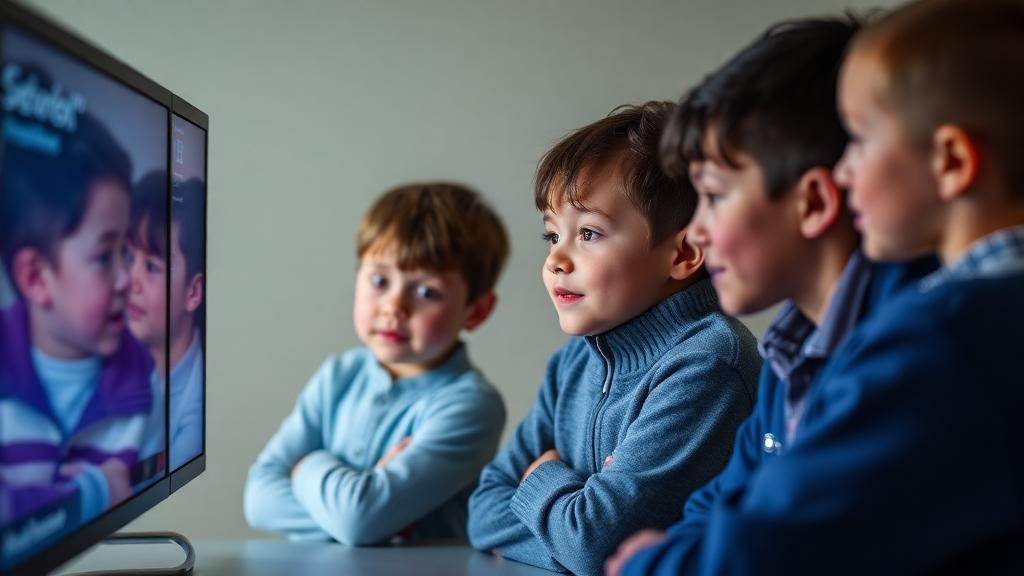
The technology at the heart of the study differs in an important way from the grid-based communication boards that many people picture when they think of AAC. Conventional grid displays organize vocabulary into arrays of isolated icons, which demand that users navigate abstract symbol categories mid-conversation, a cognitive load that can be especially heavy for young children. Visual scene displays instead present a photograph or video of a meaningful, familiar event, such as children playing a game together, with hotspots embedded directly onto the image. When a child taps a hotspot, a speech-generating device voices a relevant word or phrase. Because the vocabulary is anchored to the context the child can actually see, the display leverages the brain’s strong capacity for contextual and event-based processing. In this study, the researchers pushed the concept further by using video VSDs, in which the scenes themselves are dynamic, capturing the flow of an activity rather than a frozen moment, and pairing them with speech output so that every touch produces audible language.
The clinical problem the team targeted is substantial. A meaningful proportion of autistic children remain minimally speaking into their school years, and research has repeatedly shown that this group is among the most neglected in intervention science. Social communication with peers is a two-way enterprise, and most AAC research has historically focused on the child with complex communication needs in isolation, measuring requests directed at adults or responses to structured prompts. Far fewer studies have examined whether AAC tools can support the rapid, reciprocal, and often unpredictable rhythm of peer play, where turns are negotiated moment to moment and motivation depends on genuine social engagement. Yet peer interaction during play is a cornerstone of childhood development, linked to language growth, executive function, school adjustment, and long-term social competence. Children who cannot participate in that exchange risk exclusion that compounds far beyond the playground.
To test whether video VSDs could bridge that gap, the researchers enrolled fifteen autistic children who were minimally speaking, along with fifteen age-matched peers with neurotypical development. The children were organized into three cohorts of five dyads each, a structure that allowed the team to use a multiple-probe design across dyads, one of the most rigorous experimental frameworks available for interventions that cannot ethically be withheld from all participants. In this design, baseline data are collected repeatedly for all dyads, but the intervention is introduced in a staggered fashion, cohort by cohort. If communication turns rise immediately and only when the intervention begins for each dyad, the pattern provides strong evidence that the intervention itself, rather than maturation, practice, or external events, produced the change. Before any video technology was introduced, the autistic children completed baseline probes using static printed VSDs, establishing what their peer-directed communication looked like with context-based supports but without dynamic video or embedded speech generation.
The intervention phase replaced those static displays with a video-based VSD application incorporating dynamic visual supports and speech-generating communication. During peer play sessions, the autistic children could activate hotspots on video scenes depicting the very activities they were engaged in, producing voiced symbolic messages directed at their play partner. The primary outcome measure was deliberately simple and socially meaningful: the frequency of peer-directed symbolic communication turns, meaning instances in which the child used the AAC system to direct a symbolic message toward a peer rather than toward an adult or the device itself. This choice of dependent variable reflects a growing consensus in the AAC field that the ultimate test of any communication technology is not whether a child can operate it in a laboratory, but whether the child uses it to genuinely engage another person.
The results were striking in their consistency. Across all three cohorts, the introduction of the video VSD intervention was associated with immediate increases in peer-directed symbolic communication. Visual analysis of the single-case data demonstrated clear changes in level, meaning the jump in communication turns from the end of baseline to the start of intervention, and immediacy of effect, meaning the change appeared right away rather than accumulating slowly. Equally important, the researchers reported minimal overlap between baseline and intervention data paths, indicating that intervention-phase performance rarely dipped back into the range observed before the technology was introduced. When a behavioral intervention produces effects this clean across multiple staggered replications, the internal validity of the finding is considerably strengthened, because each successive cohort serves as a fresh experimental control for the ones that came before.
Quantitative analysis reinforced what the visual inspection showed. The team applied Tau-U, a nonparametric effect-size metric developed specifically for single-case research, which quantifies the degree of nonoverlap between phases while correcting for baseline trend. The Tau-U analyses indicated large intervention effects across the dyads, placing this study among the more robust demonstrations of AAC technology effects reported in the peer-interaction literature. Perhaps most encouraging were the maintenance probes conducted after the intervention formally ended. The gains in peer-directed symbolic communication were sustained, suggesting that the children did not simply perform while scaffolding was present but had integrated the technology into their communicative repertoire in a way that persisted. For families and clinicians, durability is often the difference between an intervention that looks good in a paper and one that changes a child’s daily life.
The study builds on a growing line of work by researchers including Janice Light, David McNaughton, and their collaborators, who have shown in earlier pilot studies and small experiments that video VSDs can increase communicative turns during play for autistic children and adolescents, including a well-known study of two friends spending time together and a trial with preschoolers using tablet-based VSD technology. What distinguishes the new study is its scale within the single-case tradition, with fifteen dyads across three staggered cohorts, and its explicit focus on reciprocal, peer-directed exchange rather than adult-prompted responding. It also aligns with a broader movement in autism intervention science toward naturalistic developmental behavioral approaches, which argue that communication skills are best built inside authentic, motivating social contexts rather than in decontextualized drills. By embedding the AAC system directly in the play activity, the design gives the technology a communicative reason to exist.
The implications reach well beyond the laboratory. Tablet applications implementing VSD-style supports are increasingly available to schools and families, and the findings suggest that simply handing a child a speech-generating app is not enough; the display design, the contextual anchoring of vocabulary, and the social setting in which the device is used all matter enormously. The study also highlights the role of neurotypical peers as genuine communication partners rather than passive recipients of instruction, echoing a peer-network intervention literature showing that trained peers can transform the social participation of classmates with complex communication needs. Limitations remain, as with any single-case study: the design demonstrates experimental control and replication but does not by itself establish population-level effect sizes, and the authors note the work was supported by the Research Foundation of the City University of New York with no conflicts of interest declared. Still, for a population long described as the neglected end of the autism spectrum, the message is concrete and hopeful. When minimally speaking autistic children are given dynamic, context-rich, speech-generating tools inside real play with real peers, they talk to each other, and they keep doing it.
Subject of Research: Video visual scene display AAC intervention for peer-directed social communication in minimally speaking autistic children
Article Title: Enhancing Peer-Directed Social Communication in Autistic Children Using Video Visual Scene Displays
Article References: Mishra, A., Wang, J., & Scott, L. (2026). Enhancing Peer-Directed Social Communication in Autistic Children Using Video Visual Scene Displays. Journal of Autism and Developmental Disorders. https://doi.org/10.1007/s10803-026-07564-1
Image Credits: AI Generated
DOI: 10.1007/s10803-026-07564-1
Keywords: autism, augmentative and alternative communication, visual scene displays, peer interaction, social communication, minimally speaking children, speech-generating devices, single-case design, play-based intervention, assistive technology, Tau-U, Journal of Autism and Developmental Disorders
News Source: Ophelia Keating. (October 12, 2026). Video Scene Displays Help Minimally Speaking Autistic Children Talk With Peers. Scienmag.