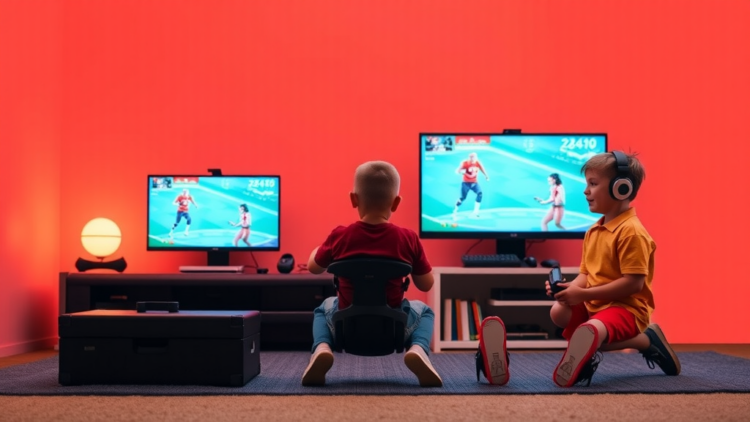
For two decades, parents and teachers have been told that active video games are a poor substitute for real exercise, a sedentary trap dressed up in bright colors and point scores. A new systematic review and meta-analysis published in Sports Medicine – Open turns that assumption on its head. After analyzing every statistically significant comparison in the published literature, researchers at Manchester Metropolitan University found that exergames are just as effective as traditional physical activities for developing fundamental movement skills in children, provided the sessions are coached and structured in the same way. The real driver of skill development, the study concludes, is not whether the activity happens on a screen or a playing field, but how much adult facilitation it receives.
The stakes of this question are enormous. More than a quarter of adults and roughly 80 percent of adolescents worldwide fail to meet recommended physical activity levels, and physical inactivity is estimated to cause nearly 50 million new cases of non-communicable disease every year, with projected treatment costs of around 300 billion US dollars between 2020 and 2030. Childhood is widely seen as the most effective intervention point, because motor skill competence and physical activity form a self-reinforcing loop: children who move well tend to move more, and children who move more become better movers. Those who fall behind early can spiral into lifelong inactivity, which is why researchers are increasingly focused on the building blocks known as fundamental movement skills.
Fundamental movement skills are the basic movement patterns that children refine into the specialized actions needed for sports and other physical pursuits. They include locomotor skills such as running and jumping, object control skills such as catching, throwing and striking, and stability skills such as balancing on one foot or walking a beam. Physical education lessons are the traditional venue for teaching them, but the average school delivers only about 60 to 130 minutes of physical education per week, far short of the World Health Organization’s recommendation of at least 60 minutes of moderate to vigorous activity per day. Home-based activity is meant to fill the gap, yet excessive screen time is widely blamed for displacing it, and interventions that simply try to limit screen time have shown little success, partly because they create family conflict, demand parental energy that work and chores already consume, and run up against financial constraints such as lacking safe outdoor spaces.
The research team, led by Oscar O’Brien, proposes a broader conceptual category they call exergamoids: physical activities that involve sensors of physical activity controlling a games technology component of the experience. Exergames, in which players develop their health as they play a complete game, are one subset. Digital gamification of exercise, such as a leveling system layered onto a step counter, is another. The umbrella term is designed to organize a fragmented literature and allow findings to transfer across game types, hardware platforms and settings. What unites exergamoids is a feedback loop in which digital tracking of movement serves as input to a game system, and the game’s output augments the physically active experience, potentially motivating children to practice skills at home that they first learned at school.
To resolve the mixed evidence that has plagued this field, the researchers systematically searched ten databases, including PubMed, APA PsycINFO, SPORTDiscus, IEEE Xplore, ACM Digital Library, Scopus, ProQuest, Web of Science, ScienceDirect and Google Scholar, for studies published between January 2000 and December 2025. After screening 2,882 retrieved records, 545 abstracts, and hundreds of full texts against strict population, intervention, comparison and outcome criteria, they identified 12 studies containing 17 statistically significant comparisons across 28 experimental groups, covering children aged 4 to 12 in school, home and clinical-adjacent settings. The corpus included 22 unique games across four hardware platforms, most of them commercial titles, and the studies varied widely in whether they used researcher-made games with design enhancements, structured physical education sessions or loosely supervised play, and whether children received targeted coaching on movement skills.
The methodological innovation of the study lies in how it handled that variability. Rather than pooling effect sizes, which the authors argue would be undermined by heterogeneity and bias, they applied what they call systematic hypothesis testing, an approach built on set theory and order theory. They generated eleven plausible hypotheses about what causes variability in movement skill outcomes, each defined by mathematical constraints such as whether coaching, activity structure or exergame status has a positive, negative or zero effect. For every hypothesis, they predicted the direction of the outcome for each of the 17 comparisons based on how the experimental groups differed, and then checked whether the observed results matched the prediction. The hypothesis that survived every test was one in which skill improvement is a function of coaching and activity structure, while exergame status itself has exactly zero effect.
That finding is more surprising than it might appear. Many exergames can be operated with sloppy or incorrect movement patterns, since permissive sensors reward effort rather than technique, which has led critics to argue that skills learned in front of a screen will not transfer to the real world. Yet the meta-analysis found no evidence of a differential effect across the temporal, environmental and functional components of movement skill, meaning exergames worked equally well for locomotor, object control and stability skills. The authors draw on dynamic systems theory to explain why: acquiring a movement skill is a search for a correct movement pattern across many degrees of freedom, and what guides that search most effectively is knowledge of performance, the actionable feedback a human coach provides about how to adjust the movement. Simple scores and game rewards, which constitute knowledge of results, do not tell a child how to change their technique, so the accuracy of the simulation matters far less than the quality of the coaching around it.
The analysis also revealed a hierarchy of facilitation. Human-delivered coaching through verbal feedback and live demonstration had a strong effect on skill outcomes, and coaching delivered through digital media, such as skill demonstration videos within the game, also improved results. Activity structure showed a positive contribution as well, though it was not a statistically significant predictor on its own, likely because most studies varied coaching and game status rather than structure in isolation. Unstructured, free-play exergaming sessions consistently underperformed, mirroring broader evidence that unstructured activities are less effective for skill development than planned ones. In practice, the most successful interventions looked like well-run physical education lessons that happened to use a game: teachers selected activities aligned with developmental needs, modeled the skills, cued corrections, and adjusted difficulty for individual children.
The practical implications reach well beyond the school gym. The authors argue that low-barrier exergames, in which cheating produces no better score than playing correctly, deserve recognition as a distinct category, because their permissiveness lets children with imperfect technique participate and stay motivated while a coach fine-tunes the specificity of the activity through praise and goal setting. Exergames can also offer experiences that schools cannot easily provide, from virtual surfing and snowboarding between classes to practicing ball heading in virtual reality, where one study noted children reported reduced fear. They enable training during bad weather, promote exertion through heart-rate-driven game mechanics, and show hints of enhanced benefit for groups that traditional activity often misses, including children with developmental delays and those who skip physical education sessions. Barriers remain, including hardware costs, staff training, IT support and the need to choose games whose movements match the curriculum, but the researchers recommend that teachers and parents treat exergames as a legitimate, freely chosen option rather than a last resort.
Looking forward, the team outlines two frontiers that could push exergames beyond parity with traditional activity. Simulated coaching, in which games assess movement competence, deliver demonstrations and provide cues automatically, could embed the knowledge-of-performance feedback that currently depends on a human presence, making uncoached home play genuinely instructional. Co-teaching systems, in which a game acts as a teaching assistant that adapts around the teacher’s plans rather than displacing them, would require a new layer of interactivity but could draw on evidence that collaborative teaching yields benefits even when the second teacher is less skilled. The authors caution that their analysis operated at the whole-class level, did not examine individual participant characteristics, and could not assess whether small differences emerge in interventions longer than six to eight weeks. Still, their central message is clear: the screen is not the enemy of childhood movement skills. Coached, structured exergaming belongs alongside traditional games as a tool for breaking the spiral of inactivity, at school and at home.
Subject of Research: The effects of exergames on children’s fundamental movement skills, examined through a systematic review and meta-analysis of methodological variables such as coaching and activity structure.
Article Title: The Effects of Exergames on Fundamental Movement Skills in Childhood: A Systematic Review and Meta-analysis
Article References: O’Brien, O., Kendrick, C., Ives, B., Yap, M. H., & Henry, J. (2026). The Effects of Exergames on Fundamental Movement Skills in Childhood: A Systematic Review and Meta-analysis. Sports Medicine – Open, 12(1), Article 139. https://doi.org/10.1186/s40798-026-01081-2
Image Credits: AI Generated
DOI: 10.1186/s40798-026-01081-2
Keywords: exergames, exergamoids, fundamental movement skills, children, physical activity, physical education, meta-analysis, motor skill development, coaching, screen time, childhood health, dynamic systems theory
Cite Scienmag News
APA
MLA
Chicago
Ophelia Keating. (September 20, 2026). Video Games That Get Kids Moving Work as Well as Traditional Sports, Landmark Meta-analysis Finds. Scienmag. https://scienmag.com/video-games-that-get-kids-moving-work-as-well-as-traditional-sports-landmark-meta-analysis-finds/
Ophelia Keating. “Video Games That Get Kids Moving Work as Well as Traditional Sports, Landmark Meta-analysis Finds.” Scienmag, 20 September 2026, https://scienmag.com/video-games-that-get-kids-moving-work-as-well-as-traditional-sports-landmark-meta-analysis-finds/. Accessed 20 September 2026.
Ophelia Keating. “Video Games That Get Kids Moving Work as Well as Traditional Sports, Landmark Meta-analysis Finds.” Scienmag. September 20, 2026. https://scienmag.com/video-games-that-get-kids-moving-work-as-well-as-traditional-sports-landmark-meta-analysis-finds/
Copy citation
Download RIS
Tags: active video gamesadult facilitation in children’s physical activitybenefits of guided exergaming in skill developmentchildhood healthchildhood physical activity and health outcomesChildrencoachingdynamic systems theoryeffectiveness of digital exercise toolsexergamesexergames for children’s physical developmentexergamoidsfundamental movement skillsglobal childhood inactivity and health risksimpact of video games on fundamental movement skillsmeta-analysismotor skill developmentPhysical activityphysical activity interventions for adolescentsphysical educationscreen timesedentary behavior vs active gamingstructured coaching in youth sportssystematic review of active video games