


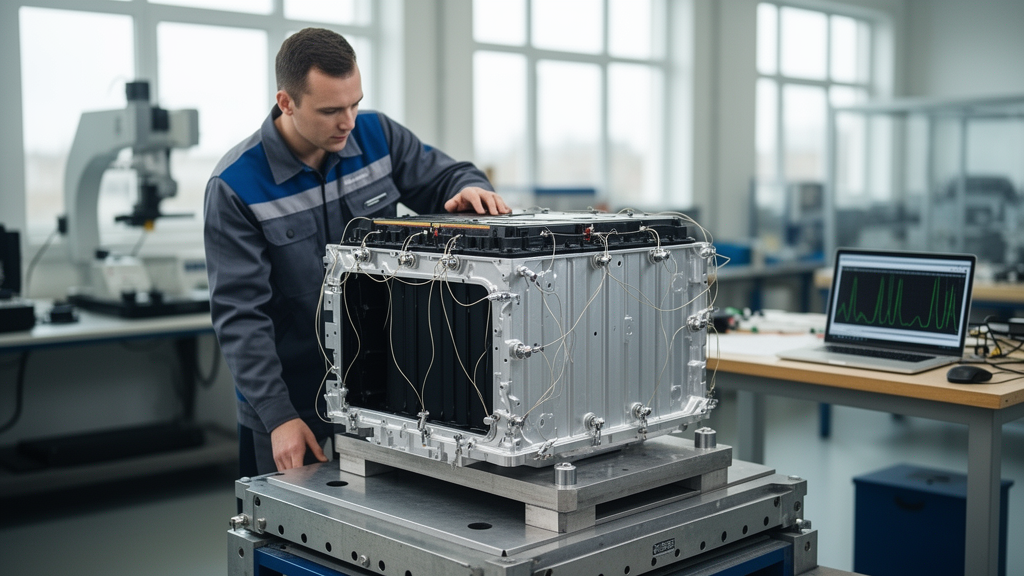
Electric vehicle battery packs live a hard life. Mounted beneath the floor of the vehicle, they absorb every pothole, every ripple of road roughness, every torque ripple from the electric motor and every sudden deceleration of braking. A new comprehensive review published in Discover Mechanical Engineering argues that the humble battery enclosure — the structural shell that houses and protects the cells — deserves far more design attention than it often receives, because vibration-induced damage accumulates silently over years of driving and can undermine safety long before any visible failure appears.
The review, authored by Fentaw Alemayehu Tesfaye and published on 20 October 2026, organizes the field around what the author calls a vibration-to-failure framework. Rather than treating vibration sources, structural response, fatigue degradation and mitigation as separate topics, the framework links them as a continuous chain: road irregularities, suspension dynamics, electric powertrain excitation, braking events and impact loads generate dynamic inputs that travel into the enclosure; those inputs produce resonance, modal amplification, stress concentration and deformation; and those responses drive fatigue damage that eventually manifests as weld cracking, fastener loosening, sealing degradation or module displacement.
The author screened 68 publications identified through databases including Scopus, Web of Science, IEEE Xplore, ScienceDirect and Google Scholar, covering the period from 2019 to 2026, and selected 45 studies for detailed analysis. The selected literature was organized into five themes: vibration sources and loading environments; analysis and evaluation methods; structural failure mechanisms and durability assessment; lightweight and multifunctional enclosure materials, particularly aluminum foam sandwich structures; and emerging monitoring and predictive maintenance technologies. The review’s stated novelty lies in connecting these themes, since most previous reviews focused on individual aspects such as thermal management, crashworthiness or material selection without tying vibration excitation to structural response and fatigue.
On the analysis side, the review surveys the full toolkit available to enclosure engineers. Analytical beam, plate and shell models offer quick early-stage estimates of natural frequencies but rely on idealized assumptions and are best used as screening tools. Experimental modal analysis, typically performed with impact hammer or shaker excitation, identifies natural frequencies, damping ratios and mode shapes, and reveals local modes in covers, brackets and mount regions that static assessment misses. Finite element analysis has become the dominant method, capable of representing geometry, boundary conditions, material layering and local reinforcements in detail, though its accuracy depends heavily on how joints, damping and supports are modeled. Harmonic response analysis locates resonant peaks under sinusoidal excitation, while random vibration analysis addresses the inherently stochastic nature of road loading by working with power spectral density profiles in the frequency domain, avoiding time-domain simulation over millions of load cycles while still enabling fatigue estimation.
The review stresses that numerical results are only as good as their validation. Model updating is often required to align computed modal frequencies and damping ratios with measured values, and validation is especially critical for advanced structures such as multi-material enclosures and foam-filled sandwich panels, whose damping and contact behavior are difficult to predict. Real-world vibration loads are typically measured with accelerometers and strain gauges at battery-pack mounts and attachment points, then processed into acceleration time histories, frequency spectra and PSD profiles that feed both laboratory shaker tests and simulations. Fatigue durability is then assessed using stress–life, strain–life or frequency-domain PSD-based approaches to estimate cumulative damage at welds, fasteners, mounting points and reinforced panels.
Failure mechanisms receive detailed treatment. Fatigue cracking is singled out as especially dangerous because it can begin microscopically and remain hidden until stiffness loss or leakage paths become apparent — a serious concern in sealed enclosures where even a small crack can compromise protection against moisture, dust and thermal exposure. Fastener loosening under continuous vibration increases relative motion between parts, promoting fretting and wear. Weld toes, inherently notched, become natural crack initiation sites in lightweight housings under cyclic loading. Cell displacement and internal module motion create electrical reliability risks and can damage connections or insulation. The review also notes that residual stresses from welding and forming can raise effective mean stress at critical points, and that ignoring them makes life predictions overly optimistic.
Standardized testing anchors the validation picture. The review catalogs the key automotive standards: SAE J2380 for vibration durability testing of rechargeable energy storage systems, ISO 12405-3 and ISO 12405-4 for mechanical and environmental performance of lithium-ion battery packs, GB/T 31467.3 for mechanical performance testing of electric vehicle battery systems, and UN R100/UNECE R100 for regulatory safety requirements of electric powertrain systems. The author argues that finite element and modal analysis should be integrated with these regulatory procedures to predict natural frequencies and responses before experimental testing, improving design efficiency and reducing the risk of vibration-related failures, while acknowledging that stronger correlations between numerical predictions and standardized test results are still needed.
Materials form another pillar of the review. Steel offers high stiffness, mature joining methods and strong crash performance but adds substantial mass that can reduce driving range. Aluminum alloys, widely adopted for their low density, corrosion resistance and manufacturing flexibility, also provide high thermal conductivity that eases integration with cooling systems, yet their relatively low inherent damping means they may need additional mitigation such as optimized stiffeners, damping treatments or hybrid configurations. Composites deliver high specific stiffness and improved damping but face cost barriers, complex joining, difficult inspection and weaker thermal conduction. The review’s particular focus, however, is the aluminum foam sandwich panel: two lightweight aluminum face sheets bonded to a cellular foam core. Reported aluminum-foam densities commonly fall in the range of roughly 500 to 1200 kilograms per cubic meter, substantially below solid aluminum at 2700 kilograms per cubic meter, offering significant mass-reduction potential while retaining structural efficiency. The foam core attenuates vibration through progressive crushing, local deformation and internal friction, dissipating energy over a broad range of amplitudes and spreading localized loads rather than concentrating them — attractive for underbody applications where vibration and impact resistance must coexist. The trade-offs are real: denser foam improves stiffness but can reduce energy absorption, lighter foam improves damping but weakens structural support, and fatigue at the foam–face-sheet interface, along with manufacturability, cost, corrosion protection and recyclability of bonded multi-material structures, remain open questions.
Beyond passive measures, the review classifies mitigation into passive, active and semi-active approaches. Rubber isolators and viscoelastic materials dissipate vibrational energy without external power, though their performance varies with temperature, frequency and aging. Active vibration control, using sensors and actuators to counteract incoming vibration in real time, offers adaptability but adds cost, mass, power demands and maintenance burden, and the review judges it still a future-oriented solution rather than a mainstream production approach. Semi-active systems — controllable dampers, variable-stiffness mounts, smart materials — offer a compromise, adapting to road conditions without the full energy burden of active control. The review also points to tuned vibration absorbers, inerter-based systems, honeycomb structures and other energy-absorbing architectures as concepts adaptable to battery enclosures, and highlights optimization methods such as Taguchi design and ANOVA for systematically evaluating foam density, core thickness, face-sheet thickness and geometric reinforcement within multi-objective frameworks that balance vibration, mass, crash, sealing and thermal requirements.
The most forward-looking section concerns intelligent monitoring. Artificial intelligence techniques including artificial neural networks, support vector machines, convolutional neural networks and recurrent neural networks can extract hidden patterns from multidimensional vibration data to detect abnormal responses linked to joint degradation, mounting defects and fatigue accumulation. Digital twins — continuously updated virtual representations combining finite element models, vibration measurements, thermal histories and fatigue models — could estimate structural degradation and remaining useful life in real time throughout the vehicle’s service life. Smart sensor networks using accelerometers, strain gauges, piezoelectric, fiber-optic, temperature and acoustic emission sensors, connected through IoT platforms, would provide the data foundation. The review is candid about the obstacles: severe enclosure failures are rare, making labeled failure data scarce; models may not generalize across vehicle platforms; and deployment requires reliable sensor data, robust model updating, data interoperability, cybersecurity and standardization. The author’s conclusion is that the future of battery enclosure design lies in integration — combining structural design, material engineering, physics-based modeling and intelligent monitoring to shift from reactive repair toward predictive durability management, so that the enclosure becomes not merely a passive shell but an active participant in the safety and longevity of the electric vehicle battery system.
Subject of Research: Vibration analysis, structural integrity and mitigation strategies for electric vehicle battery enclosures
Article Title: A comprehensive review of vibration analysis, structural integrity assessment, and vibration mitigation strategies for electric vehicle battery enclosures
Article References: Tesfaye, F. A. (2026). A comprehensive review of vibration analysis, structural integrity assessment, and vibration mitigation strategies for electric vehicle battery enclosures. Discover Mechanical Engineering, 5(1), Article 203. https://doi.org/10.1007/s44245-026-00395-5
Image Credits: AI Generated
DOI: 10.1007/s44245-026-00395-5
Keywords: electric vehicles, battery enclosures, vibration analysis, fatigue, aluminum foam sandwich, finite element analysis, digital twins, structural health monitoring, vibration damping, lightweight materials, automotive standards, comprehensive
News Source: Faith Mcneil. (October 29, 2026). Vibration, fatigue and smart monitoring converge in EV battery enclosure review. Scienmag.



