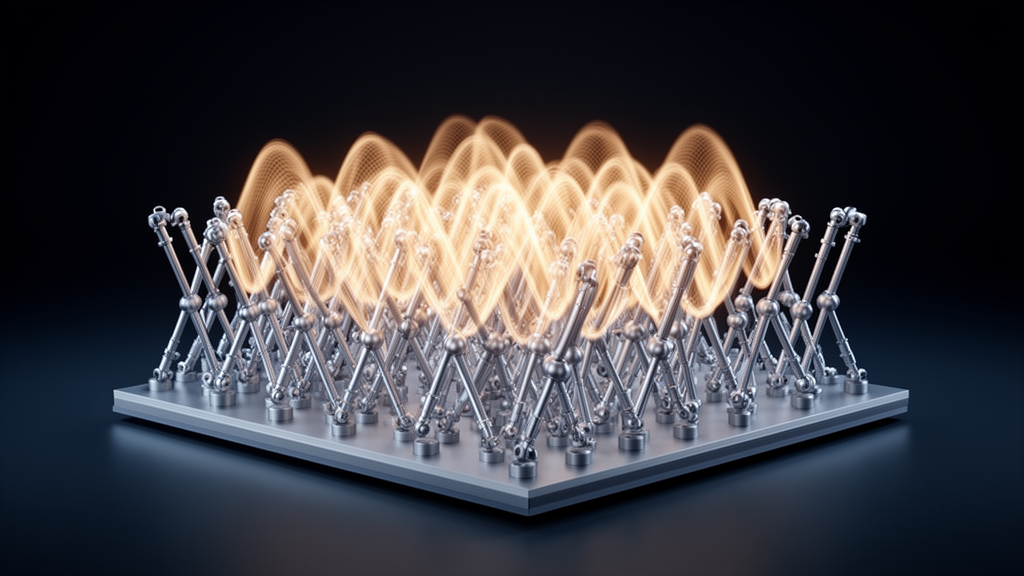
A material that starts out vibrating in chaotic, disconnected fragments and ends up pulsing as one coordinated whole has been created by engineers and physicists working across six European universities. The achievement, published in Nature, is more than a laboratory curiosity: it demonstrates a form of spontaneous self-organisation that the researchers say could underpin a new generation of robots whose movements emerge from the material itself rather than from a central controller. The work was led from the University of Birmingham in collaboration with the Universities of Amsterdam, Lyon, Delft, Leiden and Cambridge, and it brings together ideas from condensed matter physics, robotics and mechatronic engineering in an unusually direct way.
At the heart of the study is a mechatronic metamaterial, an engineered structure that combines elastic mechanical elements with sensors, electronics and actuators so that neighbouring components can influence one another’s behaviour. Unlike ordinary materials, whose parts simply transmit forces passively, an active metamaterial contains units that can generate their own motion and respond to what their neighbours are doing. In the experiments described in the paper, the individual building blocks were, in effect, tiny robotic oscillators embedded in an elastic lattice. When the researchers pushed the material beyond a critical stability threshold, these units began to self-oscillate, each one vibrating on its own at a frequency of around 30 hertz.
What happened next is the striking part. Instead of remaining a patchwork of independent vibrations, the material progressively reorganised itself. Vibrations first appeared at short wavelengths, but over time longer and longer waves came to dominate, growing in wavelength, period and amplitude, until the entire structure settled into a single, globally synchronised cycle. The researchers describe this process as wave coarsening, and they demonstrate that the final synchronised state is a time crystal, an unusual form of matter in which the constituents move endlessly in a regular, repeating cycle. In conventional time crystals the repeating units are atoms or spins; here, the repeating units were robots.
The key ingredient that made this collective order possible was a deliberate act of asymmetry. The researchers made the interactions between components non-reciprocal, meaning that one component’s response to another does not have to be mirrored in reverse. In everyday physics, reciprocity is the norm: if component A pushes component B with a certain force, B pushes back on A equally. Breaking that symmetry changes the mathematics of the system profoundly. Non-reciprocal interactions can destabilise uniform states and drive patterns to grow and compete with one another, and it is precisely this competition that allowed short-wavelength vibrations to be progressively replaced by longer, slower, larger-amplitude waves until a single rhythm took over the whole material.
The experimental evidence came from two complementary platforms. The first was a two-dimensional honeycomb material built from 37 active units. Once driven past its stability threshold, the individual units began self-oscillating at roughly 30 hertz, and gradually longer waves came to dominate until the entire material oscillated collectively. The second was an elastic ring containing 24 motorised units. In the ring, higher-frequency deformation patterns appeared first around the circumference, but these progressively combined into larger patterns until the ring settled into a slow collective cycle. In both geometries, the outcome was the same: many independent oscillators giving way to one shared motion.
Crucially, the team showed that this collective order is robust. In both the experiments and the theoretical model, random disturbances did not destroy the synchronised pattern as the size of the material was increased. This stability matters enormously for any practical application, because real robotic systems must operate in noisy environments where small perturbations, manufacturing imperfections and external shocks are unavoidable. A synchronised state that shatters at the first disturbance would be of little use; one that persists and reasserts itself as the material grows offers a genuine route to reliable, self-organising machines.
Co-lead author Dr Jack Binysh, from the University of Birmingham, who began working on the project at the University of Amsterdam, framed the work as a two-way exchange between disciplines. He described the research as a beautiful example of what robotics can teach us about physics, and vice-versa, and a showcase for combining fundamental physical concepts about different states of matter with outstanding technical expertise in mechatronic fabrication. The framing is apt: the material is simultaneously a physics experiment, probing how non-equilibrium matter organises in time, and an engineering demonstration, showing that coordinated motion can be built into the fabric of a structure rather than programmed into a controller.
The analogy the researchers themselves reach for is musical. As Binysh put it, the research provides a striking example of spontaneous organisation, with tiny vibrations organising themselves until an entire material moves in a coordinated way. Like musicians gradually finding the same beat, individual parts of an active material can organise their movements until the whole structure moves together. No conductor dictates the tempo; the shared rhythm emerges from the interactions among the players. In the metamaterial, those interactions are designed into the coupling between units, and the non-reciprocal character of the coupling is what steers the system from disorder toward a single, stable tempo.
The engineering behind the experiments was itself a considerable undertaking. The research originated in the Amsterdam group led by Dr Corentin Coulais, and the experimental metamaterials incorporated more than 100 sensors and actuators alongside 3D-printed components and custom-made Lorentz actuators, which convert electrical energy into mechanical motion. Coulais emphasised the scale of the fabrication effort, noting that the university’s Technology Centre in Amsterdam provided enormous help, with interns assembling metamaterials in which each actuator required more than 20 points of glue, and with 3D-printed parts made from varied materials. The image of the team mirrors the image of the material: as Coulais observed, like the materials themselves, the research team that produced them consisted of many moving and interacting parts.
Looking forward, the researchers see wave coarsening as a control mechanism as much as a phenomenon. Binysh suggested that it could be exploited as a way of controlling shape changes and directed motion, proving useful in robotics, active matter and optomechanics, and that the discovery could form a key step towards the development of biology-inspired multifunctional robots. Jonas Veenstra, co-lead author, who was a PhD student at Amsterdam when the research started and is now a postdoctoral fellow at ENS Lyon, outlined the next ambition: making one material support several distinct, stable patterns of motion, and switching between them so that each pattern serves a different robotic function, such as a different shape change or direction of movement. Instead of designing a separate structure for every task, the different modes of a single material could achieve different behaviours, leading to remarkably simple but highly multifunctional robots. The team’s stated aim is a biology-inspired form of robotics in which coordinated behaviour emerges from carefully designed interactions between building blocks, rather than from instructions issued by a central controller.
The longer-term roadmap points into the third dimension. The researchers aim to develop 3D active materials, which would provide many more ways for components to interact, including shearing, bending and twisting. They hope to understand how wave coarsening behaves in three dimensions and how it could be harnessed to control changes in the shape of self-supporting materials. If the two-dimensional results are any guide, three-dimensional active structures could coarsen their internal vibrations into coordinated, large-scale motions that fold, bend or twist the whole body on command-free, in effect, by the material’s own dynamics. Such capabilities would mark a meaningful departure from conventional robotics, where motion is typically computed and actuated through discrete joints and motors. Here, the vision is of machines whose gait, shape and function are properties of the material itself, tuned through the physics of non-reciprocal interactions and the spontaneous emergence of a shared rhythm. From a patchwork of 30-hertz jitters to a single collective pulse, the path from chaos to coordination may prove to be one of the more consequential design principles in the emerging field of active, life-like materials.
Subject of Research: Wave coarsening and time-crystalline synchronisation in non-reciprocal mechatronic metamaterials
Article Title: Chaos to coordination: Vibrating material organizes itself into a single rhythm
Article References: Chaos to coordination: Vibrating material organizes itself into a single rhythm. (n.d.). Original publication
Image Credits: AI Generated
DOI: Not provided
Keywords: active matter, metamaterials, time crystals, wave coarsening, non-reciprocal interactions, self-organisation, synchronisation, soft robotics, mechatronics, Lorentz actuators, Nature, bio-inspired robotics
News Source: Neil Sanderson. (October 15, 2026). Vibrating metamaterial syncs itself into a single rhythm, like musicians finding the same beat. Scienmag.