As smartphones, data centers, electric vehicles, and power electronics continue to shrink while packing in more transistors and brighter light-emitting diodes, the heat those devices generate has become one of the fundamental bottlenecks on the road to better performance. Every chip that runs hotter wastes energy, ages faster, and risks failure, and the problem is compounded by the fact that the materials used to pull heat away from sensitive components must, at the same time, never conduct electricity. A research team at Tiangong University in China, working with the Shandong Institute for Product Quality Inspection, now reports a cleverly engineered composite material that threads this needle with unusual elegance. Writing in the Journal of Materials Science, Zhaopeng Xia, Kexin Huang, Kongke Tang, Chunfen Cheng, and Ning Wang describe a silicone-based thermal interface material in which boron nitride platelets and graphene nanoplatelets are assembled into vertically oriented networks, delivering remarkably high heat flow straight through the material while keeping its electrical resistance extraordinarily high.
The core challenge the researchers set out to solve is one that has dogged polymer thermal management for years. Silicone elastomers such as polydimethylsiloxane, or PDMS, are flexible, cheap, chemically stable, and superb electrical insulators, which makes them natural candidates for the thermal interface materials that sit between a hot chip and its heat sink. But pristine PDMS conducts heat poorly, with a thermal conductivity of only around 0.2 watts per meter-kelvin, roughly a hundred times worse than the ceramic and carbon fillers engineers would love to stuff into it. Simply mixing conductive fillers into the polymer rarely helps as much as theory suggests, because randomly scattered platelets and particles end up touching each other at awkward angles, forcing heat to hop across countless poorly bonded interfaces where phonons, the quantum packets of vibrational energy that carry heat in nonmetals, scatter and lose momentum.
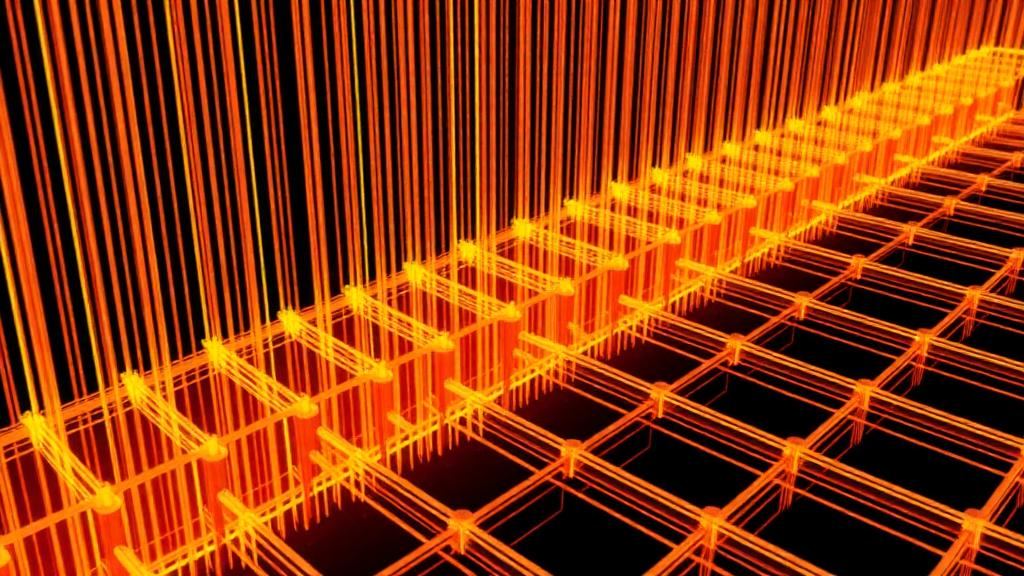
The Tiangong team’s answer was to abandon randomness altogether and build order into the material’s architecture. Instead of stirring boron nitride and graphene nanoplatelets into liquid PDMS and letting them settle wherever physics dictates, the researchers first constructed a vertically oriented scaffold of the two hybrid fillers, so that the flat, plate-like particles stand on edge, stacked like a miniature forest aligned perpendicular to the plane of the finished film. This orientation matters enormously because of the intrinsic anisotropy of the fillers themselves. Boron nitride platelets and graphene nanoplatelets both conduct heat superbly along their flat surfaces, where strong covalent bonds create efficient phonon highways, but conduct poorly across their thin edges. By standing the platelets upright, the researchers pointed those in-plane thermal highways directly through the thickness of the composite, along exactly the path that heat must travel from a chip to a heat sink in a real device.
Getting the two fillers to cooperate required some surface chemistry. Graphene nanoplatelets are among the best thermal conductors known, but they are electrically conductive too, which is a liability in an insulating composite, and they tend to clump together rather than disperse evenly. Boron nitride, by contrast, is both thermally conductive and electrically insulating, making it the natural guardian of the composite’s dielectric properties. The researchers coated both fillers with polydopamine, a bio-inspired polymer that forms spontaneously on almost any surface and dramatically improves compatibility with polymer matrices. The polydopamine layer helps the platelets disperse uniformly, strengthens the interfacial bonding between the rigid fillers and the soft silicone, and reduces the interfacial thermal resistance that would otherwise choke heat flow at every filler-polymer boundary. The composite, designated B-PDA-G-PVA/PDMS, was completed by vacuum infiltration, in which liquid PDMS is drawn into the pores of the vertically structured filler network, ensuring the polymer fills every gap and the architecture is preserved in the cured material.
The performance figures are striking. At a filler loading of just 8 weight percent, a modest amount by the standards of thermal composites, which often require 30 to 50 weight percent of filler to reach comparable performance, the vertically oriented composite achieved a through-plane thermal conductivity of 2.51 watts per meter-kelvin. That is more than ten times the conductivity of pristine PDMS and significantly higher than what the same fillers deliver when they are randomly distributed in the polymer. The comparison underscores the central lesson of the work: geometry can matter as much as chemistry. The same grams of filler, arranged differently, produce a fundamentally different material. The pronounced anisotropy of the composite, meaning heat flows far more readily through its thickness than along its plane, is not a defect but a feature, precisely matched to the geometry of thermal interface applications where heat must cross the pad’s thickness.
Just as important is what the material does not do. Despite containing graphene, one of the most electrically conductive substances on Earth, the composite maintains a volume resistivity of 1.08 times ten to the twelfth ohm-centimeters, an extraordinarily high value that places it firmly in the category of electrical insulators. The boron nitride platelets, wrapped in insulating polydopamine and embedded in the insulating silicone matrix, appear to prevent the graphene nanoplatelets from forming percolating electrical pathways through the material. In practical terms, this means the composite could sit directly on live circuitry without shorting anything out, a non-negotiable requirement for thermal interface materials in electronics. The researchers also report that the composites show stable dielectric, mechanical, and thermal properties, suggesting the material can withstand the mechanical compression, thermal cycling, and electrical fields of real service conditions without degrading.
To demonstrate that the laboratory numbers translate into device-level benefits, the team applied their vertically oriented composites as thermal interface materials on light-emitting diode chips, one of the most demanding and easily measured thermal management scenarios. LEDs convert a substantial fraction of their electrical input into heat, and that heat, if not removed, raises the junction temperature, which dims the light, shifts its color, and accelerates the degradation of the semiconductor. When the new composite was used to bridge the gap between LED chips and their heat sinks, the steady-state operating temperature of the chips dropped measurably compared with conventional arrangements. Lower operating temperatures mean brighter, longer-lived, more energy-efficient lighting, and the same principle applies directly to power amplifiers, battery packs, and processor packages.
The significance of the work extends beyond the specific material system. Thermal interface materials are a quiet but critical layer in the global technology stack; every laptop, server, base station, and electric vehicle inverter depends on them, and the industry has long sought materials that combine high thermal conductivity, high electrical insulation, low filler loading, and mechanical compliance. High filler loadings make composites stiff, heavy, and expensive, and they can clog the viscous polymer during processing. By achieving 2.51 watts per meter-kelvin at only 8 weight percent filler, the vertical architecture approach points toward lighter, softer, cheaper thermal pads that could be manufactured with relatively conventional polymer processing techniques. The vacuum infiltration method used to lock in the vertical structure is compatible with scalable fabrication, and polydopamine surface modification is a mild, aqueous, widely adopted chemistry rather than an exotic laboratory-only process.
There are, as always, questions that further work must address. The long-term reliability of the composite under thousands of thermal cycles, its performance under sustained compressive loads, and its manufacturability at industrial scale will determine whether the laboratory achievement becomes a commercial product. The interplay between the polydopamine coating thickness and interfacial thermal resistance also offers room for optimization, since every polymer layer between conductive fillers adds a barrier to phonon transport even as it improves bonding. But the conceptual advance is clear and likely to influence the field broadly: rather than fighting the anisotropy of plate-like fillers, engineers should exploit it, orienting the material’s internal structure to match the direction in which heat actually needs to travel.
For a field often dominated by incremental improvements in filler chemistry, the Tiangong University study is a reminder that architecture is a design variable in its own right. A forest of upright boron nitride and graphene platelets, glued together with mussel-inspired polydopamine and flooded with silicone, turns a mediocre insulating polymer into a heat-conducting channel that keeps its electrical guard up. As electronic devices continue their relentless march toward greater density and power, materials that can move heat quickly without conducting electricity will only grow in importance, and this vertically constructed network offers a compelling blueprint for how to build them.
Subject of Research: Vertically oriented boron nitride and graphene nanoplatelet networks in PDMS composites for thermally conductive, electrically insulating thermal interface materials
Article Title: Achieving high through-plane thermal conductivity and electrical insulation in BN/GNPs insulating PDMS materials with vertically constructed networks
Article References: Xia, Z., Huang, K., Tang, K., Cheng, C., & Wang, N. (2026). Achieving high through-plane thermal conductivity and electrical insulation in BN/GNPs insulating PDMS materials with vertically constructed networks. Journal of Materials Science. https://doi.org/10.1007/s10853-026-12616-z
Image Credits: AI Generated
DOI: 10.1007/s10853-026-12616-z
Keywords: thermal interface materials, boron nitride, graphene nanoplatelets, PDMS composite, thermal conductivity, electrical insulation, polydopamine, vertical alignment, LED cooling, electronics thermal management, nanocomposites, anisotropic heat transport
News Source: Neil Sanderson. (October 7, 2026). Vertical Nanotube Networks Supercharge Heat Flow in Electrically Insulating Polymer Films. Scienmag.