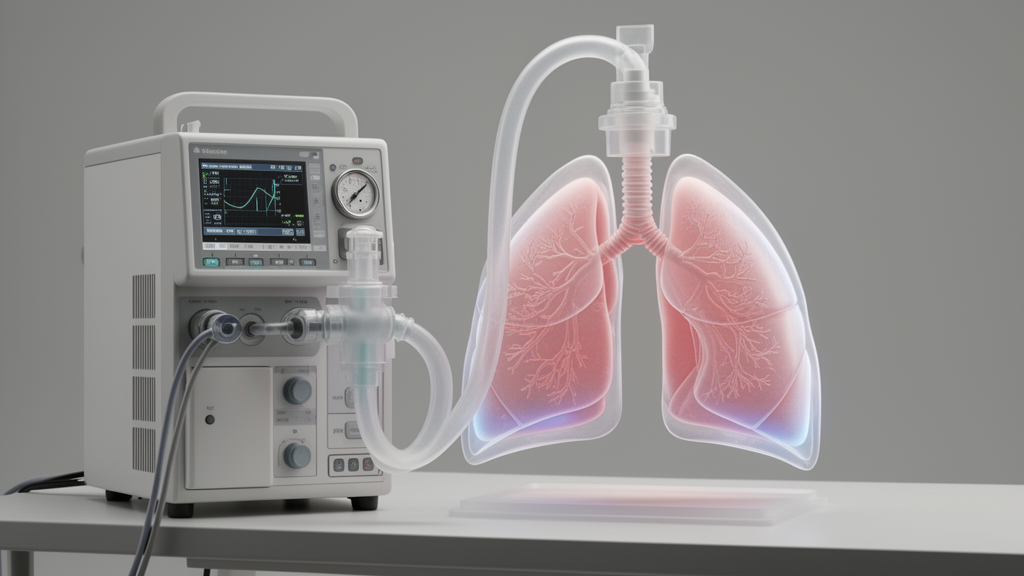
In an evaluation of mechanical ventilation modeling, incorporating ventilatory efficiency altered the trade-off between tidal volume and respiratory rate, shifting modeled mortality-minimizing settings toward higher tidal volumes. Researchers Alessandro Stronati, Domenico Luca Grieco, Massimo Antonelli, and colleagues examined how effective dead-space volume influences the ventilatory balance required to sustain isocapnia, responding to correspondence on their previously published analytical framework. Their reanalysis demonstrated that when physiological dead space increases, maintaining carbon dioxide clearance requires adjustments that systematically change the mathematical balance between lung volume and cycling frequency.
The evaluation addressed physiological concerns that high total effective dead-space volume increases the respiratory rate necessary to maintain stable arterial carbon dioxide levels at any specified tidal volume. To incorporate this mechanism, the authors used baseline ventilatory ratio measurements averaged across intensive care days 0 to 1, available for a cohort of 1113 patients. Ventilatory ratio served as an estimate of effective dead-space volume, assuming predicted carbon dioxide production alongside a reference dead-space fraction of 0.30.
Under the mathematical specification, dead-space volume was calculated as the observed tidal volume multiplied by one minus 0.70 divided by the ventilatory ratio, constrained by a physiological lower bound of 1.0 mL per kilogram of predicted body weight. Across the patient cohort, the derived dead space yielded a median of 194 mL, with an interquartile range extending from 143 to 245 mL. Across subgroup extremes, median values reached 103 mL in the lowest ventilatory ratio quartile and 271 mL in the highest quartile. This calculation directly replaced prior fixed modeling assumptions that had assigned a standard airway dead space of 1.5 mL per kilogram of predicted body weight plus an alveolar dead-space fraction fixed at 20 percent of tidal volume.
To generate comparative isocapnic curves, alveolar ventilation was expressed as respiratory rate multiplied by the difference between tidal volume and effective dead space, holding dead space constant along each individual curve. The investigators subsequently split the patient cohort around the median baseline ventilatory ratio of 1.19. In their statistical models, the pooled driving pressure-to-respiratory rate coefficient ratio was 2.65 breaths per minute per centimeter of water. Independent coefficient ratio estimates were 1.49 in the low ventilatory ratio group and 2.54 in the high ventilatory ratio group, though both separate respiratory rate coefficients had 95 percent confidence intervals that spanned zero.
Because the independent group respiratory rate coefficients crossed zero, both ventilatory ratio strata were plotted using the identical pooled coefficients, thereby holding mortality associations constant across groups. In the highest respiratory-system elastance tertile, the modeled minimum mortality settings occurred at a tidal volume of 6.0 mL per kilogram of predicted body weight and a respiratory rate of 17.9 breaths per minute among patients with a low ventilatory ratio. Conversely, for patients with a high ventilatory ratio in the same elastance tertile, the modeled minimum shifted to a tidal volume of 7.5 mL per kilogram and a respiratory rate of 17.2 breaths per minute.
Across all examined elastance tertiles, the modeled tidal volume minima were consistently 1.4 to 1.8 mL per kilogram of predicted body weight higher in patients exhibiting higher baseline ventilatory ratios compared to those with lower ratios. Lower ventilatory efficiency, marked by higher dead space and an elevated ventilatory ratio, shifted the modeled curves upward and rightward, favoring combinations characterized by higher tidal volume and lower cycling frequency to achieve the same alveolar ventilation targets.
The authors emphasized that these mathematical associations represent physiological modeling rather than proven clinical benefits or therapeutic recommendations. Because patient groups differed across other baseline inputs utilized to construct the curves, the observational comparison did not isolate the independent causal effect of dead space. Furthermore, interpreting the ventilatory ratio as an exact indicator of ventilatory inefficiency assumes constant carbon dioxide production and a standard reference minute ventilation of 100 mL per kilogram of predicted body weight per minute, conditions that can fluctuate significantly in individual critically ill patients.
An additional physiological constraint in the study design was that applying a fixed dead space along each curve fails to account for dynamic, rate-dependent efficiency losses that may occur as breathing frequencies change. While the reanalysis successfully integrated baseline ventilatory efficiency, it left the dynamic physiological response to changing respiratory rates unresolved. Consequently, the researchers noted that direct measurements of total carbon dioxide production and dead space will be essential to accurately guide clinical tidal volume and rate titration.
Subject of Research: Ventilatory efficiency and tidal volume trade-offs in mechanical ventilation modeling
Article Title: Should ventilatory efficiency be considered when trading tidal volume against respiratory rate? Author's reply
Article References: Stronati, A., Grieco, D. L., Taccone, F. S., Robba, C., Citerio, G., & Antonelli, M. (2026). Should ventilatory efficiency be considered when trading tidal volume against respiratory rate? Author's reply. Intensive Care Medicine. https://doi.org/10.1007/s00134-026-08662-5
Image Credits: AI Generated
DOI: 10.1007/s00134-026-08662-5
Keywords: ventilatory efficiency, ventilatory ratio, tidal volume, respiratory rate, dead space volume, mechanical ventilation, isocapnic curves, respiratory-system elastance, alveolar ventilation, driving pressure, carbon dioxide production, intensive care medicine, physiological modeling, isocapnia, critical care physiology, predicted body weight
News Source: Ophelia Keating. (November 21, 2026). Ventilatory Efficiency Shifts Optimal Tidal Volume Higher in Mechanical Ventilation Models. Scienmag.