• HOME
  • NEWS
  • EXPLORE
    • CAREER
      • Companies
      • Jobs
    • EVENTS
    • iGEM
      • News
      • Team
    • PHOTOS
    • VIDEO
    • WIKI
  • BLOG
  • COMMUNITY
    • FACEBOOK
    • INSTAGRAM
    • TWITTER
Saturday, May 16, 2026
BIOENGINEER.ORG
No Result
View All Result
  • Login
  • HOME
  • NEWS
  • EXPLORE
    • CAREER
      • Companies
      • Jobs
        • Lecturer
        • PhD Studentship
        • Postdoc
        • Research Assistant
    • EVENTS
    • iGEM
      • News
      • Team
    • PHOTOS
    • VIDEO
    • WIKI
  • BLOG
  • COMMUNITY
    • FACEBOOK
    • INSTAGRAM
    • TWITTER
  • HOME
  • NEWS
  • EXPLORE
    • CAREER
      • Companies
      • Jobs
        • Lecturer
        • PhD Studentship
        • Postdoc
        • Research Assistant
    • EVENTS
    • iGEM
      • News
      • Team
    • PHOTOS
    • VIDEO
    • WIKI
  • BLOG
  • COMMUNITY
    • FACEBOOK
    • INSTAGRAM
    • TWITTER
No Result
View All Result
Bioengineer.org
No Result
View All Result
Home NEWS Science News Biology

Venetian physician had a key role in shaping early modern chemistry

Bioengineer by Bioengineer
May 26, 2017
in Biology
Reading Time: 2 mins read
0
Share on FacebookShare on TwitterShare on LinkedinShare on RedditShare on Telegram
IMAGE

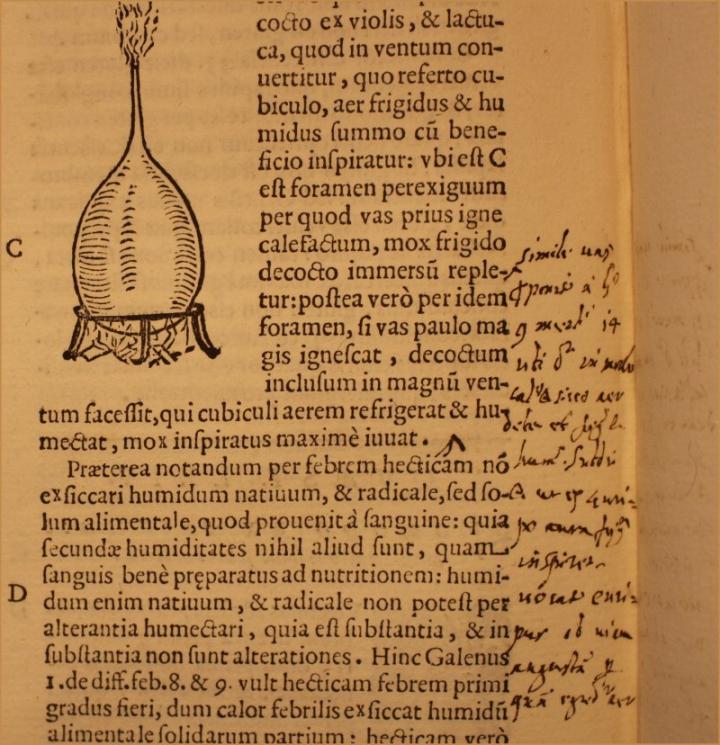
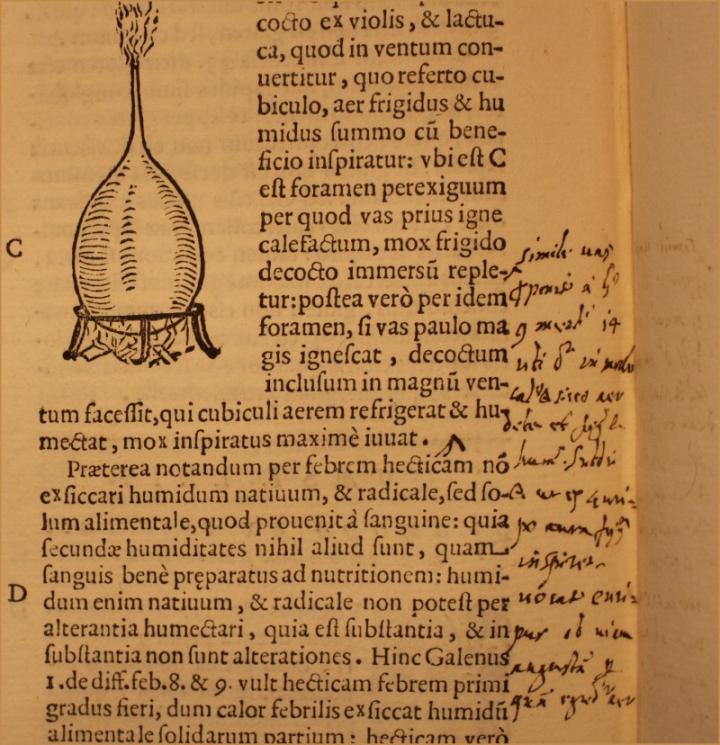
Credit: Santorio's marginal note to col. 406C-D, in Santorio Santori, Commentaria In Primam Fen Primi Libri Canonis Avicennae (Venice, 1625), British Library, 542.h.11. Courtesy of the British Library….

Newly discovered notes show for the first time the Venetian doctor who invented the thermometer and helped lay the foundations for modern medical treatment also played a key role in shaping our understanding of chemistry.

The physician Santorio Santori, who lived between 1561 and 1636, came up with an accurate explanation for how matter works twenty years before Galileo.

Handwritten notes made by Santorio in a 1625 edition of his own book Commentaria in primam Fen primi libri Canonis Avicennae (A Commentary on the First Fen of the First Book of Avicenna's Canon) show he realised matter was made from invisible 'corpuscles'. Although the Greek philosopher Democritus and others after him had already maintained the existence of such bodies, historians previously believed that nobody had come up with the proof for their existence before Galileo.

The book, kept in the British Library, was found by Dr Fabrizio Bigotti, from the Centre for Medical History at the University of Exeter. The language used and handwriting style strongly suggest the notes were made by Santorio.

Dr Bigotti said: "This discovery makes the case for a deeper study of early modern chemistry in the Medical School of Padua, where Santorio taught, and the work carried out there between the end of the sixteenth and the beginning of the seventeenth century. Santorio's true contribution to chemistry has been forgotten but, I hope, this new discovery means that will no longer be the case.

"The notes show he did not see the world not made up of four elemental qualities – hot, cold, dry and moist – as Aristotle had suggested. This helped to start the process of getting rid of the idea that magic and the occult could be found in nature.

"It is truly remarkable that, beyond his undoubted merits in science and early modern technology, Santorio also held very innovative ideas on chemistry and was so fully committed to investigating the structure of matter."

Santorio had correctly identified the minimal structure of matter as a series of corpuscles as early as 1603, and proved his assumptions by means of a series of optical experiments on light, as well as distilling urine. All these experiments were carried out with instruments Santorio made especially for his own research.

It was already known that Santorio laid the foundations for what is understood today as evidence-based medicine and the study of metabolism. The new discovery shows he was he among the first scientists to suggest the body aims at preserving its own balance through discharge of invisible particles.

Dr Bigotti began researching the life and works of Santorio in 2013. His project is now funded by Wellcome Trust. He outlined this new discovery at an international conference organised with Professor Jonathan Barry, Co-director of the Centre for Medical History of the University of Exeter, in Pisa this month.

###

Media Contact

Kerra Maddern
[email protected]
44-139-272-2062
@uniofexeter

http://www.exeter.ac.uk

############

Story Source: Materials provided by Scienmag

Share12Tweet8Share2ShareShareShare2

Related Posts

Uncovering C. elegans Immunity via Genetic Screens — Biology

Uncovering C. elegans Immunity via Genetic Screens

May 16, 2026
Single mother must adapt swiftly — the survival of her colony depends on it — Biology

Single mother must adapt swiftly — the survival of her colony depends on it

May 15, 2026

Why Are Nearly Everyone Right-Handed? It Might Be Linked to How We Learned to Walk

May 15, 2026

Excessive Neuronal Activity Initiates Severe Autoimmune Brain Disorder

May 15, 2026
Please login to join discussion

POPULAR NEWS

  • Research Indicates Potential Connection Between Prenatal Medication Exposure and Elevated Autism Risk

    844 shares
    Share 338 Tweet 211
  • New Study Reveals Plants Can Detect the Sound of Rain

    730 shares
    Share 291 Tweet 182
  • Salmonella Haem Blocks Macrophages, Boosts Infection

    62 shares
    Share 25 Tweet 16
  • Breastmilk Balances E. coli and Beneficial Bacteria in Infant Gut Microbiomes

    58 shares
    Share 23 Tweet 15

About

We bring you the latest biotechnology news from best research centers and universities around the world. Check our website.

Follow us

Recent News

Uncovering C. elegans Immunity via Genetic Screens

Congenital Heart Disease’s Lasting Impact on Brain Health

Metabolic Stress Worsens Parkinson’s via Mitochondrial Ferroptosis

Subscribe to Blog via Email

Enter your email address to subscribe to this blog and receive notifications of new posts by email.

Join 82 other subscribers
  • Contact Us

Bioengineer.org © Copyright 2023 All Rights Reserved.

Welcome Back!

Login to your account below

Forgotten Password?

Retrieve your password

Please enter your username or email address to reset your password.

Log In
No Result
View All Result
  • Homepages
    • Home Page 1
    • Home Page 2
  • News
  • National
  • Business
  • Health
  • Lifestyle
  • Science

Bioengineer.org © Copyright 2023 All Rights Reserved.