• HOME
  • NEWS
  • EXPLORE
    • CAREER
      • Companies
      • Jobs
    • EVENTS
    • iGEM
      • News
      • Team
    • PHOTOS
    • VIDEO
    • WIKI
  • BLOG
  • COMMUNITY
    • FACEBOOK
    • INSTAGRAM
    • TWITTER
Thursday, July 2, 2026
BIOENGINEER.ORG
No Result
View All Result
  • Login
  • HOME
  • NEWS
  • EXPLORE
    • CAREER
      • Companies
      • Jobs
        • Lecturer
        • PhD Studentship
        • Postdoc
        • Research Assistant
    • EVENTS
    • iGEM
      • News
      • Team
    • PHOTOS
    • VIDEO
    • WIKI
  • BLOG
  • COMMUNITY
    • FACEBOOK
    • INSTAGRAM
    • TWITTER
  • HOME
  • NEWS
  • EXPLORE
    • CAREER
      • Companies
      • Jobs
        • Lecturer
        • PhD Studentship
        • Postdoc
        • Research Assistant
    • EVENTS
    • iGEM
      • News
      • Team
    • PHOTOS
    • VIDEO
    • WIKI
  • BLOG
  • COMMUNITY
    • FACEBOOK
    • INSTAGRAM
    • TWITTER
No Result
View All Result
Bioengineer.org
No Result
View All Result
Home NEWS Science News Chemistry

Vectorial adaptive optics: correcting both polarization and phase

Bioengineer by Bioengineer
November 28, 2023
in Chemistry
Reading Time: 2 mins read
0
V-AO methods and their applications.
Share on FacebookShare on TwitterShare on LinkedinShare on RedditShare on Telegram

Adaptive optics (AO) is a technique used for real-time correction of phase aberrations by employing feedback to adjust the optical system. Polarization aberrations represent another significant type of distortion that can impact optical systems. Various factors, such as stressed optical elements, Fresnel effects, and polarizing effects in materials or biological tissues, can induce polarization aberrations. These aberrations affect both system resolution and the accuracy of vector information.
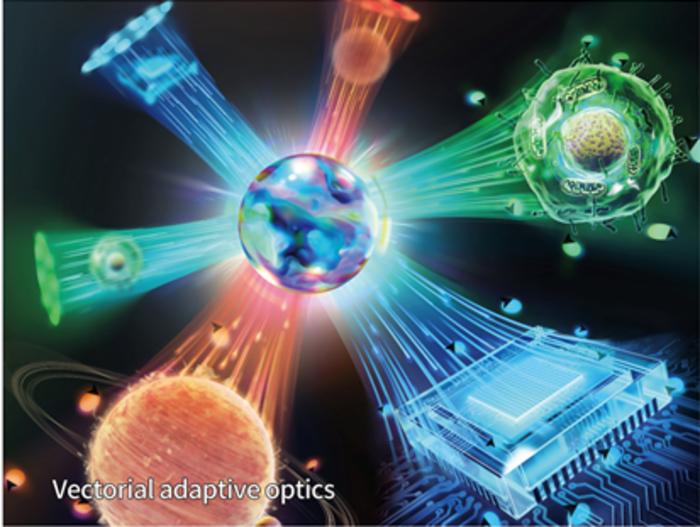
V-AO methods and their applications.

Credit: by Chao He, Jacopo Antonello, Martin J. Booth

Adaptive optics (AO) is a technique used for real-time correction of phase aberrations by employing feedback to adjust the optical system. Polarization aberrations represent another significant type of distortion that can impact optical systems. Various factors, such as stressed optical elements, Fresnel effects, and polarizing effects in materials or biological tissues, can induce polarization aberrations. These aberrations affect both system resolution and the accuracy of vector information.

Vectorial aberrations result from the combined effects of phase and polarization aberrations. They can substantially influence the performance of many modern optical systems, especially those sensitive to vectors or requiring high resolution. For example, in lithographic systems, polarization aberrations play a crucial role in systematic resolution, affecting the quality of the manufactured chips.

In a recent publication in eLight, a team of scientists, led by Dr. Chao He from the University of Oxford, has introduced a next-generation AO technique termed vectorial adaptive optics (V-AO). This technique aims to enhance both the uniformity of the vector field state and the optical resolution of an optical system.

V-AO is an innovative technique designed to correct both polarization and phase aberrations. It stands as a powerful tool capable of improving the performance of various optical systems, including microscopes, telescopes, and laser systems. This advancement offers new insights into cutting-edge biomedical imaging, planetary observation, and the manufacturing of integrated circuit chips.

The authors of the paper outline three distinct methods for implementing V-AO: sensor-based, quasi-sensorless, and modal-sensorless. They also present experimental results showcasing the effectiveness of V-AO in correcting common vectorial aberrations.

V-AO represents a promising and innovative technology poised to revolutionize the optics community. Its potential lies in enhancing the performance of optical systems and enabling new applications. Through vectorial field feedback control methods, this next-generation AO technique is expected to benefit various research areas, ranging from astronomical telescopes to microscopy. Its applications extend from galaxy detection to laser-based and lithographic nanofabrication, as well as biomedical and clinical characterization.


Journal

eLight

DOI

10.1186/s43593-023-00056-0

Article Publication Date

27-Nov-2023

Share12Tweet8Share2ShareShareShare2

Related Posts

Graz University of Technology Deciphers the Structural Secrets of MOF Thin Films — Chemistry

Graz University of Technology Deciphers the Structural Secrets of MOF Thin Films

July 2, 2026
Breaking Thermodynamic Limits: Wavelength-Driven Catalysis Advances Ammonia Synthesis — Chemistry

Breaking Thermodynamic Limits: Wavelength-Driven Catalysis Advances Ammonia Synthesis

July 2, 2026

From Quantum Mechanics to AI-Powered Materials Discovery: MARVEL Marks 12 Years of Transforming Computational Science

July 2, 2026

Djire Recognized with National Award for Outstanding Contributions in Research and Teaching

July 2, 2026

POPULAR NEWS

  • Detection of EDCs in Breast Milk and Infant Urine Up to Six Months Highlights Early Exposure Risks

    77 shares
    Share 31 Tweet 19
  • Saying Goodbye to PGY-6: Pediatric Fellowship Realities

    103 shares
    Share 41 Tweet 26
  • New Drug Candidate Developed at McMaster Shows Potential for Treating Brain Cancer

    58 shares
    Share 23 Tweet 15
  • KTU Researchers Explore Ultrasound’s Role in Enhancing Blood Flow Beyond Diagnostics

    53 shares
    Share 21 Tweet 13

About

BIOENGINEER.ORG

We bring you the latest biotechnology news from best research centers and universities around the world. Check our website.

Follow us

Recent News

Steatosis Drives Liver Metastasis Diversity in CRC

Unlocking the Mysteries of Alzheimer’s Disease

Pensoft Introduces New Peer-Reviewed Journal of Regeneration to Advance Restorative Biology Across Species

Subscribe to Blog via Email

Enter your email address to subscribe to this blog and receive notifications of new posts by email.

Join 83 other subscribers
  • Contact Us

Bioengineer.org © Copyright 2023 All Rights Reserved.

Welcome Back!

Login to your account below

Forgotten Password?

Retrieve your password

Please enter your username or email address to reset your password.

Log In
No Result
View All Result
  • Homepages
    • Home Page 1
    • Home Page 2
  • News
  • National
  • Business
  • Health
  • Lifestyle
  • Science

Bioengineer.org © Copyright 2023 All Rights Reserved.