• HOME
  • NEWS
  • EXPLORE
    • CAREER
      • Companies
      • Jobs
    • EVENTS
    • iGEM
      • News
      • Team
    • PHOTOS
    • VIDEO
    • WIKI
  • BLOG
  • COMMUNITY
    • FACEBOOK
    • INSTAGRAM
    • TWITTER
Monday, August 10, 2026
BIOENGINEER.ORG
No Result
View All Result
  • Login
  • HOME
  • NEWS
  • EXPLORE
    • CAREER
      • Companies
      • Jobs
        • Lecturer
        • PhD Studentship
        • Postdoc
        • Research Assistant
    • EVENTS
    • iGEM
      • News
      • Team
    • PHOTOS
    • VIDEO
    • WIKI
  • BLOG
  • COMMUNITY
    • FACEBOOK
    • INSTAGRAM
    • TWITTER
  • HOME
  • NEWS
  • EXPLORE
    • CAREER
      • Companies
      • Jobs
        • Lecturer
        • PhD Studentship
        • Postdoc
        • Research Assistant
    • EVENTS
    • iGEM
      • News
      • Team
    • PHOTOS
    • VIDEO
    • WIKI
  • BLOG
  • COMMUNITY
    • FACEBOOK
    • INSTAGRAM
    • TWITTER
No Result
View All Result
Bioengineer.org
No Result
View All Result
Home NEWS Science News Biology

Vascular disease in COVID-19 is not caused by viral infection of blood vessels

Bioengineer by Bioengineer
October 27, 2021
in Biology
Reading Time: 3 mins read
0
SARS-CoV-2 virus added to cells
Share on FacebookShare on TwitterShare on LinkedinShare on RedditShare on Telegram

The SARS-CoV-2 virus does not infect blood vessels, despite the high risk of blood clots to COVID-19 patients, University of Queensland researchers have found.
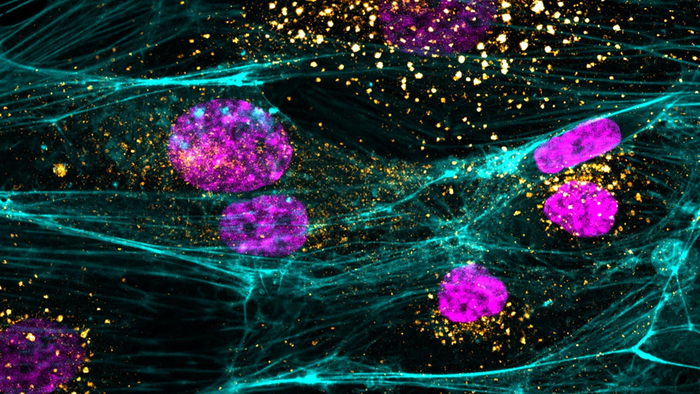
SARS-CoV-2 virus added to cells

Credit: Please credit Institute for Molecular Bioscience, The University of Queensland.

The SARS-CoV-2 virus does not infect blood vessels, despite the high risk of blood clots to COVID-19 patients, University of Queensland researchers have found.

Dr Emma Gordon and Dr Larisa Labzin from UQ’s Institute for Molecular Bioscience and Dr Kirsty Short from UQ’s School of Chemistry and Molecular Biosciences pooled their expertise in vascular biology and virology to determine how the virus causes damage to blood vessels.

The researchers found that the cardiovascular complications of COVID-19 are triggered by inflammation caused by infected airway cells.

“At least 40 per cent of patients that are hospitalised with COVID-19 are at high risk of blood clots, and anti-coagulation therapies are now being routinely used,” Dr Gordon said.

“There have been many studies attempting to prove whether the virus is infecting cells of the inner blood vessel wall or not.

“By conducting our experiments using real, infectious virus rather than fragments of the virus’s spike protein, we can definitively say it is not.”

The researchers used UQ’s sophisticated microscopy facilities to track where the virus travelled in the cells and visualise how blood vessels respond to the live virus.

Immunologist Dr Labzin said the body’s inflammatory response had a big effect on the cardiovascular system because they work together to fight infection – the blood delivers the immune cells to the site of infection and makes blood clots if the blood vessel is damaged.

“When our immune system works well, it clears the virus from our bodies,” Dr Labzin said.

“But sometimes it goes into overdrive and we get an overblown inflammatory response causing complications –in the case of COVID-19, this is often blood clots, when there shouldn’t be any.
“Knowing that it is inflammation causing these cardiovascular complications arising from COVID-19 rather than the virus itself will help us develop the right treatments, and a better understanding of how and why these complications arise.”

Heart Foundation interim CEO, Professor Garry Jennings said the study helps clarify a key debate about the relationship between the virus and the lining of the blood vessels.
“How the cells lining the blood vessels sense the virus and the damage to nearby cells is still not completely understood,” he said.

“There is more research to do, but this study is an important step in our understanding of the virus and which cells and mechanisms we should look at next.”
This research is published in Clinical and translational Immunology .

This work was supported by a Future Leader Fellowship (104692) from the National Heart Foundation of Australia and the National Health and Medical Research Council.

Explainer video: https://youtu.be/zk8PHO0LBPo


Journal

Clinical & Translational Immunology

DOI

10.1002/cti2.1350

Method of Research

Experimental study

Subject of Research

Cells

Article Title

Endothelial cells are not productively infected by SARS-CoV-2

Article Publication Date

24-Oct-2021
Share12Tweet8Share2ShareShareShare2

Related Posts

New Bypass Highway and Watercourse Restoration Shape Southern Damselfly Genetics and Recolonisation

New Bypass Highway and Watercourse Restoration Shape Southern Damselfly Genetics and Recolonisation

August 10, 2026
Antisense transcription uncovers disease-linked adaptations in the human gut microbiome

Antisense transcription uncovers disease-linked adaptations in the human gut microbiome

August 10, 2026

New Thai mountain dragon lizard named after House of the Dragon’s Syrax

August 10, 2026

How Dogs Evolved Worldwide to Mirror the Traits of Their Human Companions

August 10, 2026

POPULAR NEWS

  • Parkinson’s Disease Links Cholinergic Deficits to Hallucinations

    29 shares
    Share 12 Tweet 7
  • New Bypass Highway and Watercourse Restoration Shape Southern Damselfly Genetics and Recolonisation

    29 shares
    Share 12 Tweet 7
  • Carbon Accounting Rules Influence Incentives for Hydrogen Production

    29 shares
    Share 12 Tweet 7
  • Implementing an ICU education bundle for neurally adjusted ventilatory assist

    29 shares
    Share 12 Tweet 7

About

We bring you the latest biotechnology news from best research centers and universities around the world. Check our website.

Follow us

Recent News

Parkinson’s Disease Links Cholinergic Deficits to Hallucinations

New Bypass Highway and Watercourse Restoration Shape Southern Damselfly Genetics and Recolonisation

Carbon Accounting Rules Influence Incentives for Hydrogen Production

Subscribe to Blog via Email

Enter your email address to subscribe to this blog and receive notifications of new posts by email.

Join 86 other subscribers
  • Contact Us

Bioengineer.org © Copyright 2023 All Rights Reserved.

Welcome Back!

Login to your account below

Forgotten Password?

Retrieve your password

Please enter your username or email address to reset your password.

Log In
No Result
View All Result
  • Homepages
    • Home Page 1
    • Home Page 2
  • News
  • National
  • Business
  • Health
  • Lifestyle
  • Science

Bioengineer.org © Copyright 2023 All Rights Reserved.