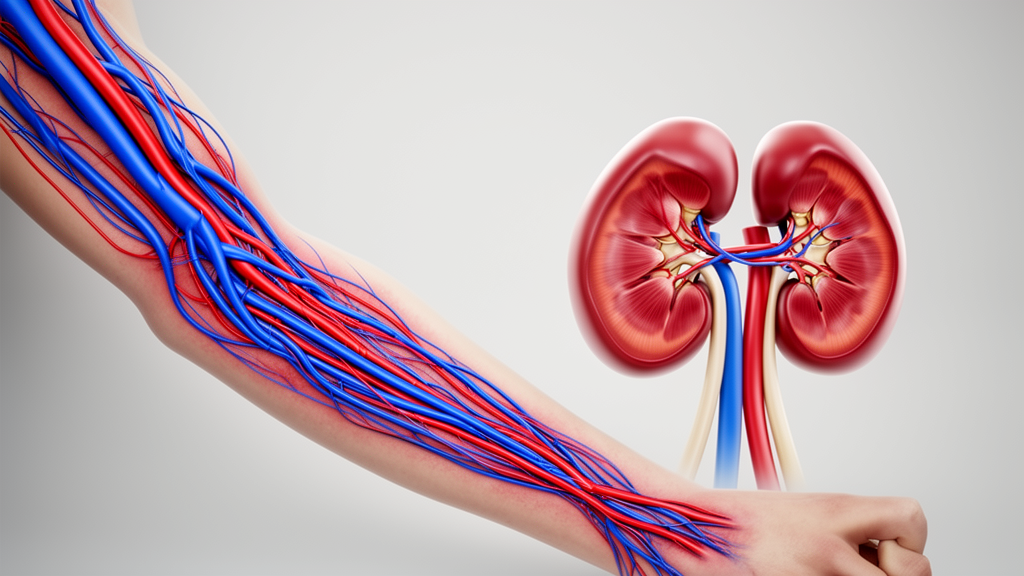
In an observational investigation evaluating renal function trajectories in advanced chronic kidney disease, researchers observed that the rate of estimated glomerular filtration rate decline became significantly less steep following the surgical creation of an arteriovenous access compared with the preceding pre-operative monitoring interval. The retrospective single-center study, conducted by nephrology investigators at Nagasaki Harbor Medical Center in Japan and published in Renal Replacement Therapy, examined longitudinal laboratory data from one hundred and fifty-three patients who underwent planned arteriovenous fistula or arteriovenous graft construction and subsequently transitioned to maintenance hemodialysis between 2016 and 2023. Tracking the progression of renal filtration capacity from the initial outpatient nephrology referral through surgical vessel construction and onward to the first hemodialysis session demonstrated that the median annual decrease in estimated glomerular filtration rate dropped from 7.5 milliliters per minute per 1.73 square meters per year before vascular access surgery to 3.0 milliliters per minute per 1.73 square meters per year afterward.
Establishing reliable vascular access through a native arteriovenous fistula or synthetic arteriovenous graft prior to initiating renal replacement therapy remains a central clinical priority for mitigating adverse clinical outcomes. Unplanned hemodialysis initiation, frequently necessitated by acute metabolic decompensation, fluid overload, or uremic complications, often compels the emergent placement of temporary central venous catheters. Catheter-dependent dialysis initiation is widely recognized to increase early patient mortality, prolong initial hospitalizations, and drive higher overall medical expenditures relative to planned elective access pathways. Concurrently, prior clinical reports have repeatedly described an unexpected deceleration in the progressive loss of residual kidney function following access surgery, though the specific clinical profiles and demographic characteristics associated with this altered filtration slope had not been fully delineated in earlier cohort analyses.
To rigorously examine these functional shifts across defined clinical intervals, the investigative team screened three hundred and five individuals with progressive renal impairment who presented to the medical center and subsequently commenced maintenance renal replacement therapy over an eight-year observation window. The investigators systematically excluded sixty individuals who began hemodialysis via indwelling catheters without vascular access placement, including six patients who died prior to planned surgery, as well as sixteen patients opting for peritoneal dialysis, two individuals lacking complete clinical records, and seventy-four patients whose estimated glomerular filtration rate fell below ten milliliters per minute per 1.73 square meters at initial department referral. Ultimately, one hundred and fifty-three adult patients met all inclusion criteria, with researchers recording serial serum creatinine concentrations, physiological measurements, and concurrent medical conditions across three standardized clinical milestones: first nephrology referral, vascular access creation, and hemodialysis initiation.
The demographic and clinical profile of the analyzed cohort mirrored advanced chronic kidney disease populations managed in specialized hospital settings. The cohort exhibited a mean age of 70.1 years at first department referral, with male patients comprising 69.9 percent of the total sample and an overall mean body mass index of 24.7 kilograms per square meter. Diabetic nephropathy represented the primary underlying cause of end-stage kidney disease in 47.1 percent of patients, followed by hypertensive nephrosclerosis in 27.5 percent and chronic glomerulonephritis in 12.4 percent. Documented comorbid conditions included hypertension in 98.0 percent of individuals, diabetes mellitus in 52.9 percent, dyslipidemia in 47.7 percent, and ischemic heart disease in 18.3 percent. Nearly all participants underwent native arteriovenous fistula creation, with only two receiving arteriovenous grafts, while 54.3 percent participated in a structured inpatient chronic kidney disease education program administered by a multidisciplinary team.
Across the complete observational pathway, the mean duration elapsed from initial nephrology referral to vascular access creation was 2.1 years, while the subsequent period from access surgery to hemodialysis initiation averaged 0.4 years. At initial presentation, patients displayed a mean serum creatinine concentration of 2.8 milligrams per deciliter and a mean estimated glomerular filtration rate of 20.5 milliliters per minute per 1.73 square meters. By the time access surgery took place, mean serum creatinine had progressed to 6.2 milligrams per deciliter with a corresponding mean filtration rate of 6.2 milliliters per minute per 1.73 square meters, subsequently reaching 8.1 milligrams per deciliter and 5.2 milliliters per minute per 1.73 square meters at hemodialysis entry. Paired non-parametric analysis confirmed that the median individual difference in annualized filtration decline before and after access placement was 4.1 milliliters per minute per 1.73 square meters per year, establishing a statistically significant reduction in decline velocity.
Recognizing that uneven observation periods could introduce analytical variability, the investigators conducted a targeted sensitivity analysis restricted to fifty-nine individuals who had at least three independent serum creatinine determinations recorded within the four months immediately preceding and the four months following access surgery. Applying least-squares linear regression to these symmetrical observational windows confirmed a substantial attenuation of functional deterioration, with the mean estimated glomerular filtration rate slope moderating from negative 7.2 milliliters per minute per 1.73 square meters per year pre-operatively to negative 3.6 milliliters per minute per 1.73 square meters per year post-operatively. Stratified sub-analyses demonstrated that this deceleration remained statistically significant among male patients but did not achieve significance among female participants, whereas significant slope differences persisted regardless of whether patients had participated in the inpatient education program.
To characterize which patients experienced the most pronounced trajectory modifications, researchers stratified the full cohort into quartiles based on the magnitude of change in annualized filtration slope, comparing the upper twenty-five percent designated as quartile one against the combined lower three quartiles. Patients categorized within quartile one were predominantly male, representing 86.8 percent of that subgroup compared with 64.4 percent across quartiles two through four. Additionally, quartile one patients progressed through significantly shorter clinical intervals, spending a median of 0.8 years between referral and access creation compared to 1.8 years in the reference group, and a median of 0.1 years between access creation and dialysis compared to 0.3 years. Notably, patients exhibiting these greater slope differences were significantly less likely to have undergone multidisciplinary chronic kidney disease education hospitalization prior to starting renal replacement therapy.
Univariate and multivariable logistic regression models verified that male sex and the absence of education hospitalization were robustly associated with classification into quartile one. In an initial multivariable model adjusted for age, sex, body mass index, education hospitalization, diabetes mellitus, hypertension, and ischemic heart disease, male sex yielded an adjusted odds ratio of 4.66, while prior educational hospitalization produced an adjusted odds ratio of 0.43. A second multivariable regression model incorporating pharmacological therapies, including phosphate binders, active vitamin D analogs, and oral iron supplementation, reaffirmed these associations, showing an adjusted odds ratio of 3.79 for male sex and 0.43 for educational hospitalization. Corresponding linear regression analyses examining annual slope alterations as a continuous metric yielded consistent statistical relationships, confirming that male patients and non-hospitalized individuals experienced larger relative slope shifts.
Despite the notable differences in filtration trajectories observed between subgroups, overall patient survival did not diverge significantly according to the degree of slope modification following access placement. Across a mean follow-up period of 950.4 days and a median tracking duration of 801 days following initial nephrology referral, thirty-eight total patient deaths were documented, including thirteen in quartile one and twenty-five distributed across quartiles two through four. Kaplan-Meier survival curves evaluated by the log-rank test demonstrated no statistically significant difference in cumulative mortality between the high-change quartile and the remaining cohort. Furthermore, multivariable Cox proportional hazards regression adjusting for age, sex, and educational hospitalization revealed that advanced chronological age remained the sole independent factor significantly associated with all-cause mortality during the post-referral observation timeline.
While hemodynamic adaptations—such as elevated cardiac output, reduced systemic vascular resistance, and localized steal-induced remote ischemic preconditioning—represent hypothesized biological explanations for preserved post-surgical filtration, the researchers emphasized that observational designs cannot establish direct causality. Inherent methodological limitations include reliance on simplified two-point slope calculations, the potential influence of regression to the mean, unavoidable selection bias from single-center retrospective recruitment, and unmeasured clinical confounders such as acute intercurrent infections or heart failure episodes occurring near dialysis onset. Moreover, the mean filtration rate at access creation of 6.2 milliliters per minute per 1.73 square meters fell considerably below guideline-recommended intervention thresholds, underscoring that these findings should be regarded as hypothesis-generating observations that warrant prospective validation in expansive multicenter cohorts.
Subject of Research: Renal function trajectory changes before and after arteriovenous vascular access creation
Article Title: Association of patient characteristics with changes in estimated glomerular filtration rate before and after arteriovenous fistula/graft creation: a retrospective study
Article References: Fukuda, H., Kitamura, M., Mori, A., Sakai, M., Torigoe, K., Abe, S., Yamashita, H., Matsushima, T., Aoki, D., Watanabe, J., Takahiro, T., Sakamoto, N., Imamura, R., Mukae, H., & Nishino, T. (2026). Association of patient characteristics with changes in estimated glomerular filtration rate before and after arteriovenous fistula/graft creation: a retrospective study. Renal Replacement Therapy, 12(1), Article 69. https://doi.org/10.1186/s41100-026-00752-w
Image Credits: AI Generated
DOI: 10.1186/s41100-026-00752-w
Keywords: arteriovenous fistula, arteriovenous graft, chronic kidney disease, estimated glomerular filtration rate, hemodialysis, vascular access, nephrology, kidney failure, disease progression, hemodynamics, renal replacement therapy, patient education, diabetic nephropathy, nephrosclerosis, serum creatinine, observational study, survival analysis
News Source: Jerry Hayes. (November 25, 2026). Vascular Access Creation Preceding Hemodialysis Linked to Slower Kidney Function Decline. Scienmag.