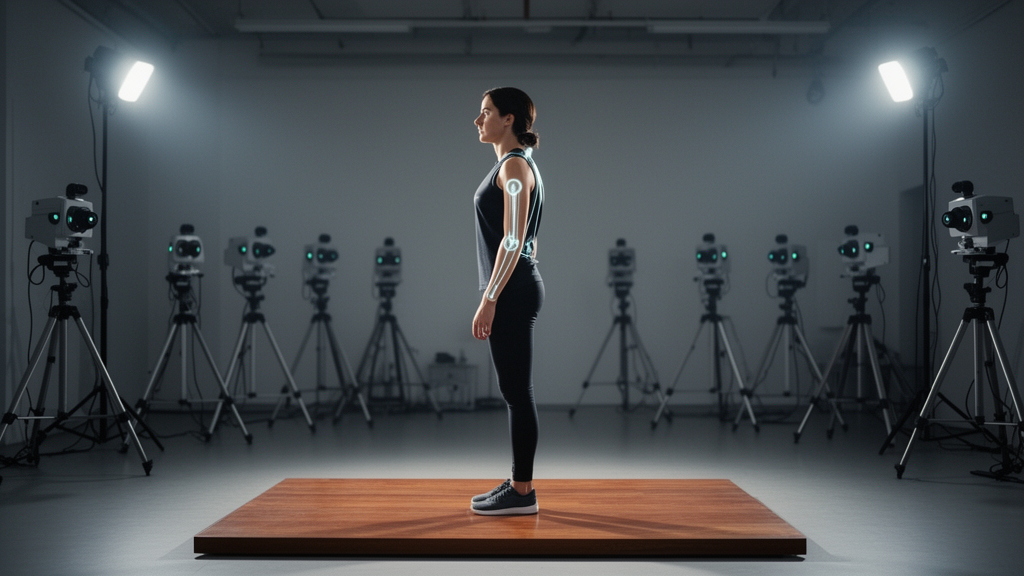
A variable-length upper-body link model can estimate human joint positions during standing movements with significantly higher accuracy than existing models while preserving the simplicity required for practical applications. Developed through an analysis of human standing motion, the formulation addresses long-standing geometric discrepancies in motion capture by allowing the represented upper body to adjust its length as posture changes. According to the research team, incorporating flexibility into the upper-body link substantially reduces position estimation errors across diverse postures without introducing the computational complexity that hinders routine deployment.
Motion analysis and biomechanical state estimation rely heavily on human body modeling across various operational settings. In environments such as workplaces and nursing care facilities, large-scale optical or multi-sensor measurement systems are generally impractical due to spatial constraints, high equipment demands, and operational complexity. Consequently, practitioners and engineers frequently depend on simpler measurement frameworks to track human movement. To achieve this operational simplicity, two-dimensional human-link models evaluated specifically in the sagittal plane have served as a common foundation for estimating movement and posture.
Despite their widespread adoption, conventional two-dimensional models face fundamental mathematical and geometric limitations when tracking complex human transitions. When every link length within a kinematic chain remains strictly fixed, the underlying model routinely fails to compute specific body postures. These failures arise because rigid segments cannot accommodate natural anatomical discrepancies between simplified geometric links and the continuously shifting geometry of the physical human body during motion.
To mitigate these calculation failures, researchers previously introduced models that permit variability in individual segment lengths based on how apparent link dimensions shift with human posture. Prior implementations introduced variable lengths confined strictly to either the thigh or the upper-arm segment, allowing the kinematic representation to absorb positional discrepancies. For instance, the variable-length upper-arm formulation incorporates shoulder degrees of freedom and achieves comparatively small errors overall; however, it continues to exhibit substantial estimation inaccuracies under specific postures.
To overcome these posture-dependent inaccuracies while maintaining computational economy, the investigators proposed a variable-length link model focused on the upper body. Because the human upper body naturally flexes during movement, its apparent link length undergoes considerable variation throughout a motion cycle. By modeling this upper-body link as variable rather than rigid, the system effectively absorbs geometric discrepancies and curbs joint position errors across varying standing configurations without sacrificing structural simplicity.
The validation of the proposed model specifically targeted prospective users of standing support robots, where reliable joint estimation is critical for physical assistance. To evaluate performance against real-world movements, the researchers measured the standing-up trajectories of eight young, healthy participants. The experimental protocol tracked these movements to compare joint position errors generated by the newly proposed variable-length upper-body formulation directly against errors produced by existing comparative models relative to actual observed positions.
Ground-truth movement data for the comparative evaluation were captured using the VisionPose optical measurement system. Statistical analysis conducted via t-tests confirmed that the proposed variable-length upper-body model estimated joint positions with greater overall accuracy than existing human-link models. The findings demonstrate that accommodating upper-body flexion provides a robust mechanism for reducing kinematic errors during standing motion while preserving the essential simplicity needed for assistive and workplace robotics.
Subject of Research: Two-dimensional joint position estimation in human standing motion
Article Title: A Variable-Length Upper-Body Link Model for Improved 2D Joint Position Estimation in Standing Movements
Article References: Takeda, M., Saito, Y., & Sato, K. (2026). A Variable-Length Upper-Body Link Model for Improved 2D Joint Position Estimation in Standing Movements. Journal of Intelligent & Robotic Systems. https://doi.org/10.1007/s10846-026-02460-3
Image Credits: AI Generated
DOI: 10.1007/s10846-026-02460-3
Keywords: joint position estimation, standing motion, variable-length link model, upper-body link model, two-dimensional link models, sagittal plane, standing support robots, human posture analysis, VisionPose, motion analysis, nursing care robotics, workplace ergonomics, apparent link length, shoulder degrees of freedom, t-test analysis, upper-body flexion, error reduction
News Source: Denise Maddox. (November 19, 2026). Variable-Length Upper-Body Model Improves 2D Joint Position Estimation in Standing Motion. Scienmag.